RiskPercept-X: Explainable Transaction-Level Prediction of Investor-Perceived Risk on E-Investment Platforms
RiskPercept-X achieves 89.0% accuracy and 86.8% macro-averaged F1 on risk dimensions on a temporally held-out split.
624 documents
RiskPercept-X achieves 89.0% accuracy and 86.8% macro-averaged F1 on risk dimensions on a temporally held-out split.
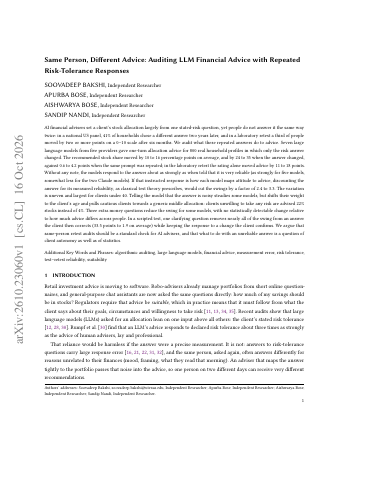
Across 800 real household profiles where only the risk answer changed, seven large language models shifted recommended stock allocations by 10 to 16 percentage points on average.
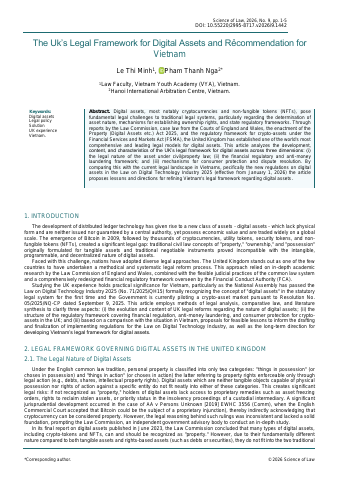
The United Kingdom Parliament passed the Property (Digital Assets etc.) Act 2025, which came into force on December 2, 2025, establishing a legal basis for a third category of personal property.
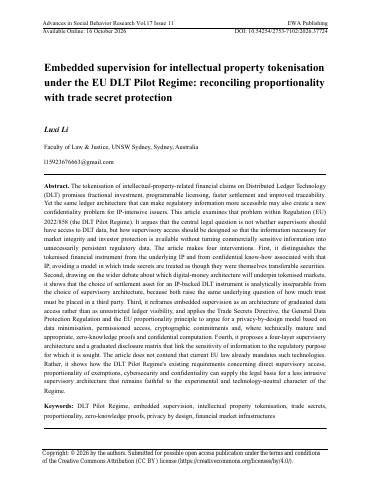
Regulation (EU) 2022/858 establishes a pilot regime allowing financial market infrastructures to test DLT financial instruments subject to regulatory oversight.
The Financial Stability Board (FSB) identified 12 sound practices to help all financial institutions realise the benefits of AI while managing its risks responsibly.
The implementation of regulatory risk-based supervision helped lower Nigeria's banking sector non-performing loans ratio from 34.4% in 2010 to 5.2% in 2023.
The total bank credit portfolio in Uzbekistan expanded from 277.0 to 604.0 trillion UZS between 2020 and 2025, representing a growth of +118.1%.
The We Company withdrew its S-1 registration statement 47 days after public filing, abandoning a US$47 billion private valuation.
Article 42 grants the general meeting authority to give instructions to directors that remain binding unless contrary to applicable legal rules.
Total tokenized assets reached $346.1 billion across 47 asset classes in September 2026, with stablecoins comprising 86% of the total.
The IMR review working group was established in 2024 to evaluate the implementation status of international financial reforms and recommend improvements to monitoring.
Global cross-border payment transactions are projected to expand from over $150 trillion in 2017 to more than $250 trillion by 2027.
A stocktake conducted by the FSB gathered 126 modernisation efforts from 24 jurisdictions and 3 SSBs across various financial sectors and entity types.
Total costs for stablecoin cross-border remittances range between 0.5% and 3.0%, compared to 9.50% for traditional banking channels.
Researchers drew a stratified random sample of 400 SEC-registered investment advisers from a population frame of 16,223 active firms.
Total stablecoin market capitalization surpassed $300 billion in 2025.
By the end of 2025, TBC Uzbekistan's ecosystem reached 23 million registered users, while Uzum services exceeded 20 million monthly users.
In Indonesia, Islamic Equity Crowdfunding (IEC) is governed by POJK No. 17 of 2025 and DSN-MUI Fatwa No. 140/DSN-MUI/VIII/2021.
At year-end 2024, outstanding participatory financing in Morocco reached MAD 33.8 billion, representing a 19.9% increase year on year.
Digital payment adoption reduces transaction costs and administrative duties, but introduces risks of resource centralization without institutional checks [p.1].
Saudi Arabia's gross written premiums expanded from SAR 42.03 billion in 2021 to SAR 53.36 billion in 2022, SAR 65.46 billion in 2023, and SAR 76.14 billion in 2024.
Satgas PASTI stopped 242 illegal investment entity offers between January and August 2026.
The Federal Reserve Board provided a periodic report update on the Paycheck Protection Program Liquidity Facility on October 13, 2026.
FinTech penetration in Uzbekistan reached Level 3 (developed), whereas RegTech and SupTech remain at Level 2 (emerging).
Global financial wealth is projected to grow by 10.7% in 2025 to reach US$333 trillion according to BCG's report.
The study examines how algorithmic intelligence and decision architecture shape strategic and behavioral decision outcomes based on data from 176 banking decision-makers in the Philippines.
The number of bank cards in Uzbekistan reached 68 mln units in 2025.
Fintech activity in Indonesia is highly geographically skewed, with approximately 89% concentrated in the Java–Bali region and only 11% distributed across other regions.
As of mid-2026, the total market value for stablecoins stands at around $300 billion.
A bibliometric and integrative review analyzed 256 documents indexed in Scopus and Web of Science published up to July 2024.