Digital Evolution in Indian Banking: Unveiling the Opportunities and Challenges of Payments Banks
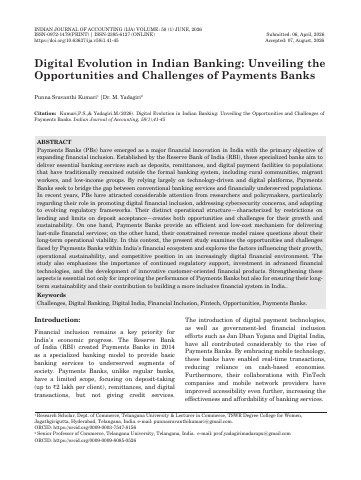
The Reserve Bank of India created Payments Banks in 2014 as a specialized banking model to deliver basic financial services to underserved populations.
624 documents
The Reserve Bank of India created Payments Banks in 2014 as a specialized banking model to deliver basic financial services to underserved populations.
The research framework was conducted in 4 analytical stages.
According to KPMG, 71% of surveyed financial firms have deployed AI tools, with global banking sector AI spending estimated at USD 31.3 billion in 2024.
The study collects an initial sample of 1,244 IPO firms listed on China's registration-based boards from 2019 to 2025, yielding a final sample of 689 valid observations after screening.
The empirical study examines the impact of FinTech adoption on financial inclusion using an unbalanced panel dataset of 12 developing countries across the 2014, 2017, 2021, and 2024 Global Findex survey waves.
The study conducts an empirical investigation covering 74 countries over the 2002 – 2022 period to evaluate how digital financial innovations impact systemic financial stability.
The systematic literature review synthesized 25 peer-reviewed research works published between 2015 and 2026 to evaluate RWA tokenization.
Only 4 (21%) of reviewed jurisdictions are fully compliant with KA 6, while 8 (42%) are materially non-compliant.
The ITI modeling framework established average baseline indices of 0.81 for behavioural transformation and 0.77 for responsibility institutionalization across platforms.
ESG mutual fund investments grew by 67.3% from $5.2B pre-adoption to $8.7B post-Fintech adoption.
The systematic review protocol based on Google Scholar searches spanning 2004 to 2025 screened 98 unique references and retained 74 publications.
The Insurance Authority launched the TAMEEN digital portal in February 2025 with 36 licensing, approval, supervisory and regulatory services.
The research analyzes digital green bonds and ESG-linked platforms through 3 theoretical lenses: financial inclusion theory, institutional innovation theory, and sustainability transition framework.
Primary data were collected from 264 valid respondents using convenience sampling to analyze mutual fund investment decisions in Nepal.
Across 96,600 prompts to Llama-3.1-8B-Instruct, the average identity swing in recommended equity allocation rises from 4.78 percentage points at full disclosure to 10.34 percentage points when no financial facts are supplied.
In the EU, 26 PE-related insurance undertakings managed a total of 260 billion euros in assets across 14 Member States at year-end 2023.
A structured questionnaire survey was conducted with 309 individual investors in Vietnam who have experience using AI for financial analysis and investment decision-making.
The global insurtech market was valued at $30.27 billion in 2025 and is projected to reach $254.64 billion by 2030, representing a 53.1% compound annual growth rate.
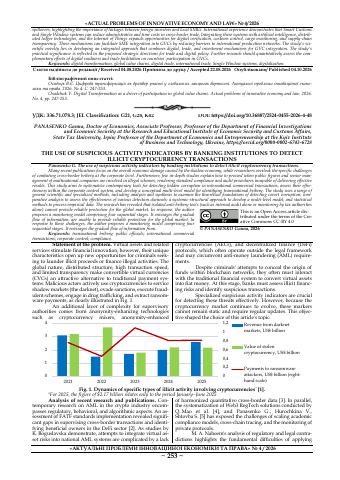
The author proposes a monitoring model comprising 4 sequential stages to enable the gradual flow of information in detecting money laundering [p.1].
From 364 documents retrieved from Scopus, the PRISMA 2020 protocol led to selecting 42 articles for bibliometric and thematic analysis.
The study analyzed in-depth interviews with 18 retail investors who use AI tools for making investment decisions.
AI governance integrates explainability, model risk management, lifecycle governance, and internal controls to satisfy regulatory expectations in banking.
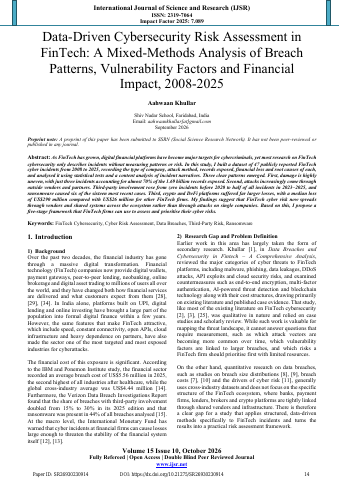
The study analyzes a dataset of 47 publicly reported FinTech cyber incidents occurring between 2008 and 2025.
The long-run FMOLS and DOLS models accounted for 79.6% of the variation in commercial banks' Return on Assets.
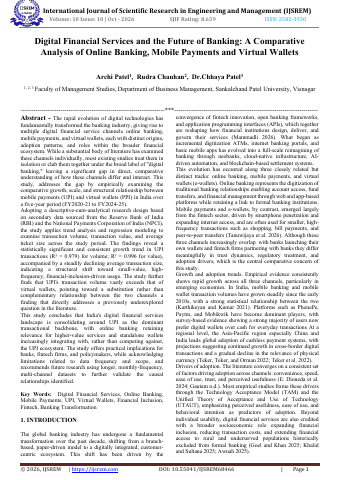
UPI transaction volume grew continuously over five years from 2,233 crore transactions in FY2020-21 to 18,585 crore transactions in FY2024-25.
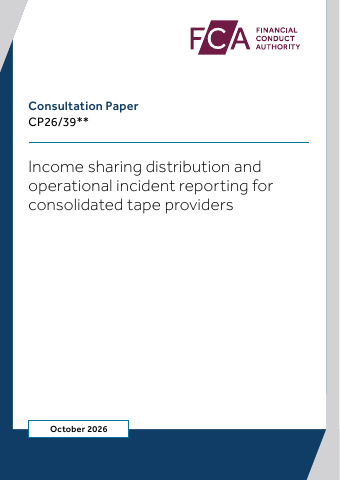
The FCA proposes splitting the equity consolidated tape income pool 50/50, reserving 50% for all eligible trading venues and APAs and 50% exclusively for CLOB and periodic auction trading systems.
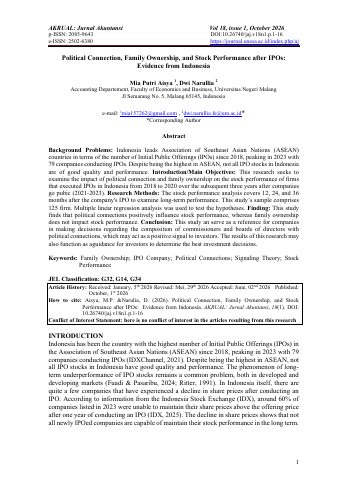
Indonesia led ASEAN countries in IPO volume since 2018, peaking in 2023 with 79 companies conducting IPOs.
Corporate stablecoin adoption live in production doubled from 9% in 2025 to 18% in 2026.
Financial Services Authority data records over 300 companies completing an IPO in Indonesia throughout 2015–2024.
Total fees and commissions income in the analyzed EU banking sector sample reaches approximately EUR 157 billion, representing 37% of net operating income.