Management Practices of Regulatory Agencies in Advancing Economic Credit Transactions: Comparative Dimensions (International Journal of Labour and Gender Rights Law)
Summary
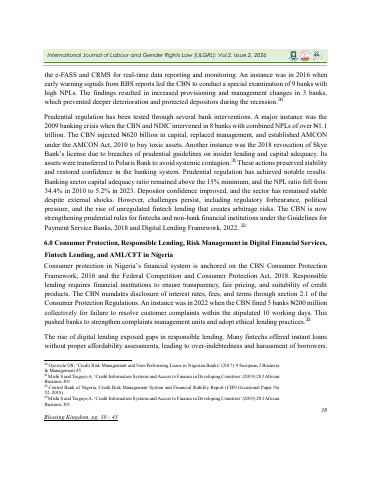
- The implementation of regulatory risk-based supervision helped lower Nigeria's banking sector non-performing loans ratio from 34.4% in 2010 to 5.2% in 2023.p.6
- The Asset Management Corporation of Nigeria purchased over ₦4.1 trillion in non-performing loans between 2010 and 2013 to clean commercial bank balance sheets.p.5
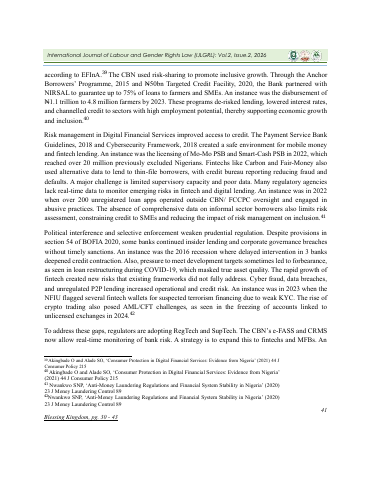
- Under the Anchor Borrowers' Programme, the Central Bank of Nigeria disbursed over ₦1.1 trillion to 4.8 million farmers by 2023 with 75% credit risk guarantees.p.6
- Credit reporting reforms expanded the number of individuals with credit files in Nigeria from 24 million in 2017 to over 60 million in 2023.p.8
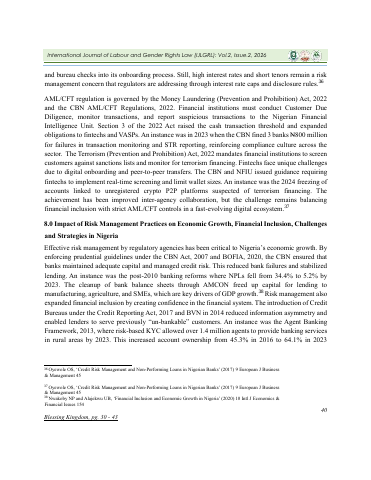
- Financial inclusion initiatives and agent banking frameworks expanded adult account ownership in Nigeria from 45.3% in 2016 to 64.1% in 2023.p.11
- The Nigeria Deposit Insurance Corporation disbursed over ₦12.3 billion to depositors of closed financial institutions between 2016 and 2022.p.5
Key insights
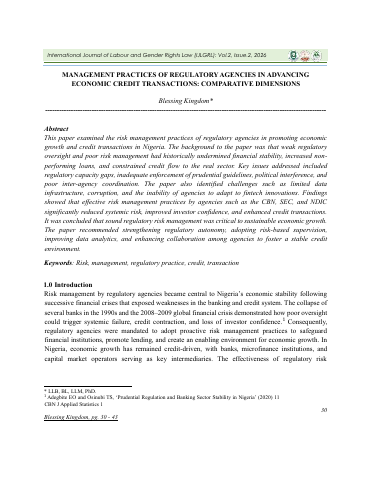
- Proactive risk management by financial regulators significantly reduces systemic risk and reinforces investor confidence in economic credit transactions.p.1
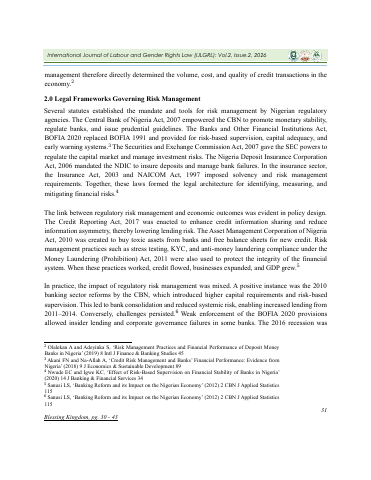
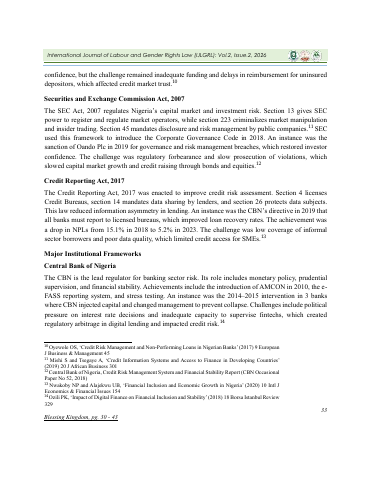
- Enactment of the Credit Reporting Act in 2017 lowered lending risks by establishing mandatory data sharing across credit bureaus.p.4
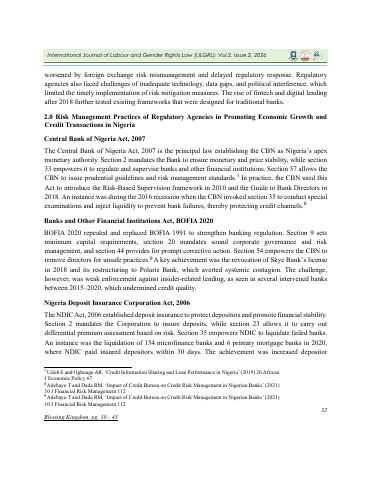
- Adoption of Risk-Based Supervision in 2010 forced Nigerian banks to strengthen loan appraisal mechanisms and restrict exposure to high-risk sectors.p.6
- Increasing the regulatory Loan-to-Deposit Ratio requirement to 65% in 2019 forced commercial banks to increase credit allocation to the real sector.p.7
- Mandatory integration with credit bureau databases reduced small business loan processing times from 2 weeks to 48 hours at major deposit money banks.p.8
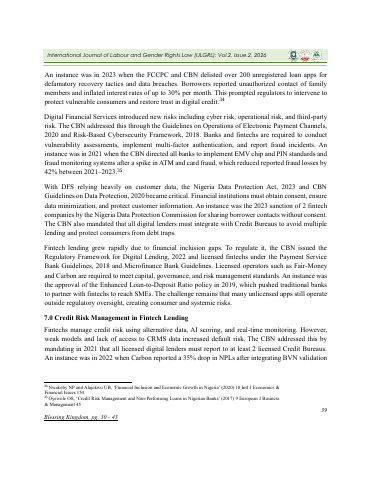
- Deployment of multi-factor authentication and EMV chip standards reduced reported card and ATM fraud losses by 42% between 2021 and 2023.p.10
- Joint enforcement action by financial and competition regulators resulted in the delisting of over 200 illegal digital lending apps in 2023.p.10
Pages
 p.1
 p.2
 p.3
 p.4
 p.5
 p.6
 p.7
 p.8
 p.9
 p.10
 p.11
 p.12
 p.13
 p.14
Topics and entities
Summary and figures generated from the document and checked automatically: every number shown appears on the cited page. Publishers can request removal.