Algorithmic & Architectural Intelligence in Banking: A Theory-Driven Framework and Empirical Evidence from Banking Decision-Makers (American Journal of Business and Management Innovation)
Summary
- The study examines how algorithmic intelligence and decision architecture shape strategic and behavioral decision outcomes based on data from 176 banking decision-makers in the Philippines.p.8
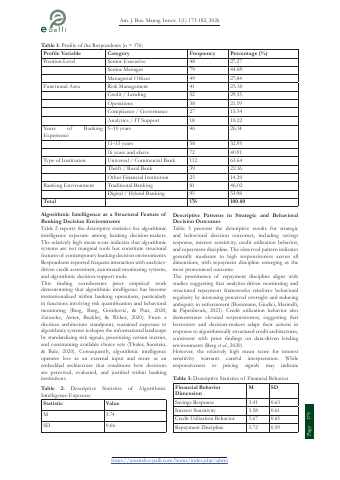
- Banking decision-makers reported high exposure to algorithmic intelligence tools, with an overall mean score of 3.74.p.8
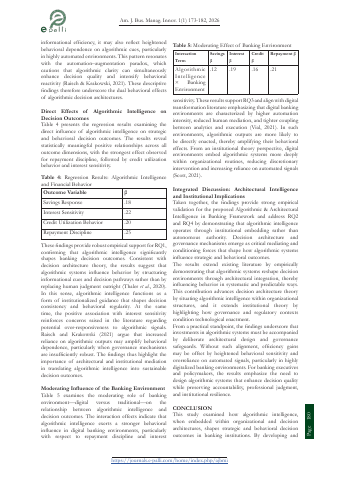
- Direct regression results indicate that algorithmic intelligence has the strongest positive impact on repayment discipline with a beta of .25, followed by interest sensitivity at .22.p.9
Key insights
- Algorithmic intelligence directly influences decision outcomes, exhibiting the strongest statistical effect on repayment discipline at β = .25.p.9
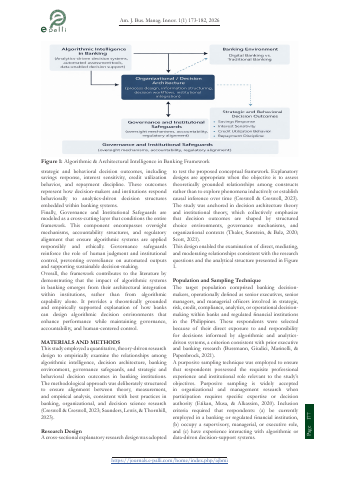
- Decision architecture serves as an essential mediating capability that conditions how automated insights are translated into institutional choice pathways.p.5
- The influence of algorithmic intelligence is significantly moderated by the banking environment, showing heightened interaction effects in digital and hybrid settings.p.9
- Savings response demonstrates a positive direct relationship with algorithmic intelligence exposure, showing a beta of .18.p.9
- Governance mechanisms and institutional safeguards act as a cross-cutting operational layer to mitigate overreliance on automated systems and preserve human oversight.p.6
Pages
 p.1
 p.2
 p.3
 p.4
 p.5
 p.6
 p.7
 p.8
 p.9
 p.10
 p.11
Topics and entities
Summary and figures generated from the document and checked automatically: every number shown appears on the cited page. Publishers can request removal.