Governing AI and Blockchain in Finance: A Layered Trust Framework (Academic research)
Summary
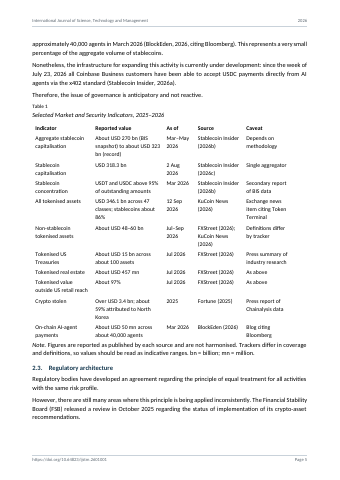
- Total tokenized assets reached $346.1 billion across 47 asset classes in September 2026, with stablecoins comprising 86% of the total.p.4
- Tokenized United States Treasury products accounted for approximately $15 billion distributed across about 100 assets in July 2026.p.4
- More than $3.4 billion was stolen through crypto cyberattacks in 2025, with about 59% attributed to North Korea.p.4
- On-chain AI-agent payments accounted for approximately $50 million across roughly 40,000 agents in March 2026.p.5
Key insights
- Trust in converged AI and blockchain financial systems is generated across multiple layers of assurance rather than through any single technology.p.1
- Data governance and algorithmic accountability currently represent the weakest areas within the financial technology governance architecture.p.1
- Stablecoin provision exhibits extreme market concentration, with USDT and USDC accounting for above 95% of total outstanding amounts.p.4
- Tokenization has functioned primarily as an institutional collateral and cash-management tool rather than a mechanism for retail investment.p.4
- Crypto security losses are highly concentrated, with two-thirds of stolen value in 2025 resulting from just three major attacks.p.4
- Decentralized ledgers shift the locus of trust from central institutional entities to protocol code, parameters, and governing parties.p.4
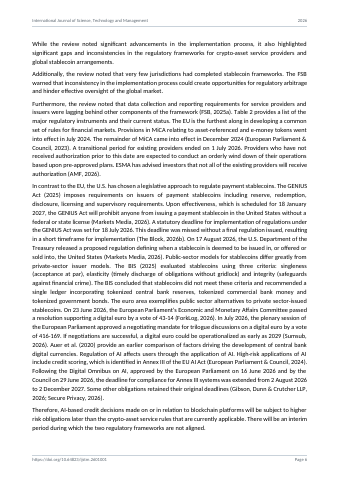
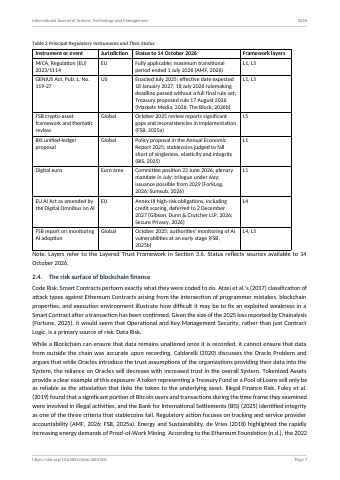
- International implementation of crypto-asset regulatory standards remains inconsistent, creating vulnerabilities for regulatory arbitrage.p.6
Pages
 p.1
 p.2
 p.3
 p.4
 p.5
 p.6
 p.7
 p.8
 p.9
 p.10
 p.11
 p.12
 p.13
 p.14
 p.15
Topics and entities
Summary and figures generated from the document and checked automatically: every number shown appears on the cited page. Publishers can request removal.