Reconceptualizing Investor Protection in Islamic Equity Crowdfunding: A Maqāṣid al-Sharīʿah-Based Framework for Digital Financial Governance (Al-Manahij Jurnal Kajian Hukum Islam)
Summary
- In Indonesia, Islamic Equity Crowdfunding (IEC) is governed by POJK No. 17 of 2025 and DSN-MUI Fatwa No. 140/DSN-MUI/VIII/2021.p.1
- Digital platform intermediaries introduce structural governance challenges, including persistent information asymmetry and constrained post-investment oversight.p.1
- Field research indicates investors experience difficulties independently verifying financial projections, issuer business performance, and continuing Sharia compliance.p.6
- Regulatory authorities note that supervising initial fundraising compliance is simpler than monitoring post-disbursement issuer performance and disclosure.p.7
- Initial Sharia screening sets entry compliance, but ongoing Sharia verification requires continuous monitoring resources and information access throughout the investment cycle.p.12
- Emerging digital hazards such as cybersecurity breaches, data privacy failures, and platform operational errors expand investor vulnerability beyond conventional financial disclosure.p.14
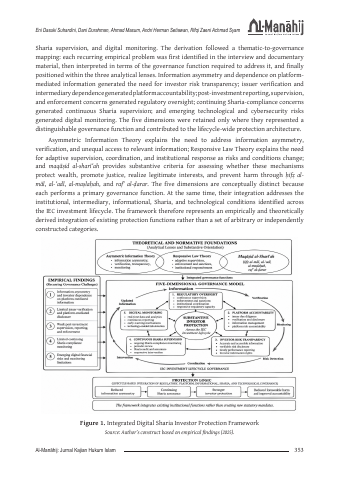
- The study develops an Integrated Digital Sharia Investor Protection Framework covering 5 interconnected protection dimensions.p.17
Key insights
- Formal regulatory and Sharia compliance at fundraising does not automatically ensure substantive protection throughout the post-investment lifecycle.p.1
- Retail investors rely heavily on platform-mediated disclosure due to limited resources for conducting independent due diligence.p.6
- Information asymmetry persists after capital disbursement, increasing investor exposure to adverse selection and moral hazard.p.7
- Indonesia's dual regulatory system combines state oversight under OJK with Sharia governance under DSN-MUI.p.8
- Ex ante Sharia screening evaluates initial eligibility but cannot guarantee that issuer operational practices remain compliant over time.p.12
- Platform governance must address cybersecurity, data protection, and digital system reliability alongside financial risks.p.14
- Combining Responsive Law Theory with maqāṣid al-sharīʿah provides an institutional and ethical framework for adaptive digital financial governance.p.15
- Effective investor protection requires integrating regulatory oversight, platform accountability, risk transparency, continuous Sharia supervision, and digital monitoring.p.17
Pages
 p.1
 p.2
 p.3
 p.4
 p.5
 p.6
 p.7
 p.8
 p.9
 p.10
 p.11
 p.12
 p.13
 p.14
 p.15
 p.16
 p.17
 p.18
 p.19
 p.20
 p.21
 p.22
 p.23
 p.24
 p.25
 p.26
Topics and entities
Summary and figures generated from the document and checked automatically: every number shown appears on the cited page. Publishers can request removal.