The Use of Suspicious Activity Indicators by Banking Institutions to Detect Illicit Cryptocurrency Transactions (Actual problems of innovative economy and law)
Summary
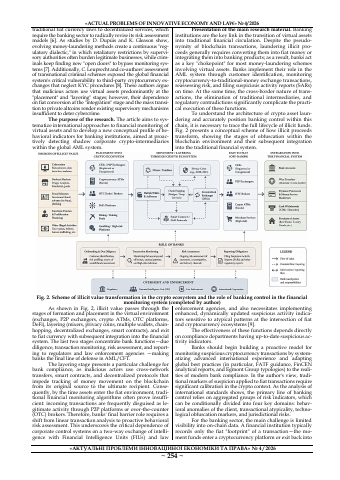
- The author proposes a monitoring model comprising 4 sequential stages to enable the gradual flow of information in detecting money laundering [p.1].p.1
- The document was published in issue № 4/ 2026 across pages 247-253 [p.1].p.1
- Prior research cited includes findings from CEUR Workshop Proceedings Vol. 4225, P. 25–39 [p.4].p.4
- The analysis references the 14th public edition of the Basel AML Index 2025 [p.4].p.4
- The advisory FIN-2019-A003 issued in 2019 by FinCEN is highlighted regarding convertible virtual currencies [p.4].p.4
Key insights
- Banking institutions act as the critical chokepoint in the AML system when virtual assets exit into traditional fiat money or banking products [p.2].p.2
- Retaliatory restrictions by supervisory authorities often burden legitimate businesses while malicious actors continuously find new ways to bypass monitoring [p.2].p.3
- Standard compliance and audit procedures fail when senior management or public figures are involved in illicit transnational schemes [p.1].p.1
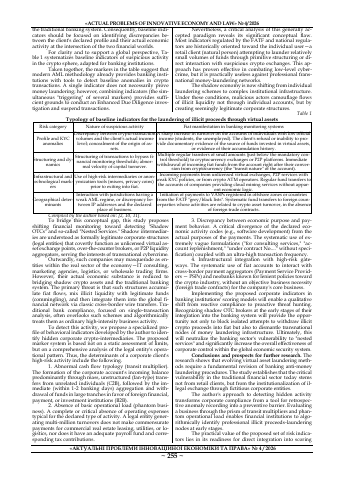
- Traditional AML indicators focused on individual retail clients are largely ineffective against professional transnational money-laundering networks [p.3].p.3
- Malicious actors camouflage illicit liquidity flows by establishing legitimate corporate structures rather than relying on individual user accounts [p.3].p.3
Pages
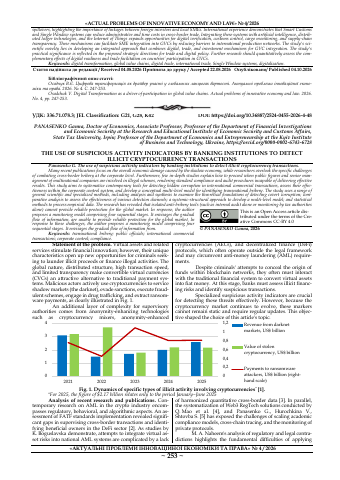 p.1
 p.2
 p.3
 p.4
Topics and entities
Summary and figures generated from the document and checked automatically: every number shown appears on the cited page. Publishers can request removal.