Hybrid Finance as an Alternative Funding Strategy in Corporate Action in the Indonesian Capital Market (JAMBURA Jurnal Ilmiah Manajemen dan Bisnis)
Summary
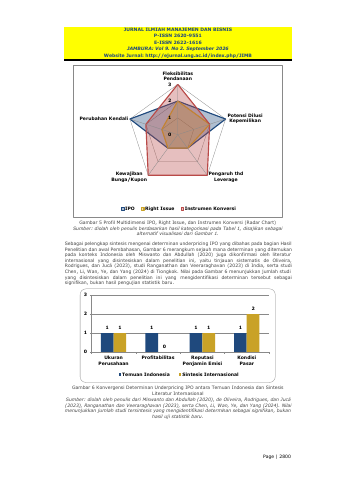
- Financial Services Authority data records over 300 companies completing an IPO in Indonesia throughout 2015–2024.p.2
- Over 200 companies conducted a Rights Issue on the Indonesia Stock Exchange between 2015–2024, whereas around 50 companies issued convertible instruments.p.2
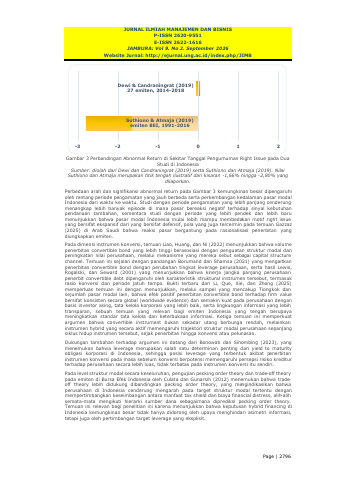
- A study of 27 Indonesian issuers between 2014–2018 showed no statistically significant abnormal returns around rights issue announcement dates.p.8
- International evidence from 65 issuers on the Saudi Stock Exchange during 2013–2023 demonstrated negative price reactions to rights issues.p.8
Key insights
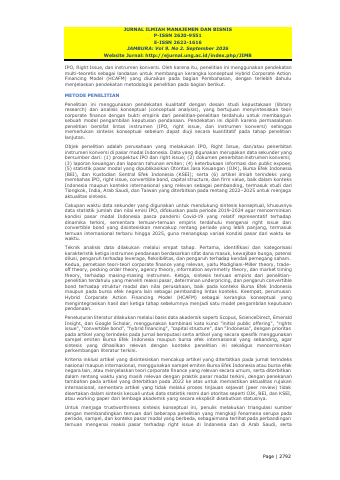
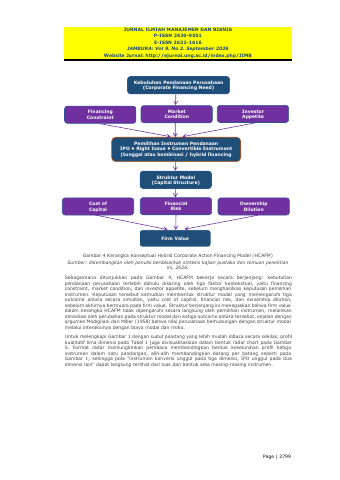
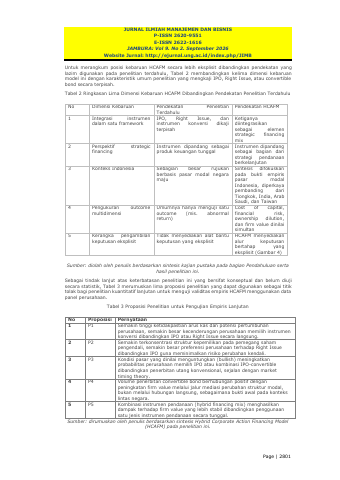
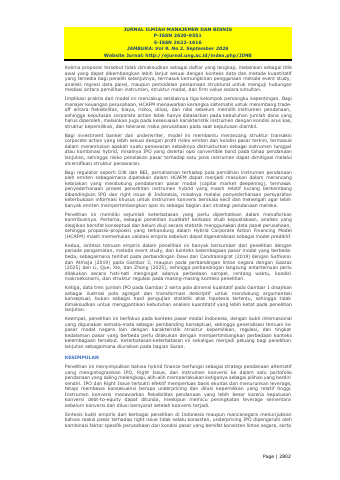
- The study proposes the Hybrid Corporate Action Financing Model (HCAFM) to synthesize corporate funding needs, market conditions, and investor appetite into a structured selection framework.p.1
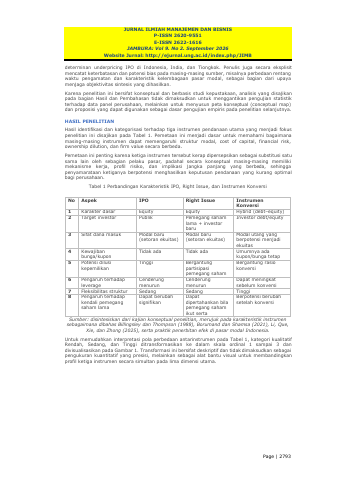
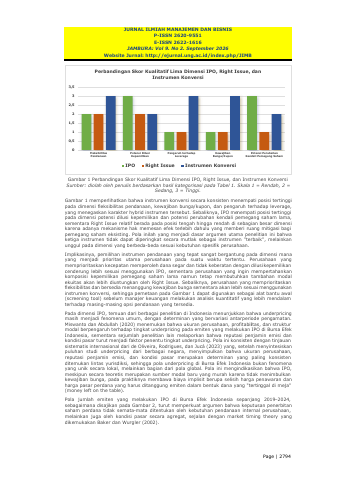
- Convertible instruments provide substantial structural flexibility, yet remain significantly underutilized in Indonesia compared to pure equity mechanisms like IPOs and rights issues.p.2
- Trade-off theory finds stronger empirical validation than pecking order theory among Indonesian listed companies, indicating explicit targeting of leverage ratios.p.4
- Convertible debt helps mitigate agency conflicts between management, equity holders, and creditors by lowering coupon obligations and aligning interests through conversion options.p.4
- Cross-country empirical syntheses show that firm size, underwriter reputation, and broader market conditions represent the most robust determinants of IPO underpricing.p.7
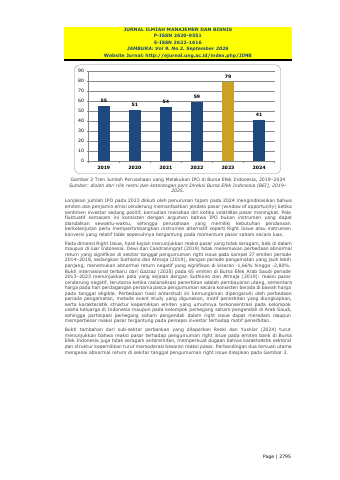
- Market timing creates distinct financing windows, as reflected in the sharp decline from 79 IPOs in 2023 to 41 in 2024 following heightened market volatility.p.8
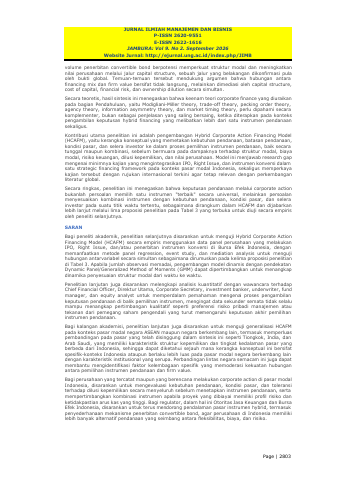
- Higher convertible bond issuance volume can enhance firm value through a capital-structure transmission channel that operates effectively across multiple international capital markets.p.9
- Pure equity offerings trigger immediate ownership dilution, while convertible instruments introduce contingent dilution deferred until conversion conditions are met.p.11
Pages
 p.1
 p.2
 p.3
 p.4
 p.5
 p.6
 p.7
 p.8
 p.9
 p.10
 p.11
 p.12
 p.13
 p.14
 p.15
 p.16
 p.17
 p.18
Topics and entities
Summary and figures generated from the document and checked automatically: every number shown appears on the cited page. Publishers can request removal.