Fintech Enabled ESG Investing for Sustainable Finance and Responsible Capital Allocation
ESG mutual fund investments grew by 67.3% from $5.2B pre-adoption to $8.7B post-Fintech adoption.
133 documents
ESG mutual fund investments grew by 67.3% from $5.2B pre-adoption to $8.7B post-Fintech adoption.
The Insurance Authority launched the TAMEEN digital portal in February 2025 with 36 licensing, approval, supervisory and regulatory services.
The author proposes a monitoring model comprising 4 sequential stages to enable the gradual flow of information in detecting money laundering [p.1].
The long-run FMOLS and DOLS models accounted for 79.6% of the variation in commercial banks' Return on Assets.
AI governance integrates explainability, model risk management, lifecycle governance, and internal controls to satisfy regulatory expectations in banking.
From 364 documents retrieved from Scopus, the PRISMA 2020 protocol led to selecting 42 articles for bibliometric and thematic analysis.
The document dataset involved 177 authors with an average citation rate of 18.79 per document and an average age of 3.56 years.
India records over 40 billion UPI transactions annually, positioning it as a leader in fintech adoption.
M&A deal volumes in fraud and digital identity grew at ~18% CAGR between 2015–25, with 2025 marked as the most active year on record.
The research conducted a systematic review following the PRISMA framework starting with an initial pool of 322 articles on blockchain and AI convergence.
Financial institutions implement Robotic Process Automation (RPA) to automate manual tasks like data entry and loan processing, freeing staff for strategic tasks.
A technological forecasting sample of 41 patent documents related to smart contracts, blockchain, and contractual automation was retrieved and analyzed.
Poland's fintech ecosystem includes over 400 active companies employing over 22,000 people.
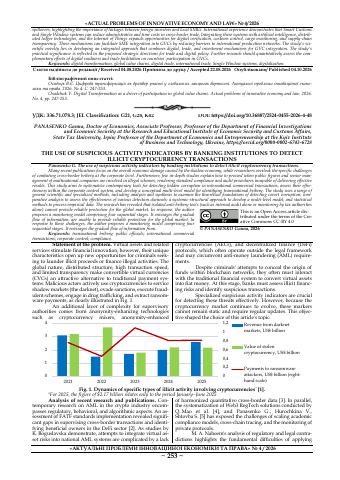
The automated processing level of regulatory reporting (SupTech) in Ukraine is projected to reach 72.8% in 2025, up from 31.0% in 2023.
The paper presents a structural-functional model featuring 3 levels of information and communication support for corporate governance in banks.
The study analyzes Shariah governance challenges facing non-bank Islamic financial technology platforms operating outside standard banking regulatory oversight.
In 2024, China recorded a record $168 billion outflow of foreign direct investment amid tightening currency movement restrictions.
The research paper was submitted on 27 April 2026 and accepted on 09 June 2026 for publication in volume 53 issue 3.
The research methodology incorporated primary data collection through a structured questionnaire administered to a sample size of 100 respondents in India.
Global asset management is projected to reach $200 trillion by 2030 as private market investments and tokenized products increase instrument-level risks.
The meta-bibliometric synthesis consolidates findings from 8 peer-reviewed bibliometric studies of AI in finance published between 2021 and 2026.
The global FinTech market is projected to reach 938–1250 млрд дол. США in the 2026–2035 period.
The study analyzes Market Sophistication indicators based on data from the Global Innovation Index 2025 across CEE economies.
An analysis of 150,165 equity and bond issuances across 65 countries between 1990 and 2016 demonstrates that firm growth is supported by accessing capital markets.
The article compares Puerto Rico's Office of the Commissioner of Financial Institutions regulatory framework with U.S. federal supervisory models of the OCC and FDIC.
Financial exclusion affects over 22 million unbanked and 47 million underbanked adults in underserved communities in the United States.
The study evaluates the dynamics of remote banking service users and digital transaction volume in Uzbekistan across the 2021–2025 period.
The systematic literature review synthesized 15 empirical studies drawn primarily from Indonesia and Malaysia published between 2016 and 2024.
Indigenous technology and services sector exports grew by 7%, reaching €9.05 billion in 2024.
72% of respondents are optimistic about the Australian economy over the next 12 months, up from 67% in the previous survey.