Technological Forecasting of Smart Contracts Applied to Governance and Compliance: Patent Landscape and Opportunities for Social Technologies and Vertical Mobility (Revista Tópicos.)
Summary
- A technological forecasting sample of 41 patent documents related to smart contracts, blockchain, and contractual automation was retrieved and analyzed.p.17
- Comparative legal analysis shows that 73% of analyzed jurisdictions recognize smart contracts as legally binding agreements.p.12
- Specific legislation governing the legal validity of smart contracts is present in 58% of surveyed jurisdictions.p.12
- Technology-neutral regulatory approaches based on existing contract laws are adopted in 45% of jurisdictions.p.12
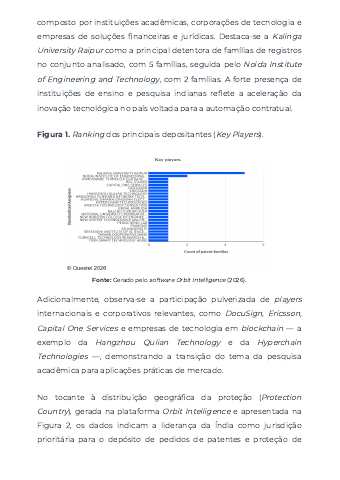
- Kalinga University Raipur leads the key assignees with 5 patent families, followed by Noida Institute of Engineering and Technology with 2 families.p.22
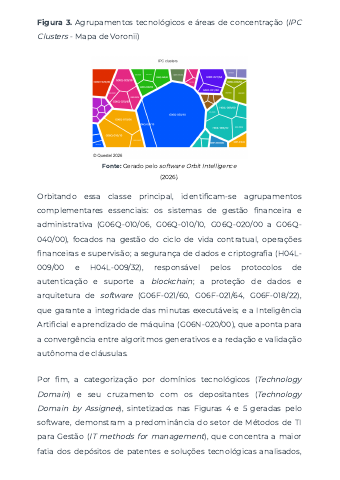
- Only 1 patent filing under class B60R 25/00 specifically targets vehicle access control and data management for vertical mobility.p.18
Key insights
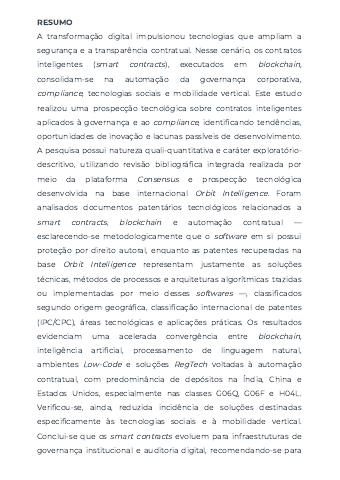
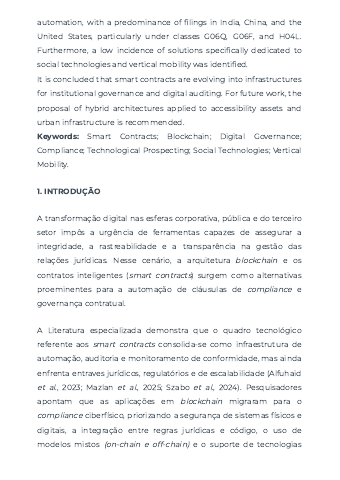
- Smart contracts are evolving into infrastructures for institutional governance and digital auditing across public and private sectors.p.3
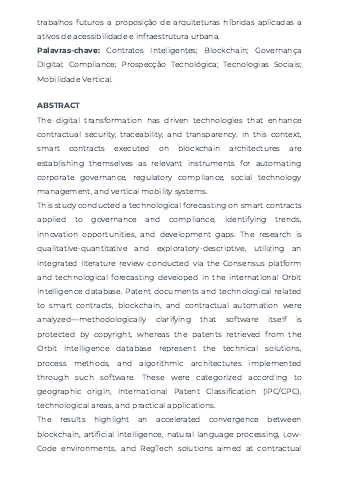
- Patent landscape results indicate an accelerated convergence between blockchain, artificial intelligence, natural language processing, Low-Code environments, and RegTech solutions.p.4
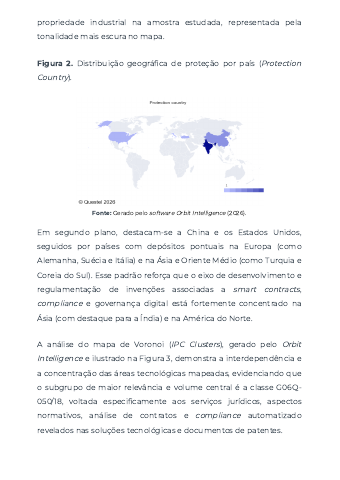
- Global patent filing activity for smart contract governance and compliance is concentrated heavily in India, China, and the United States.p.5
- A significant technological gap exists in vertical mobility and social technologies, with minimal patent filings dedicated to urban infrastructure assets or social inclusion.p.5
- Multi-signature protocols and hybrid models combining on-chain and off-chain features are used to align automated execution with traditional legal frameworks.p.7
- International practical applications of smart contracts are heavily centered on cross-border payments, public procurement, regulatory supervision, and environmental compliance.p.12
- Technological growth shifted significantly starting in 2016 from strictly financial cryptocurrency uses toward broader computational and governance applications.p.15
Pages
 p.1
 p.2
 p.3
 p.4
 p.5
 p.6
 p.7
 p.8
 p.9
 p.10
 p.11
 p.12
 p.13
 p.14
 p.15
 p.16
 p.17
 p.18
 p.19
 p.20
 p.21
 p.22
 p.23
 p.24
 p.25
 p.26
 p.27
 p.28
 p.29
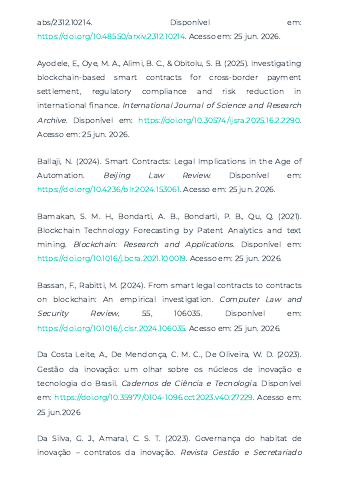 p.30
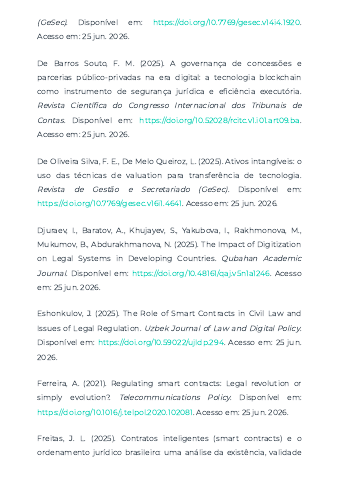 p.31
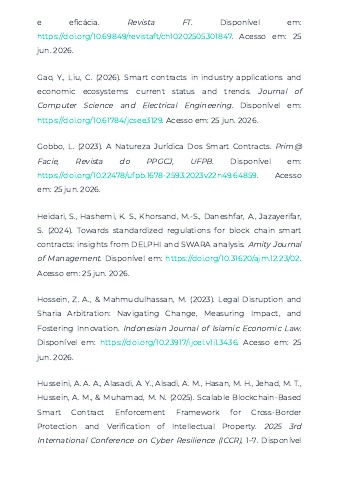 p.32
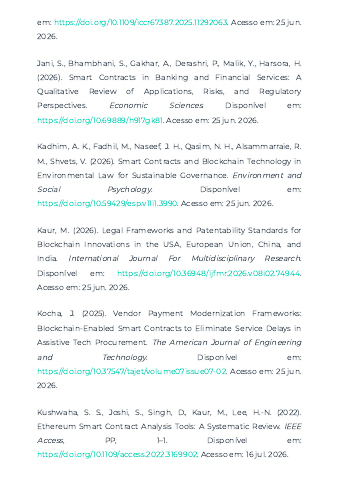 p.33
 p.34
 p.35
 p.36
 p.37
 p.38
 p.39
 p.40
Topics and entities
Summary and figures generated from the document and checked automatically: every number shown appears on the cited page. Publishers can request removal.