Impact of Digital Transformation and Fintech Technologies on the Efficiency of Commercial Banks in Uzbekistan (Zenodo (CERN European Organization for Nuclear Research))
Summary
- The study evaluates the dynamics of remote banking service users and digital transaction volume in Uzbekistan across the 2021–2025 period.p.2
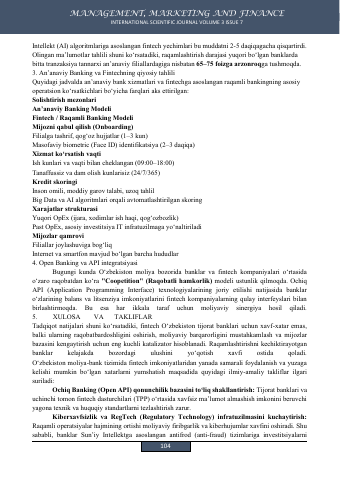
- Implementation of AI algorithms and scoring technologies reduces customer onboarding, KYC checks, and loan processing times down to 2-5 minutes.p.3
- Commercial banks with higher digitalization levels achieve transaction cost reductions of 65–75 percent compared to traditional branch operations.p.3
- Remote biometric Face ID identification enables customer onboarding in 2–3 minutes, compared to 1–3 days required for physical branch visits.p.3
- Digital banking operates on a 24/7/365 continuous schedule, contrasting with traditional branch working hours of 09:00–18:00.p.3
Key insights
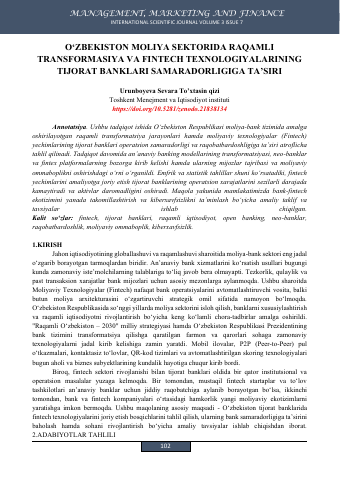
- Digital transformation in Uzbekistan's banking sector is anchored by national policy initiatives including the Raqamli O‘zbekiston – 2030 strategy.p.1
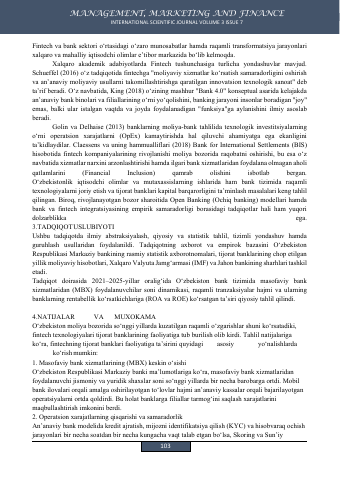
- Academic literature highlights that technological investments in banking primarily serve to optimize operational expenditure (OpEx).p.2
- Automated scoring based on Big Data and AI replaces human analysis and collateral requirements in traditional credit scoring models.p.3
- Highly digitalized banking channels lower single transaction prime costs by 65–75 percent relative to conventional bank branches.p.3
- Market dynamics in Uzbekistan are shifting toward coopetition, where banks pair licenses and balance sheets with open API fintech interfaces.p.3
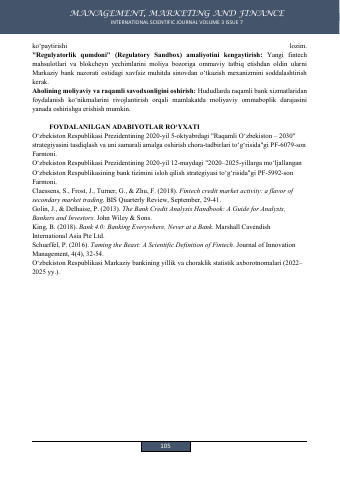
- Key policy recommendations include completing the legal framework for Open API and expanding the Regulatory Sandbox supervised by the Central Bank.p.4
Pages
 p.1
 p.2
 p.3
 p.4
Topics and entities
Summary and figures generated from the document and checked automatically: every number shown appears on the cited page. Publishers can request removal.