Emerging Risks, Fintech and Financial Sector Regulation: Performance Analysis, Science Mapping and Future Directions (International Journal of Applied Research in Business and Management)
Summary
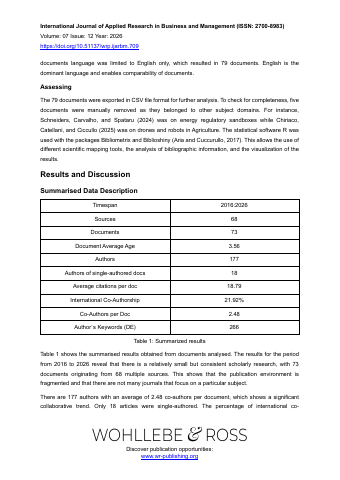
- The document dataset involved 177 authors with an average citation rate of 18.79 per document and an average age of 3.56 years.p.5
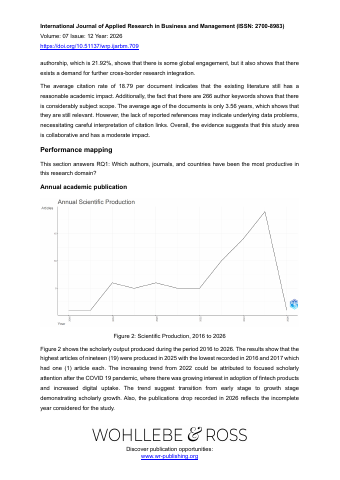
- Annual scholarly publication reached its peak in 2025 with 19 articles, up from 1 article each in 2016 and 2017.p.6
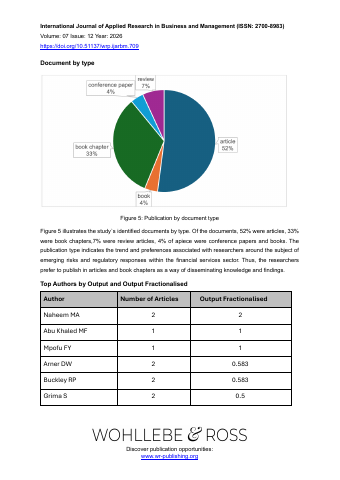
- Articles represent 52% of document output, followed by book chapters at 33%, review articles at 7%, and conference papers and books at 4% each.p.9
Key insights
- Research interest in regulatory responses to emerging risks in fintech grew noticeably starting in 2022 following post-COVID-19 digital adoption.p.6
- Central banks in the Bahamas, China, and Uruguay are testing digital currency adoption through pilot projects.p.2
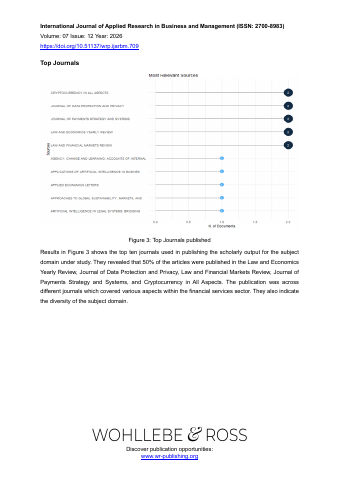
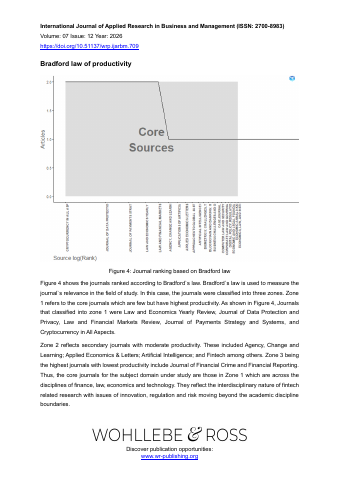
- Applying Bradford's law identified core journals across law, economics, and technology, including Law and Economics Yearly Review and Journal of Data Protection and Privacy.p.8
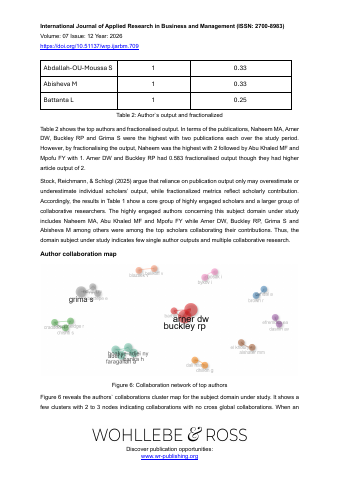
- When fractionalizing research output, Naheem MA recorded the highest score of 2, followed by Abu Khaled MF and Mpofu FY at 1.p.10
- International co-authorship stands at 21.92%, indicating that institutional collaboration in this domain remains predominantly concentrated locally.p.5
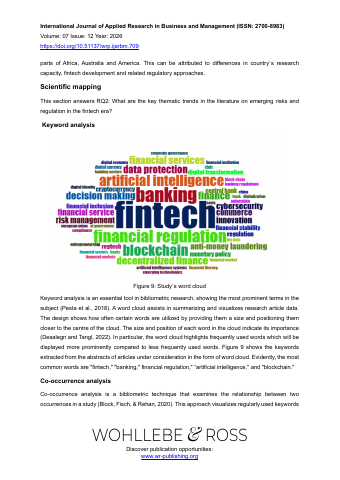
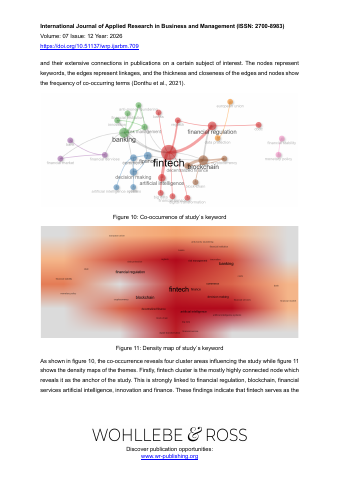
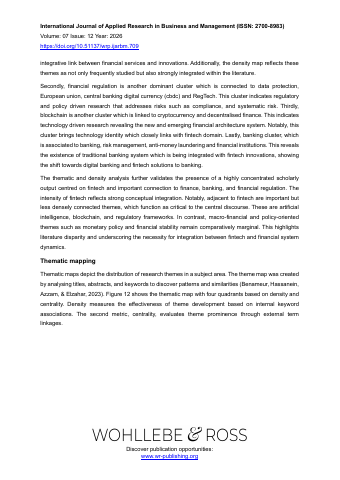
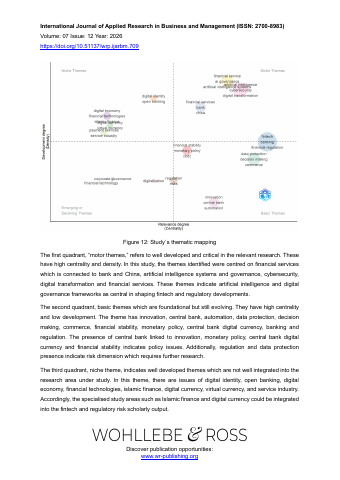
- Thematic mapping revealed motor themes centered around artificial intelligence systems, digital governance frameworks, and cybersecurity.p.16
- Macro-financial and policy-oriented topics such as monetary policy and financial stability remain underdeveloped relative to technology-focused research clusters.p.17
Pages
 p.1
 p.2
 p.3
 p.4
 p.5
 p.6
 p.7
 p.8
 p.9
 p.10
 p.11
 p.12
 p.13
 p.14
 p.15
 p.16
 p.17
 p.18
 p.19
 p.20
 p.21
 p.22
Topics and entities
Summary and figures generated from the document and checked automatically: every number shown appears on the cited page. Publishers can request removal.