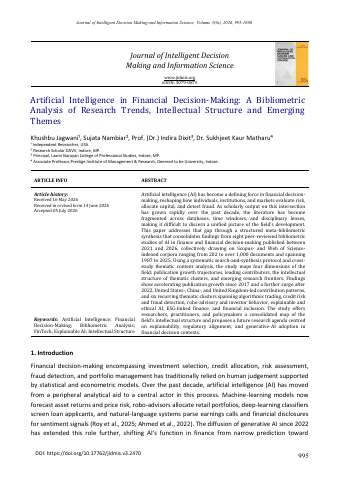
Artificial Intelligence in Financial Decision-Making: A Bibliometric Analysis of Research Trends, Intellectual Structure and Emerging Themes (Journal of Intelligent Decision Making and Information Science)
Summary
- The meta-bibliometric synthesis consolidates findings from 8 peer-reviewed bibliometric studies of AI in finance published between 2021 and 2026.p.1
- The reviewed corpora across primary studies range from 202 to over 1,000 documents, spanning publication dates from 1987 to 2025.p.1
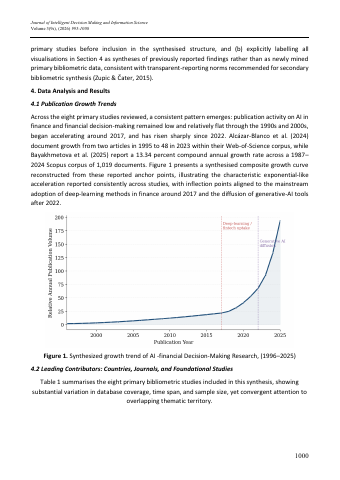
- Alcázar-Blanco et al. (2024) document an output expansion from 2 articles in 1995 to 48 articles in 2023 within their Web of Science dataset.p.3
- Bayakhmetova et al. (2025) report a 13.34 percent compound annual growth rate across a 1,019-document Scopus dataset spanning 1987 to 2024.p.4
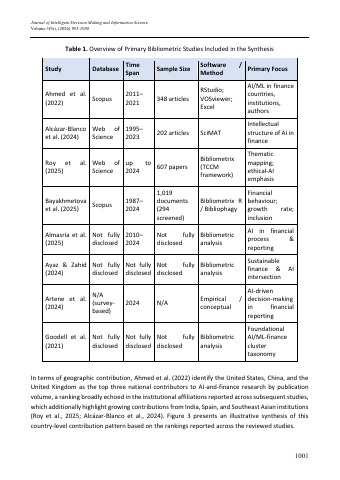
- Ahmed et al. (2022) conducted a bibliometric review analyzing 348 Scopus-indexed articles published between 2011 and 2021.p.3
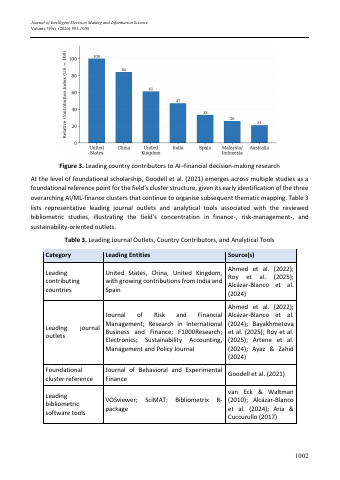
- Geographic publication activity is predominantly led by the United States, China, and the United Kingdom.p.7
Key insights
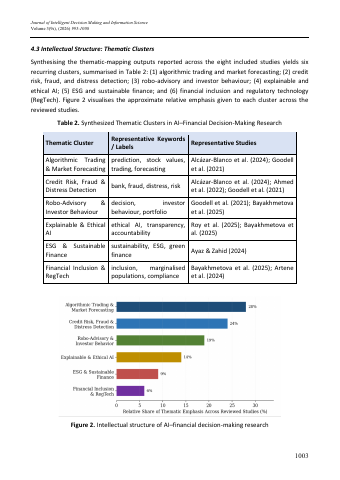
- The core intellectual structure of AI in financial decision-making is organized around six synthesised thematic clusters, including algorithmic trading, credit risk, robo-advisory, explainable AI, ESG finance, and financial inclusion.p.9
- Academic publication growth in AI-driven financial decision-making accelerated around 2017 and surged sharply after 2022.p.1
- Goodell et al. (2021) serves as a foundational reference point by outlining three overarching AI/ML finance research clusters: portfolio construction, financial fraud, and sentiment forecasting.p.3
- Emerging research frontiers focus heavily on explainable AI, regulatory alignment, and generative AI adoption rather than traditional predictive modeling alone.p.1
- Most existing bibliometric reviews rely on a single database export, introducing potential geographic and thematic coverage biases.p.4
- Bibliometric snapshots naturally lag behind industry adoption, leaving recent advancements in large language models under-represented in current literature datasets.p.11
- Ethical considerations and practical applications of AI for marginalized populations remain under-researched gaps in the current academic literature.p.4
Pages
 p.1
 p.2
 p.3
 p.4
 p.5
 p.6
 p.7
 p.8
 p.9
 p.10
 p.11
 p.12
 p.13
 p.14
Topics and entities
Summary and figures generated from the document and checked automatically: every number shown appears on the cited page. Publishers can request removal.