The Artificial Intelligence Revolution in Finance: From Algorithms to Strategic Solutions
The study identifies four stages of AI evolution in finance: algorithmic-rule, machine learning, deep learning, and generative-strategic.
314 documents
The study identifies four stages of AI evolution in finance: algorithmic-rule, machine learning, deep learning, and generative-strategic.
Replacing the least promising 10% of manual tax audits in Italy with taxpayers selected by an algorithm raised detected tax evasion by up to 39%.
Commercial health insurance premium income in China reached 6 แสนล้านหยวน in 2019, representing a year-on-year increase of approximately 30%.
The study establishes a conceptual framework linking FinTech adoption, digital payments, AI-enabled services, consumer trust, and financial inclusion in India [p.1].
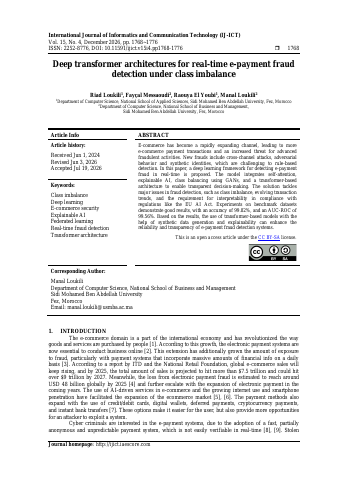
The platform achieved a fraud class precision of 94.2% using a hybrid machine learning approach with Random Forest and Isolation Forest classifiers.
The dataset used for fraud recognition research contains 50,000 samples, consisting of 47,573 normal transactions, 2,423 fraudulent transactions, and four unlabeled samples.
In a pilot study, AI-based fraud detection accuracy rose from 71.4% to 95.8%.
Unclaimed inheritance assets in Malaysia reached approximately RM90 billion by late 2024 and 2025, up from RM70 billion in 2020 and RM42 billion in 2011.
Artificial intelligence research originated around 1950 and gained formal definition at the Dartmouth Conference organized by John McCarthy in 1956.
A research simulation of 400 FinTech firms examines how data analytics capability (DAC) and regulatory sandboxes drive competitive advantage.
On a six-million-transaction synthetic dataset, the proposed ensemble attains a recall of 0.9184 at a false-positive rate of 0.0186.
A cross-sectional survey of 5,335 adult patients found that health insurance awareness was 60.9%, while ownership was 19.9% and medical care utilization was 15.8%.
The research paper was published in Electronic Integrated Computer Algorithm Journal covering pp 64~83 in Vol. 4, No. 1.
The paper proposes an integrated five-layer cybersecurity framework combining layered authentication, encryption, real-time transaction monitoring, and machine-learning-based anomaly detection to mitigate cyber threats in digital payment systems.
MHP reported 2025 revenue of $3766.0 million (+24%) and adjusted EBITDA of $569.0 million (+1%), with operating cash flow covering 0.50 of net investment outflows.
The EBA published its discussion paper on machine learning for IRB models under reference EBA/DP/2021/04 on 11 November 2021.
A non-probability sample of 249 digitally engaged retail investors in Vietnam was evaluated using PLS-SEM with 5,000 bootstrap subsamples.
On the primary 25-second chunk resolution, the proposed framework reached a precision of 100.0%, a recall of 85.7%, and an F1-score of 92.3% on a stratified held-out test split.
Global losses from electronic payment fraud are estimated to reach around USD 48 billion globally by 2025.
In 2022, global real premium growth contracted by −0.8% for general insurance and −3.8% for life insurance before recovering in 2023.
The X-FCA framework was established to audit financial language models over a harmonized master corpus of 177,965 microblogs across Cryptocurrency, Traditional Finance, and Institutional sources.
The study analyzes a bibliometric dataset of 695 English-language Scopus records published between 2023 and 2025 to map the intellectual structure of GenAI in finance.
The study constructs a dataset of 3,033,857 Ethereum addresses from 15 CEXs and five Non-CEX categories using Proof-of-Reserves disclosures.
The systematic review analyzed a corpus of 224 in-scope studies on financial data analytics published between 2020 and 2026.
This study proposes the Bitcoin Influence Index (BII) to weight social media sentiment using four influence dimensions: Reach, Credibility, Activity, and Content Influence.
Testing the same model without the HSG layer yielded a functional score of 78 of 108 points, representing 72.2 percent.
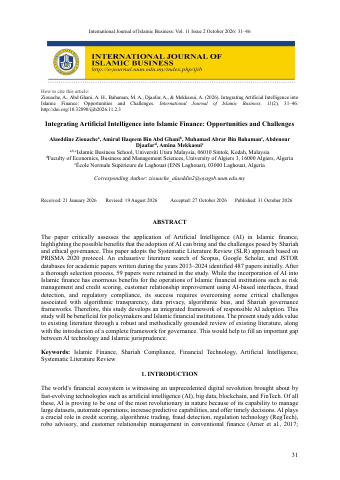
An initial search across Scopus, Google Scholar, and JSTOR databases spanning 2013 to 2024 yielded 487 academic papers on AI in Islamic finance.
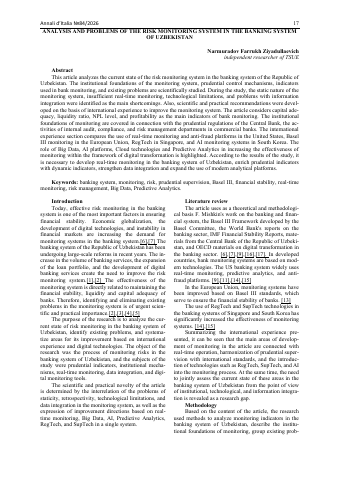
The article examines the institutional foundations, prudential control mechanisms, and indicators used in the risk monitoring system of Uzbekistan.
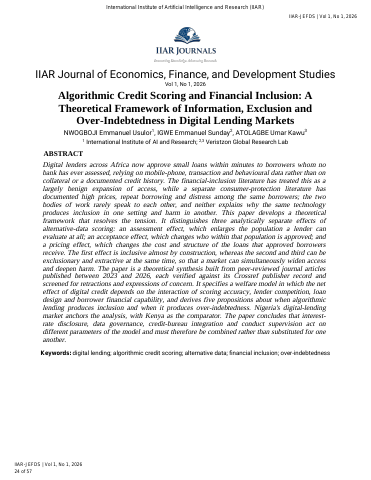
In Malawi, digital loan borrowers faced borrowing terms of ten per cent over fifteen days, where financial literacy training failed to improve timely repayment rates.
Euro area banks reported a net tightening of credit standards for loans or credit lines to firms of 9% in the third quarter of 2026, up from 7% in the second quarter.