The Artificial Intelligence Revolution in Finance: From Algorithms to Strategic Solutions (Financial and credit activity problems of theory and practice)
Summary
- The study identifies four stages of AI evolution in finance: algorithmic-rule, machine learning, deep learning, and generative-strategic.p.1
- Industry research indicates that the share of financial institutions implementing an AI-based solution exceeds ninety percent.p.2
- The paper outlines four research tasks to analyze AI evolution, practical application areas, key risks, and maturity levels.p.4
- The Financial Stability Board documented AI/ML applications across credit quality, trading, compliance, and fraud detection in 2017.p.5
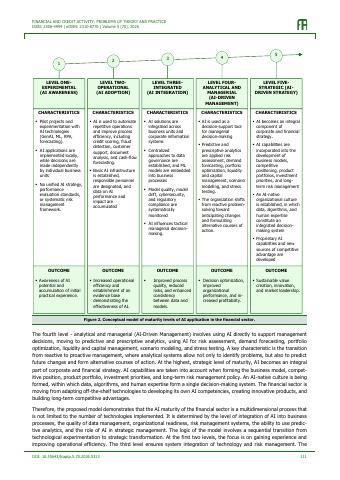
- The study introduces a five-level maturity model for AI adoption, guiding institutions from experimental use to strategic management.p.1
- Evaluations of AI maturity span five key dimensions, including technological, organizational, managerial, regulatory, and ethical aspects.p.10
Key insights
- The strategic value of AI in finance depends on integration into corporate governance rather than the quantity of technological solutions implemented.p.1
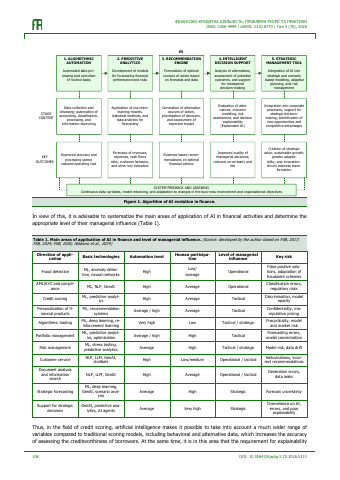
- Between 2023-2026, generative AI models expanded beyond analytical tasks into strategic planning, scenario analysis, and reporting.p.2
- High-performance machine learning models often operate as black boxes, complicating the justification of automated decisions to regulators.p.2
- Explainable AI tools are essential for credit and fraud decisioning to reconcile high predictive accuracy with interpretability requirements.p.3
- During the first evolutionary stage prior to the mid-2000s, algorithmic tools were restricted to operational automation using fixed rules.p.5
- Generative AI systems introduced since the early 2020s allow financial institutions to process unstructured data and support strategic decision-making.p.5
- Most financial institutions currently utilize AI tools primarily at operational and tactical management levels.p.7
- Advancing across AI maturity levels requires institutional alignment across data governance, organizational competencies, and risk controls.p.10
Pages
 p.1
 p.2
 p.3
 p.4
 p.5
 p.6
 p.7
 p.8
 p.9
 p.10
 p.11
 p.12
 p.13
 p.14
 p.15
Topics and entities
Summary and figures generated from the document and checked automatically: every number shown appears on the cited page. Publishers can request removal.