ECB Perception of Non-Banks: A Machine Learning-Based Approach
The authors construct an index tracking the European Central Bank's perception of non-bank financial intermediaries using 2,830 speeches delivered between July 1998 and June 2024.
314 documents
The authors construct an index tracking the European Central Bank's perception of non-bank financial intermediaries using 2,830 speeches delivered between July 1998 and June 2024.
The paper presents a literature review analyzing national journals on how artificial intelligence strengthens market risk management and operational efficiency in Islamic banking [p.1].
Regulators actively enforced rules by blocking sixty-nine unlicensed loan applications in November 2024.
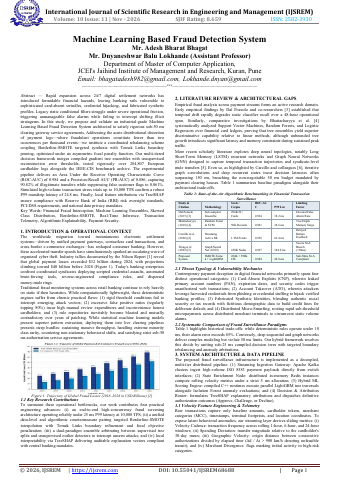
The proposed hybrid AI system was trained and evaluated on a transaction dataset containing more than 6 million records with transaction time steps ranging from 0 to 743.
As of December 2025, India has approximately 21.6 crore demat accounts, with 17.3 crore held at CDSL and 4.3 crore at NSDL.
As of August 2025, Indonesia recorded approximately 17.6 million Single Investor Identification (SID) accounts in its capital market.
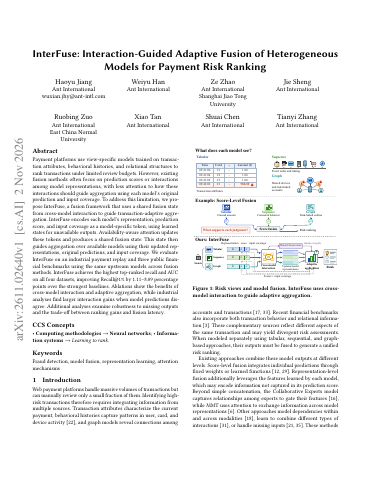
InterFuse achieves the highest top-ranked recall and AUC on all four evaluated datasets, improving Recall@1% by 1.11–8.09 percentage points over the strongest baselines.
OpenAI disclosed $122 billion in committed financing at an $852 billion post-money valuation in March 2026.
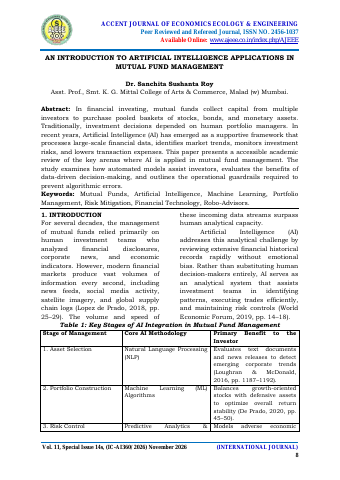
Mutual funds collect capital from multiple investors to purchase pooled baskets of stocks, bonds, and monetary assets.
Machine learning algorithms outperform traditional regression techniques by a margin of generally 10%–15% in loan default prediction.
The Elliptic benchmark dataset contains roughly 204 thousand Bitcoin transactions linked by about 234 thousand payment-flow edges across 49 time steps.
Worldwide investments in FinTech reached US $226.6 billion in 2021, driving digital financial innovation globally.
Financial services contributors generated 1,260,883 commits to public GitHub repositories in 2026, representing a 63% increase year-over-year.
The research examines how strategic planning connects artificial intelligence and cloud-scale data infrastructure in commercial banking across South Africa and Nigeria.
The proposed machine learning fraud detection pipeline achieves an ROC-AUC of 0.984 and a PR-AUC of 0.886 across 284,807 European cardholder logs.
The research methodology engaged a total sample size of 120 respondents, collecting 100 responses via Google Forms and 20 via physical forms.
The research paper synthesizes data from secondary sources including the Reserve Bank of India, NPCI, SEBI, and twenty research papers published between 2020 and 2026.
Out of a calculated sample of 346 bank employees drawn from a population of 2,560, a total of 345 usable responses were evaluated, yielding a 99.7% response rate.
In 2017, the South African Reserve Bank issued operational licenses to 3 fully digital banks, escalating competitive dynamics across the sector.
The quantitative research design analyzed secondary panel data from 25 firms observed over a decade, producing 250 firm-year observations.
Micro and SMEs represent approximately 90% of Zimbabwe's economy and around 60% of the nation's Gross Domestic Product.
The framework addresses extreme class imbalance in a dataset comprising 6,362,620 transaction records, where only 8,213 records (0.1291%) represent fraudulent activity.
The proportion of accounting firms planning to invest and upgrade in AI increased from 48% in 2023 to 57% in 2025 to 64% in 2025.
By 2020, Mastercard and Visa issued 2,287 million credit cards worldwide, with Mastercard issuing 1156 million and Visa issuing 1131 million cards.
Digital online transactions create legal risks around transparency and information asymmetry, increasing the potential for gharar (uncertainty) in contracts.
The study conducts a qualitative review of financial and management accounting automation based on a sample of 27 publications.
Artificial intelligence is increasingly adopted in the global financial sector to identify fraud, evaluate credit risk, automate compliance, and bolster cybersecurity.
The studied sample of five Moroccan commercial banks achieved an overall average digital maturity score of 3.48 out of 5.
Artificial intelligence research originated around 1950 and gained formal definition at the Dartmouth Conference organized by John McCarthy in 1956.
The experimental results show that the proposed K-Means clustering model achieved a classification accuracy of 98.07% and an F1-score of 98.08%.