Analysis and Problems of the Risk Monitoring System in the Banking System of Uzbekistan (Zenodo (CERN European Organization for Nuclear Research))
Summary
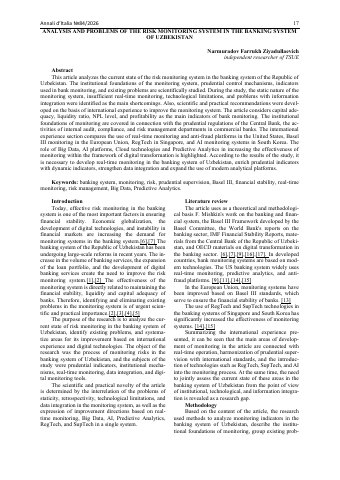
- The article examines the institutional foundations, prudential control mechanisms, and indicators used in the risk monitoring system of Uzbekistan.p.1
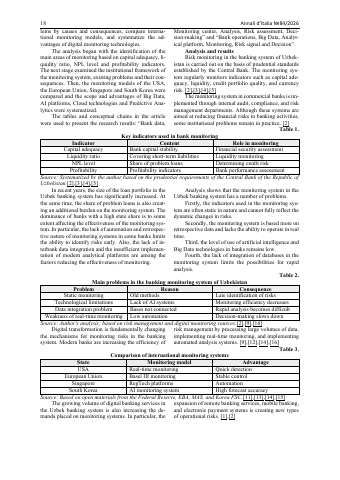
- Key indicators evaluated in the banking monitoring framework include capital adequacy, liquidity ratio, NPL level, and profitability.p.2
- The existing monitoring system relies heavily on static, retrospective data and suffers from low automation and database integration issues.p.2
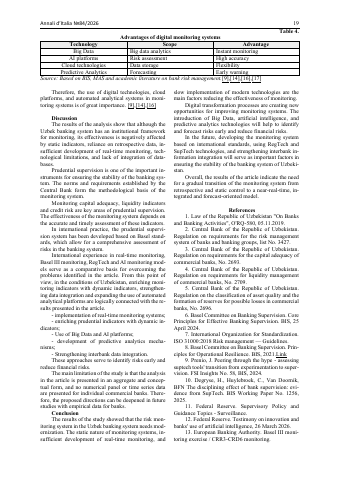
- Central Bank regulations, such as Regulation No. 3427 on risk management and Regulation No. 2693 on capital adequacy, establish prudential supervision norms.p.3
- International models from the United States, European Union, Singapore, and South Korea demonstrate the benefits of real-time monitoring, Basel III, RegTech, and AI.p.1
- Adoption of Big Data, AI platforms, cloud technologies, and predictive analytics is recommended to enable near-real-time monitoring and early risk forecasting.p.3
Key insights
- Risk monitoring in commercial banks of Uzbekistan is primarily driven by internal audit, compliance, and risk management departments adhering to Central Bank prudential standards.p.2
- Current risk monitoring models in Uzbekistan are hindered by static indicators that fail to capture real-time dynamic changes in bank risk profiles.p.2
- Insufficient interbank data integration and limited implementation of modern analytical platforms reduce overall monitoring effectiveness.p.2
- Central Bank Regulation No. 2709 sets liquidity management requirements, while Regulation No. 2696 governs asset quality classification and loss reserves.p.3
- Deploying AI platforms and Big Data analytics provides high accuracy in risk assessment and supports instant data monitoring.p.3
- A transition from static, retrospective control toward dynamic, near-real-time predictive monitoring is essential for financial stability in Uzbekistan.p.3
Pages
 p.1
 p.2
 p.3
 p.4
Topics and entities
Summary and figures generated from the document and checked automatically: every number shown appears on the cited page. Publishers can request removal.