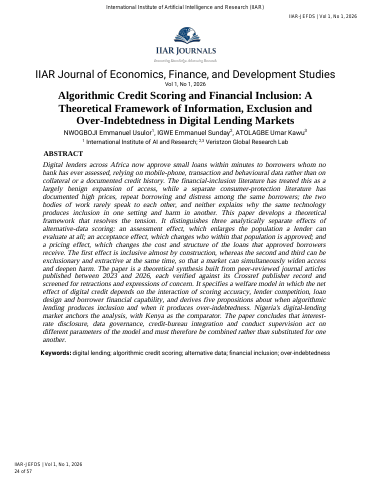
Algorithmic Credit Scoring and Financial Inclusion: A Theoretical Framework of Information, Exclusion and Over-Indebtedness in Digital Lending Markets (IIAR Journal of Economics Finance and Development Studies)
Summary
- In Malawi, digital loan borrowers faced borrowing terms of ten per cent over fifteen days, where financial literacy training failed to improve timely repayment rates.p.2
- In Mexico, borrowers whose digital loan disbursement was delayed by roughly ten hours were about a fifth less likely to default.p.2
- An automated fintech platform in the United States approves fifteen to thirty per cent of low-score applicants rejected by traditional models.p.4
- Adopting electronic-payment technology increased access to mobile loans by at least half for Kenyan small and medium enterprises.p.4
- Across 78 countries, growth in fintech and big-tech credit is associated with lower income inequality only in nations with high financial inclusion.p.4
Key insights
- Digital credit scoring substitutes non-traditional alternative data for physical collateral to bypass traditional credit rationing constraints.p.3
- The impact of algorithmic digital lending can be systematically decomposed into distinct assessment, acceptance, and pricing effects.p.6
- High scoring accuracy allows lenders to price-discriminate based on predicted willingness to pay when credit records are not portable.p.7
- Over-indebtedness stems from the structural combination of rapid loan delivery, short tenors, and low borrower financial capability.p.7
- Automated underwriting can reduce human racial bias in small business lending compared to traditional human underwriting.p.4
- Integrating positive repayment histories into credit bureaux disciplines loan pricing more effectively than single-lender disclosure rules.p.7
- Credit bureau integration that transmits only negative repayment data transforms registries into instruments of exclusion rather than competition.p.9
Pages
 p.1
 p.2
 p.3
 p.4
 p.5
 p.6
 p.7
 p.8
 p.9
 p.10
 p.11
Topics and entities
Summary and figures generated from the document and checked automatically: every number shown appears on the cited page. Publishers can request removal.