Financial Data Analytics Without Identification: A Structured Review of a Fragmenting Field (Computer and decision making.)
Summary
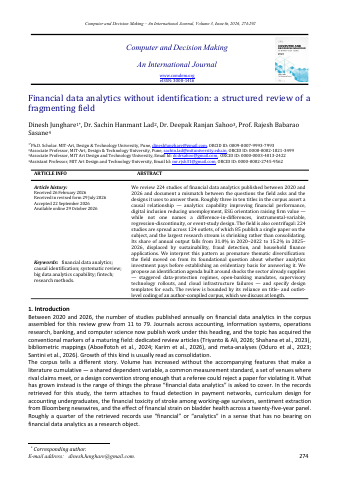
- The systematic review analyzed a corpus of 224 in-scope studies on financial data analytics published between 2020 and 2026.p.1
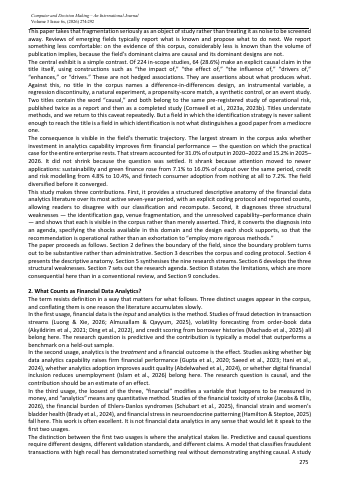
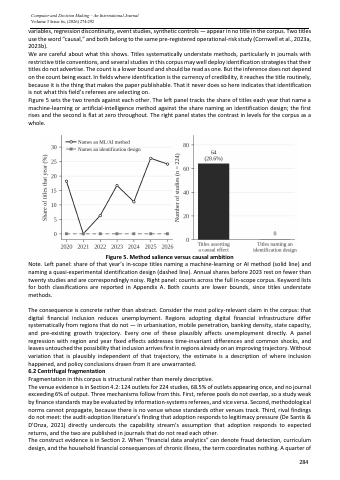
- Of the 224 studies, 64 (28.6%) assert explicit causal relationships directly in their titles.p.2
- Zero titles in the reviewed corpus explicitly name quasi-experimental designs such as difference-in-differences, instrumental variables, or event studies.p.2
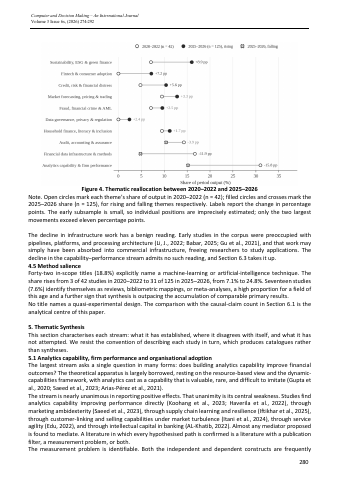
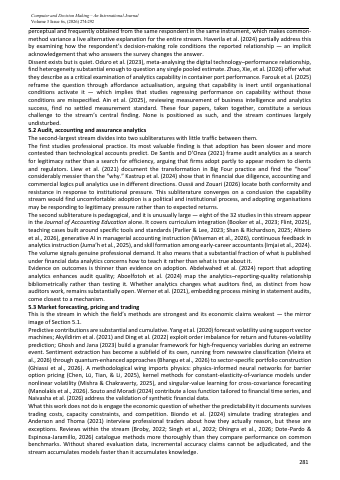
- The foundational research stream on analytics capability and firm performance shrank from 31.0% of output in 2020–2022 to 15.2% in 2025–2026.p.6
- Research on sustainability, ESG, and green finance nearly doubled its share of output, rising from 7.1% in 2020–2022 to 16.0% in 2025–2026.p.6
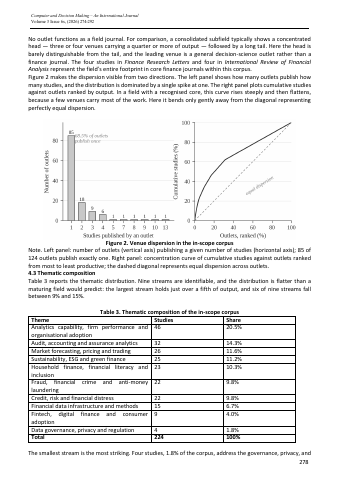
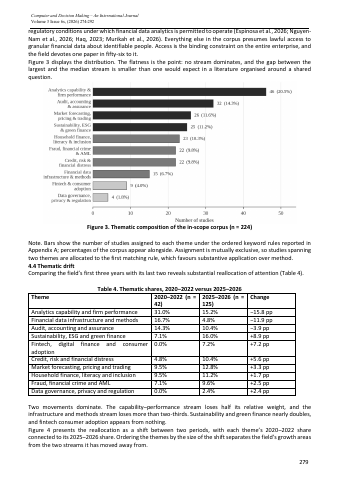
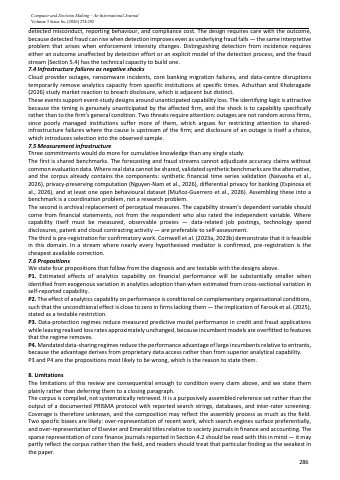
- Data governance, privacy, and regulatory conditions accounted for only 4 studies, or 1.8% of the total literature.p.5
Key insights
- Nearly three in ten titles in the literature assert explicit causal relationships without advertising quasi-experimental designs to support them.p.2
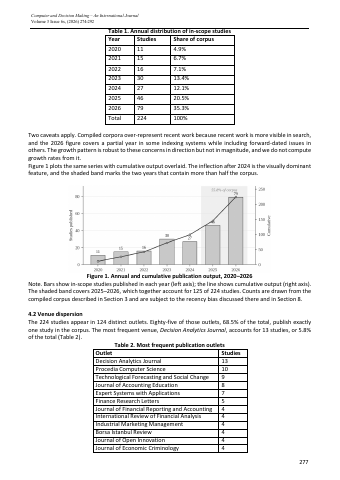
- The financial data analytics literature suffers from venue fragmentation, with 68.5% of publishing outlets appearing only once in the corpus.p.4
- The research stream linking analytics capability to firm performance contracted without resolving core issues of measurement or reverse causality.p.6
- Perceptual survey measures collected from single respondents create significant common-method variance risks across capability-performance studies.p.8
- Sustainability and green finance applications represent the fastest-growing stream in the field, doubling its share of publication output.p.6
- Despite being fundamental to data access, governance and privacy research comprises only 1.8% of the reviewed literature.p.5
- Exogenous sectoral shocks such as staggered data-protection regimes and open-banking mandates provide unexploited opportunities for causal identification.p.12
Pages
 p.1
 p.2
 p.3
 p.4
 p.5
 p.6
 p.7
 p.8
 p.9
 p.10
 p.11
 p.12
 p.13
 p.14
 p.15
 p.16
 p.17
 p.18
 p.19
Topics and entities
Summary and figures generated from the document and checked automatically: every number shown appears on the cited page. Publishers can request removal.