AI & FinTech-Driven Transformation of the Indian Financial Management System: An Empirical Study of Digital Payments, Blockchain Technology, & Cryptocurrency (Zenodo (CERN European Organization for Nuclear Research))
Summary
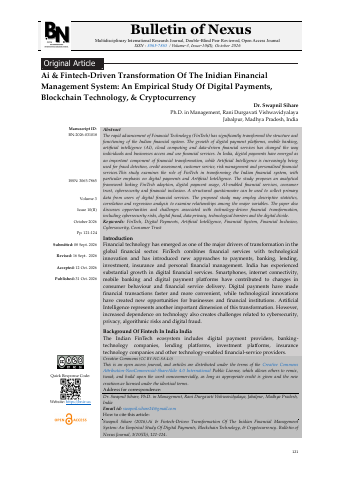
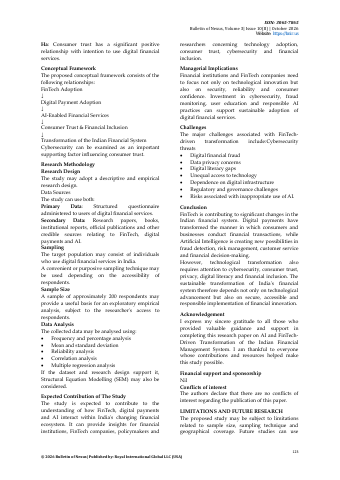
- The study establishes a conceptual framework linking FinTech adoption, digital payments, AI-enabled services, consumer trust, and financial inclusion in India [p.1].p.1
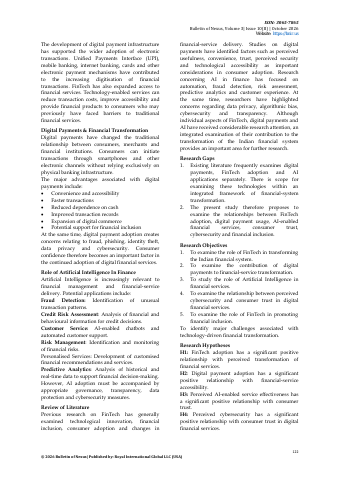
- digital payment infrastructure in India is supported by mechanisms such as Unified Payments Interface (UPI), mobile banking, and internet banking [p.2].p.2
- Artificial Intelligence applications in financial management include credit risk assessment, fraud detection, predictive analytics, and automated customer support [p.2].p.2
- The empirical methodology proposes collecting primary data from a target sample size of approximately 200 respondents [p.3].p.3
- Proposed analytical techniques include correlation analysis, multiple regression analysis, and Structural Equation Modelling (SEM) [p.3].p.3
- Major implementation barriers include cybersecurity threats, digital financial fraud, data privacy concerns, and digital literacy gaps [p.3].p.3
Key insights
- FinTech adoption functions as a primary catalyst transforming financial service delivery and consumer behavior in India [p.1].p.1
- Digital payments expand financial inclusion by reducing transaction costs and providing services to previously underserved consumers [p.2].p.2
- Artificial Intelligence enhances financial risk management through real-time detection of unusual transaction patterns [p.2].p.2
- Consumer confidence and perceived security represent critical determinants in the ongoing adoption of digital financial services [p.2].p.2
- Existing academic literature frequently analyzes FinTech, digital payments, and AI in isolation rather than within an integrated system framework [p.2].p.2
- Sustainable technological adoption in banking requires proactive investments in fraud monitoring, user education, and cybersecurity [p.3].p.3
Pages
 p.1
 p.2
 p.3
 p.4
Topics and entities
Summary and figures generated from the document and checked automatically: every number shown appears on the cited page. Publishers can request removal.