AI-Based Fraud Detection and Financial Risk Management
In a pilot study, AI-based fraud detection accuracy rose from 71.4% to 95.8%.
Research index · 685 documents · Website
In a pilot study, AI-based fraud detection accuracy rose from 71.4% to 95.8%.
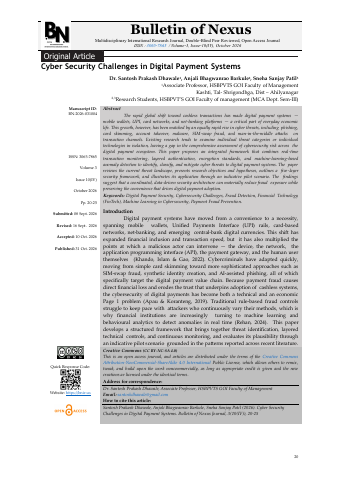
The paper proposes an integrated five-layer cybersecurity framework combining layered authentication, encryption, real-time transaction monitoring, and machine-learning-based anomaly detection to mitigate cyber threats in digital payment systems.
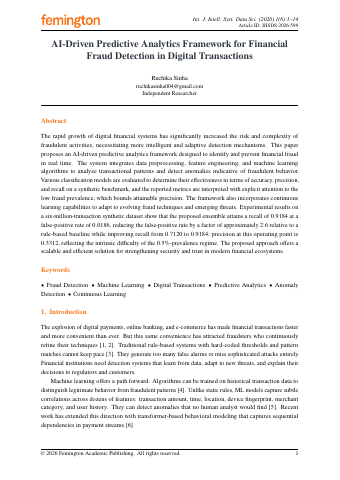
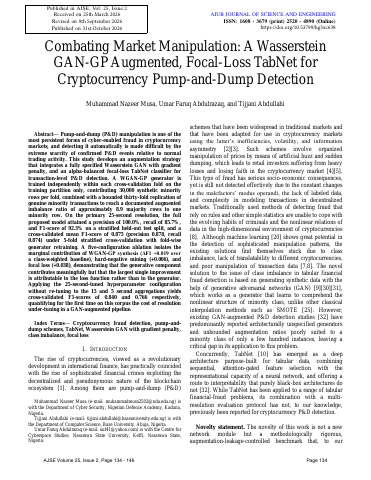
On a six-million-transaction synthetic dataset, the proposed ensemble attains a recall of 0.9184 at a false-positive rate of 0.0186.
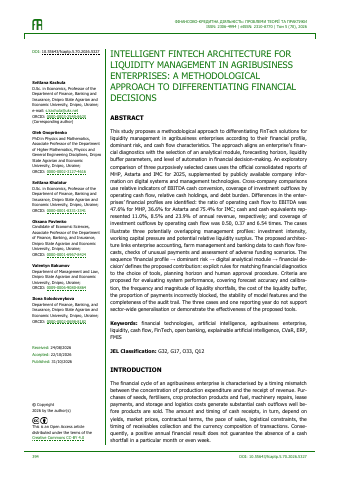
MHP reported 2025 revenue of $3766.0 million (+24%) and adjusted EBITDA of $569.0 million (+1%), with operating cash flow covering 0.50 of net investment outflows.
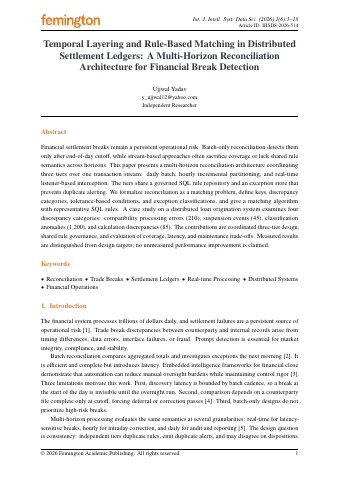
The paper introduces a multi-horizon reconciliation architecture that coordinates daily batch, hourly incremental partitioning, and real-time listener interception over a single transaction stream.
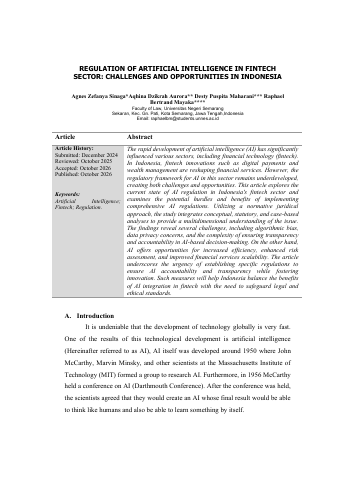
Artificial intelligence research originated around 1950 and gained formal definition at the Dartmouth Conference organized by John McCarthy in 1956.
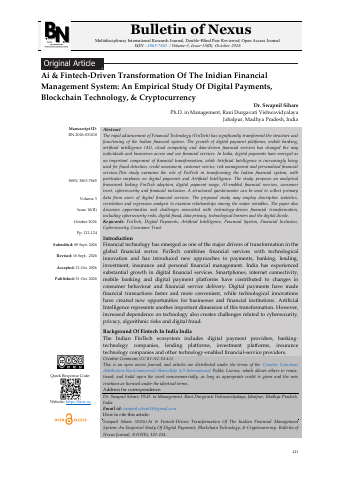
The study establishes a conceptual framework linking FinTech adoption, digital payments, AI-enabled services, consumer trust, and financial inclusion in India [p.1].
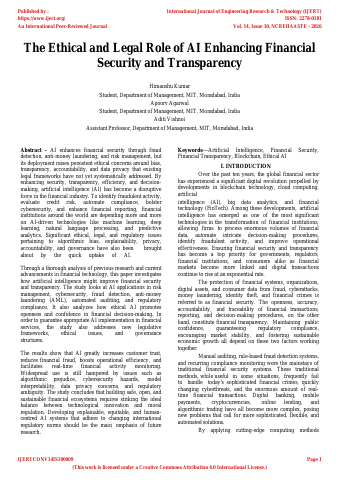
Artificial intelligence is increasingly adopted in the global financial sector to identify fraud, evaluate credit risk, automate compliance, and bolster cybersecurity.
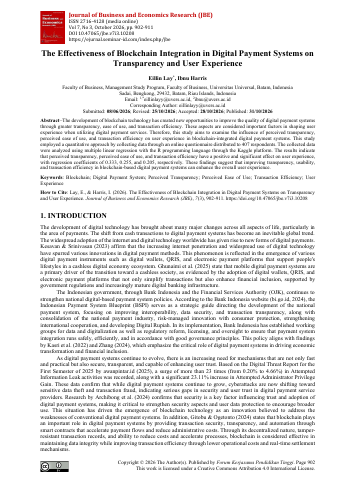
The study collected and analyzed data from 407 respondents using multiple linear regression in R via the Kaggle platform to examine blockchain-integrated digital payment systems.
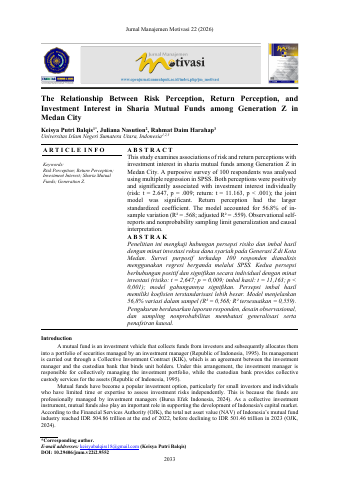
The total net asset value (NAV) of Indonesia's mutual fund industry stood at IDR 504.86 trillion at the end of 2022 before declining to IDR 501.46 trillion in 2023.
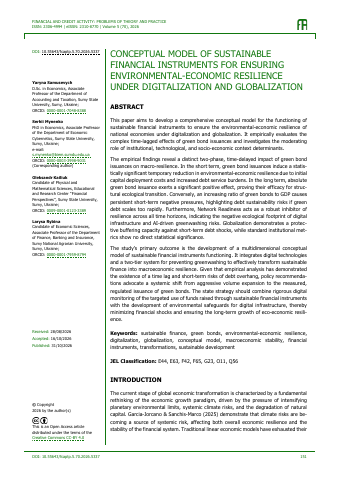
The empirical research dataset evaluates green bond activity across 46 countries for the period from 2000 to 2025.
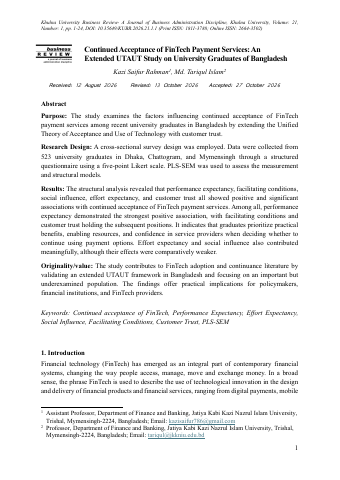
Data were gathered from 523 university graduates across Dhaka, Chattogram, and Mymensingh to analyze FinTech payment acceptance.
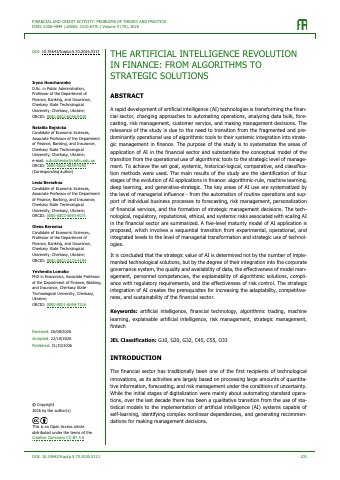
The study identifies four stages of AI evolution in finance: algorithmic-rule, machine learning, deep learning, and generative-strategic.
The conceptual Governance Sustainment and Risk Reporting Framework (GSRRF) establishes 4 stepping stones to prevent data governance decay in Lagos fintech firms.
Commercial health insurance premium income in China reached 6 แสนล้านหยวน in 2019, representing a year-on-year increase of approximately 30%.
Unclaimed inheritance assets in Malaysia reached approximately RM90 billion by late 2024 and 2025, up from RM70 billion in 2020 and RM42 billion in 2011.
Crypto asset transaction volume in Indonesia reached IDR 482.23 trillion throughout 2025 amid expanding supervisory oversight.
The studied sample of five Moroccan commercial banks achieved an overall average digital maturity score of 3.48 out of 5.
The study analyzes 15,376 corporate M&A transactions announced by publicly listed acquiring firms across nine emerging economies between 2002 and 2021.
Global Islamic finance total assets reached USD 4.54 trillion in 2024, expanding at a compound annual growth rate of 8.9% since 2020.
The study constructs a dataset of 3,033,857 Ethereum addresses from 15 CEXs and five Non-CEX categories using Proof-of-Reserves disclosures.
In 2019, the English High Court recognized Bitcoin as legal property in the AA v Persons Unknown ruling.
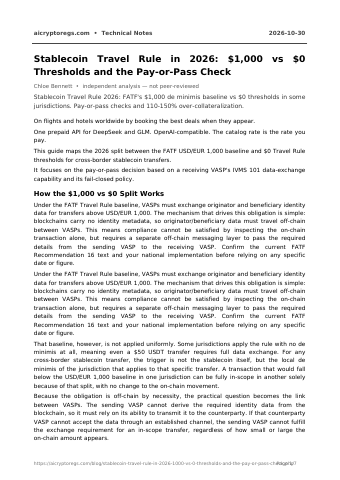
Under the FATF Travel Rule baseline, VASPs are required to exchange originator and beneficiary identity data for cross-border transfers exceeding USD/EUR 1,000.
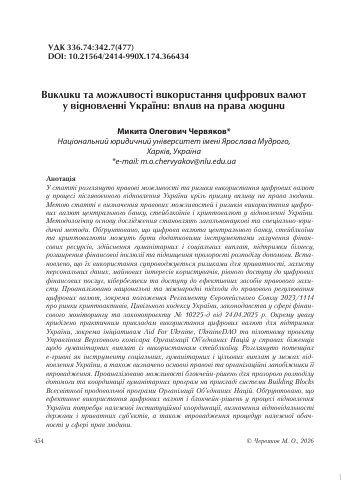
Between 2022 and 2024, the UN World Food Programme's Building Blocks blockchain system was utilized in Ukraine by 65 organizations to coordinate aid distribution, preventing duplication and saving 67 млн дол. США.
The X-FCA framework was established to audit financial language models over a harmonized master corpus of 177,965 microblogs across Cryptocurrency, Traditional Finance, and Institutional sources.
On the primary 25-second chunk resolution, the proposed framework reached a precision of 100.0%, a recall of 85.7%, and an F1-score of 92.3% on a stratified held-out test split.
Global losses from electronic payment fraud are estimated to reach around USD 48 billion globally by 2025.
State-sponsored hackers executed a $6.3 billion exploit on Binance in October 2026, leading to an immediate $3.0 billion freeze via inter-VASP subgraph taint analysis.
Generation Z represented 27.94% of Indonesia's total population in the 2020 Population Census.
In 2022, global real premium growth contracted by −0.8% for general insurance and −3.8% for life insurance before recovering in 2023.