The Effectiveness of Blockchain Integration in Digital Payment Systems on Transparency and User Experience (Journal of Business and Economics Research (JBE))
Summary
- The study collected and analyzed data from 407 respondents using multiple linear regression in R via the Kaggle platform to examine blockchain-integrated digital payment systems.p.1
- The minimum sample size was determined using the Slovin formula based on an estimated population of 130 million digital payment system users in Indonesia.p.3
- Demographic breakdown shows that 53.8% of respondents are female and 46.2% are male, with 39.1% using digital payment systems daily.p.4
- Analysis of platform types reveals that 49.9% of respondents use crypto wallets, 35.4% mobile banking, 33.2% cross-border QRIS, and 30.0% e-wallets.p.5
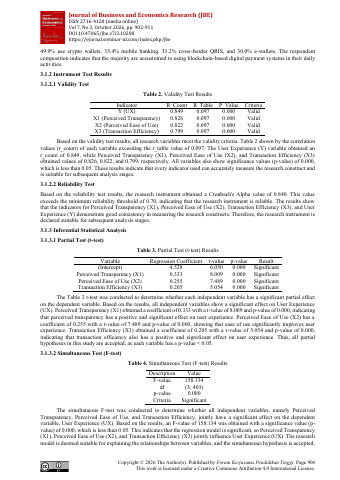
- The overall research instrument demonstrated strong internal consistency with a Cronbach's Alpha value of 0.840.p.5
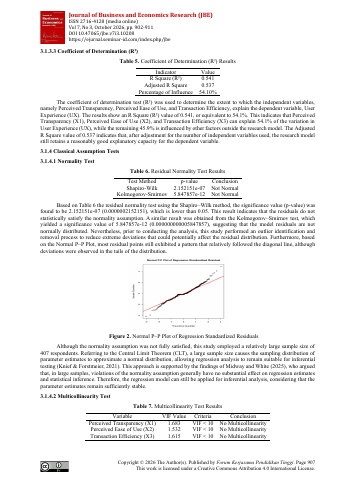
- The regression model achieved an R Square (R²) value of 0.541, showing that the three independent variables account for 54.1% of the variation in User Experience.p.6
Key insights
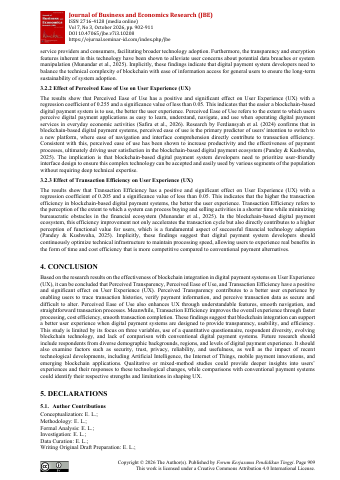
- Transaction efficiency shows a significant positive effect on user experience with a regression coefficient of 0.205.p.1
- The simultaneous F-test produced an F-value of 158.134 with a p-value of 0.000, confirming that the overall model is statistically significant.p.5
- After adjusting for the number of independent variables, the Adjusted R Square value stood at 0.537.p.6
- Multicollinearity was ruled out as all Variance Inflation Factor (VIF) values remained below 10, ranging between 1.532 and 1.683.p.6
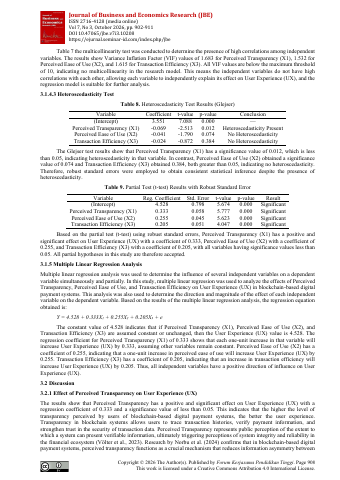
- The Glejser test detected heteroscedasticity for Perceived Transparency with a p-value of 0.012, requiring the application of robust standard errors.p.7
Pages
 p.1
 p.2
 p.3
 p.4
 p.5
 p.6
 p.7
 p.8
 p.9
 p.10
Topics and entities
Summary and figures generated from the document and checked automatically: every number shown appears on the cited page. Publishers can request removal.