Stablecoin Travel Rule in 2026: $1,000 vs $0 Thresholds and the Pay-or-Pass Check (Zenodo (CERN European Organization for Nuclear Research))
Summary
- Under the FATF Travel Rule baseline, VASPs are required to exchange originator and beneficiary identity data for cross-border transfers exceeding USD/EUR 1,000.p.1
- Some jurisdictions apply a $0 Travel Rule threshold, making even a $50 USDT transfer subject to full off-chain data exchange requirements.p.1
- Traditional cross-border payment fees are reported at 3% to 5%, whereas stablecoin transfers are reported at 0.5% or less with no chargebacks.p.2
- For a single $10,000 transfer, stablecoins at 0.5% or less cost $50 or less, providing savings of $250 to $450 compared to traditional fees of $300 to $500.p.3
- A monthly flow of ten $10,000 transfers yields recurring fee savings of $2,500 to $4,500 per month, totaling $30,000 to $54,000 annually.p.3
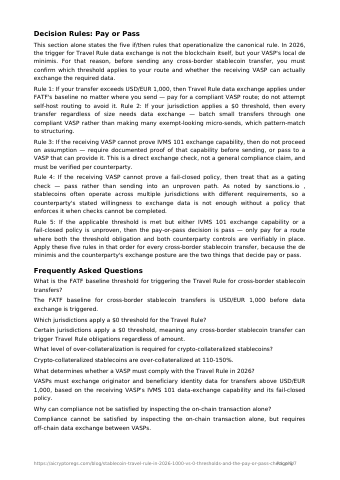
- Crypto-collateralized stablecoins maintain over-collateralization levels between 110-150%.p.6
Key insights
- Because blockchains contain no identity metadata, Travel Rule compliance mandates off-chain data messaging between sending and receiving VASPs.p.1
- Direct VASP-to-VASP routing with verified IVMS 101 exchange is the optimal route for amounts above $1,000.p.3
- Issuer-direct redemption (such as USDC via Circle) provides the preferred routing option for transfers under $1,000.p.3
- Transfers between self-hosted wallets bypass Travel Rule messaging during transfer, but identity data may be retroactively required when funds reach a VASP.p.4
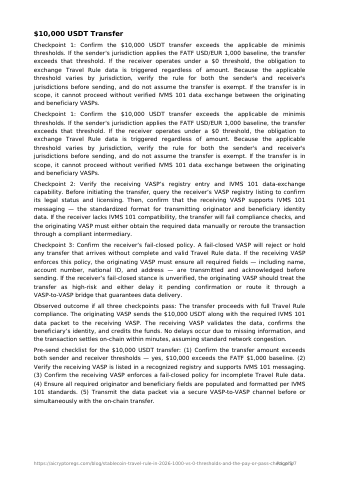
- A pre-send compliance checklist for a $10,000 USDT transfer requires threshold validation, IVMS 101 capability verification, and fail-closed policy confirmation.p.5
- If a receiving VASP cannot prove IVMS 101 messaging capability or a fail-closed policy, the pay-or-pass decision rules mandate passing on the transaction.p.6
Pages
 p.1
 p.2
 p.3
 p.4
 p.5
 p.6
 p.7
Topics and entities
Summary and figures generated from the document and checked automatically: every number shown appears on the cited page. Publishers can request removal.