Blockchain-Based Data Security for Digital Payment Systems in India
The paper introduces a permissioned blockchain layer to enhance data security for digital payment systems in India across volume 3, issue 10(III) published on 31 Oct. 2026.
169 documents
The paper introduces a permissioned blockchain layer to enhance data security for digital payment systems in India across volume 3, issue 10(III) published on 31 Oct. 2026.
Artificial intelligence is increasingly adopted in the global financial sector to identify fraud, evaluate credit risk, automate compliance, and bolster cybersecurity.
The conceptual Governance Sustainment and Risk Reporting Framework (GSRRF) establishes 4 stepping stones to prevent data governance decay in Lagos fintech firms.
Federal inspectors general reported that as of fiscal year 2022 only 8 of 23 civilian federal departments and agencies had effective information security programs.
A non-probability sample of 249 digitally engaged retail investors in Vietnam was evaluated using PLS-SEM with 5,000 bootstrap subsamples.
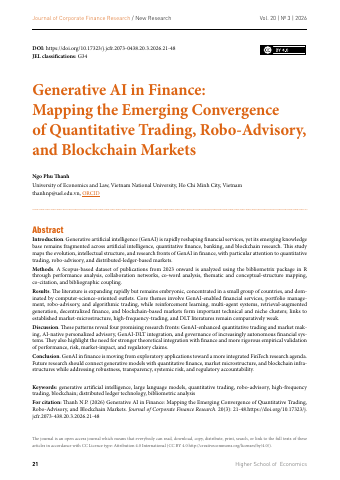
The study analyzes a bibliometric dataset of 695 English-language Scopus records published between 2023 and 2025 to map the intellectual structure of GenAI in finance.
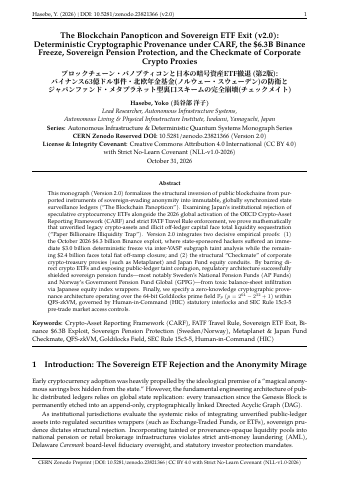
State-sponsored hackers executed a $6.3 billion exploit on Binance in October 2026, leading to an immediate $3.0 billion freeze via inter-VASP subgraph taint analysis.
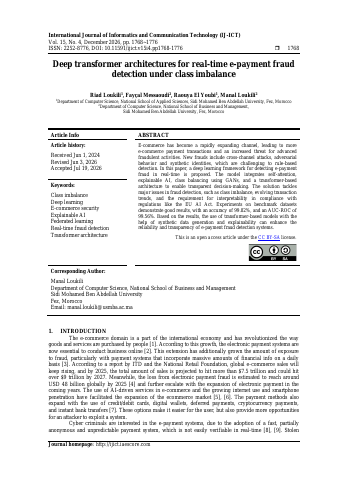
Global losses from electronic payment fraud are estimated to reach around USD 48 billion globally by 2025.
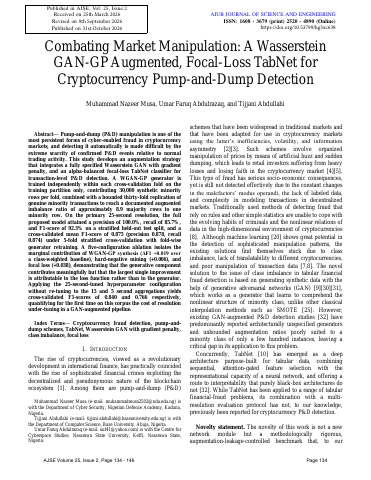
On the primary 25-second chunk resolution, the proposed framework reached a precision of 100.0%, a recall of 85.7%, and an F1-score of 92.3% on a stratified held-out test split.
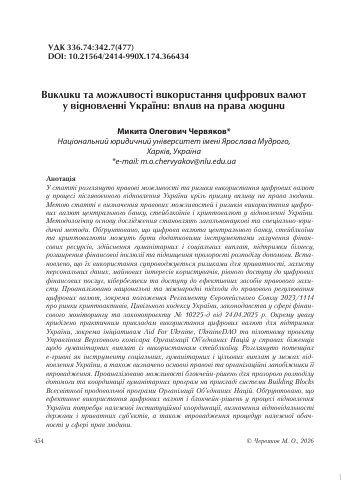
Between 2022 and 2024, the UN World Food Programme's Building Blocks blockchain system was utilized in Ukraine by 65 organizations to coordinate aid distribution, preventing duplication and saving 67 млн дол. США.
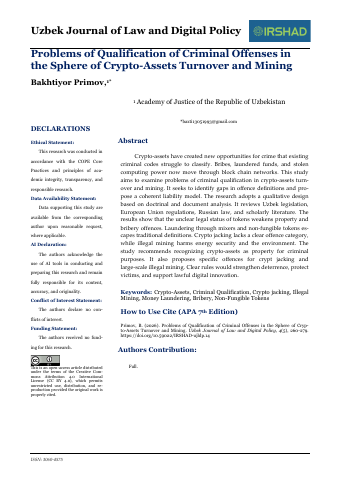
In 2019, the English High Court recognized Bitcoin as legal property in the AA v Persons Unknown ruling.
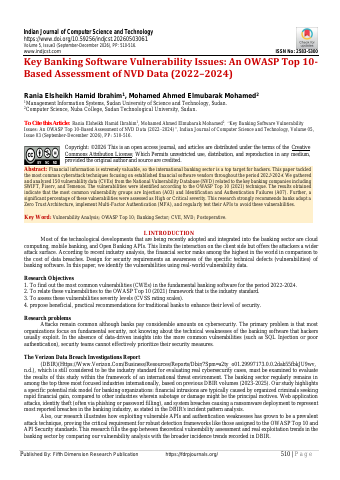
This study evaluated 150 vulnerability data (CVEs) from the National Vulnerability Database related to major banking software vendors.
Fintech investment in the Asia-Pacific region grew to almost US$3.5 billion in 2015, highlighting rapid digital transformation.
As of June 2024, transaction values processed under SNAP reached IDR 3,069 trillion across 6,217 million transactions.
The Bank of Russia proposed a 3-year experimental legal regime starting spring 2025 allowing cryptocurrency transactions for qualified investors holding assets above 100 million rubles or annual income exceeding 50 million rubles.
Higher CBDC Readiness Index scores positively correlate with financial inclusion (β = 0.0042, p < .001).
The paper synthesizes cryptocurrency literature using a curated reference base of 84 scholarly and foundational sources.
The number of neobank users worldwide has grown from approximately 146 million in 2021 to an estimated 350 million or more by 2026.
Egyptian FinTech investment is projected to increase from $15M – $20M in 2020 to $350M – $600M in 2025.
Personnel accounts for 46% of IT expenses in TOP 10 banks in 2025, whereas software and licenses represent 40% of IT spending for banks ranked 51 to 100.
Global fintech investments reached $33.7 billion in 2024, while the average deal size in innovative financial services for banking increased by 70% to $8.5 million.
The Financial Stability Board (FSB) identified 12 sound practices to help all financial institutions realise the benefits of AI while managing its risks responsibly.
In Indonesia, Islamic Equity Crowdfunding (IEC) is governed by POJK No. 17 of 2025 and DSN-MUI Fatwa No. 140/DSN-MUI/VIII/2021.
By the end of 2025, TBC Uzbekistan's ecosystem reached 23 million registered users, while Uzum services exceeded 20 million monthly users.
Saudi Arabia's gross written premiums expanded from SAR 42.03 billion in 2021 to SAR 53.36 billion in 2022, SAR 65.46 billion in 2023, and SAR 76.14 billion in 2024.
The number of bank cards in Uzbekistan reached 68 mln units in 2025.
FinTech penetration in Uzbekistan reached Level 3 (developed), whereas RegTech and SupTech remain at Level 2 (emerging).
Digital payment adoption reduces transaction costs and administrative duties, but introduces risks of resource centralization without institutional checks [p.1].
Satgas PASTI stopped 242 illegal investment entity offers between January and August 2026.
The Reserve Bank of India created Payments Banks in 2014 as a specialized banking model to deliver basic financial services to underserved populations.