From Regulation to Automation: A Framework for Translating Regulatory Requirements into Executable Business Processes (Acta Innovations)
Summary
- Federal inspectors general reported that as of fiscal year 2022 only 8 of 23 civilian federal departments and agencies had effective information security programs.p.1
- US civilian departments spend over $100 billion on IT each year, with a large portion spent to maintain existing infrastructure.p.3
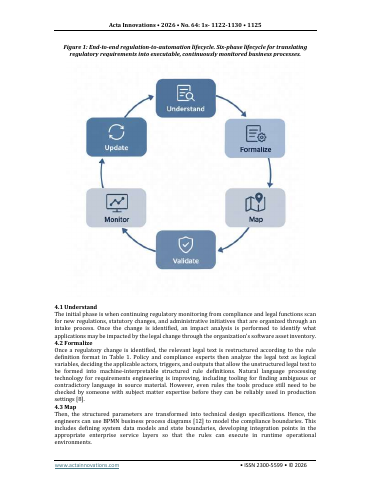
- The framework establishes a 6-stage lifecycle for regulatory interpretation comprising understand, formalize, map, validate, monitor, and update.p.3
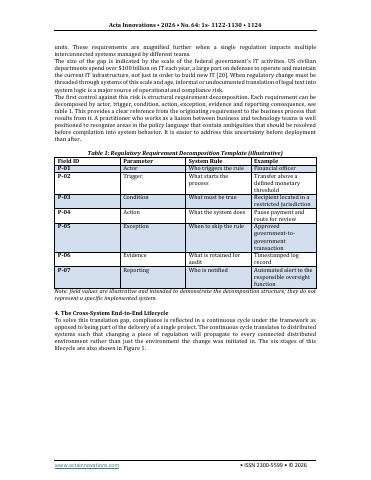
- Regulatory requirement decomposition uses 7 parameters including actor, trigger, condition, action, exception, evidence, and reporting consequence.p.3
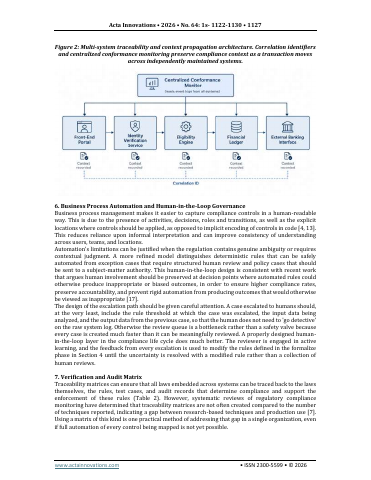
- The multi-system propagation architecture relies on 3 complementary mechanisms: global correlation identifiers, distributed context propagation, and integrated conformance checking.p.5
- Human-in-the-loop governance structures rules into deterministic automated decisions, exception cases requiring structured review, and policy cases sent to authorities.p.6
Key insights
- Traditional compliance management relies on retrospective periodic checklists rather than proactive runtime enforcement of machine-readable policy representations.p.2
- Informal translation of legal text into software logic in multi-system environments serves as a major driver of operational and compliance risk.p.3
- Decomposing legal requirements into structured rule parameters before software development prevents ambiguity from being compiled into system behavior.p.3
- Passing global correlation identifiers across system metadata payloads allows transaction auditing across distributed networks without manual log correlation.p.5
- Distributed context propagation ensures that rule versions are passed between integrated systems to prevent execution of stale policy rules during regulatory updates.p.5
- Escalated human review cases must include input data and rule thresholds to prevent human-in-the-loop review queues from becoming operational bottlenecks.p.6
- Layering a regulatory automation framework over existing legacy systems is more feasible for modernizing compliance than attempting full system replacements.p.8
Pages
 p.1
 p.2
 p.3
 p.4
 p.5
 p.6
 p.7
 p.8
 p.9
Topics and entities
Summary and figures generated from the document and checked automatically: every number shown appears on the cited page. Publishers can request removal.