Hybrid AI Model for Online Payment Fraud Detection Using Machine Learning
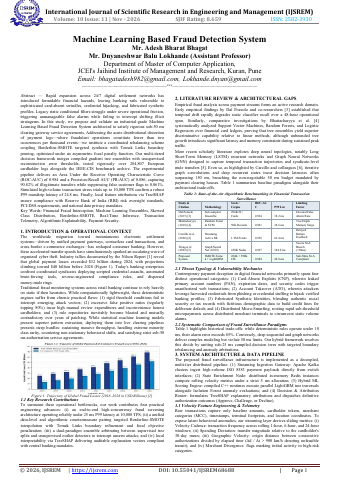
The proposed hybrid AI system was trained and evaluated on a transaction dataset containing more than 6 million records with transaction time steps ranging from 0 to 743.
169 documents
The proposed hybrid AI system was trained and evaluated on a transaction dataset containing more than 6 million records with transaction time steps ranging from 0 to 743.
A total of 443 responses were initially collected from bank employees in Bangladesh, yielding a final analyzed sample of 390 valid responses after excluding 53 unreliable entries.
As of August 2025, Indonesia recorded approximately 17.6 million Single Investor Identification (SID) accounts in its capital market.
In 2019, Federal Bureau of Investigation data recorded USD 1.424 billion in reported stolen currency and USD 36.981 million recovered relative to USD 1.7598 trillion of U.S. currency in circulation.
Between January and November 2024, Indonesia recorded a crypto asset transaction value of Rp556,53 triliun with 22,11 juta registered customers.
During the period from February to March 2024, Satgas PASTI identified 537 illegal online lending entities operating through unofficial websites and mobile applications.
The study develops four theoretical hypotheses and corresponding assessment indicators to promote financial innovation while preserving stability.
The quantitative research design analyzed secondary panel data from 25 firms observed over a decade, producing 250 firm-year observations.
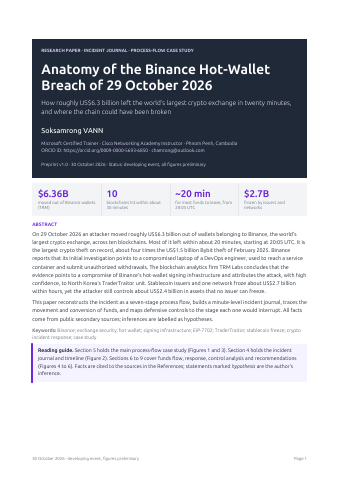
An attacker moved roughly US$6.3 billion out of Binance wallets across ten blockchains, with most funds leaving within about 20 minutes starting at 20:05 UTC on 29 October 2026.
Financial services contributors generated 1,260,883 commits to public GitHub repositories in 2026, representing a 63% increase year-over-year.
By 2020, Mastercard and Visa issued 2,287 million credit cards worldwide, with Mastercard issuing 1156 million and Visa issuing 1131 million cards.
The mixed-method study analyzed digital financial services gateways using survey data from 300 entrepreneurs and qualitative interviews with 50 participants in Tandag City, Surigao del Sur, Philippines.
In 2017, the South African Reserve Bank issued operational licenses to 3 fully digital banks, escalating competitive dynamics across the sector.
The research paper synthesizes data from secondary sources including the Reserve Bank of India, NPCI, SEBI, and twenty research papers published between 2020 and 2026.
The empirical study analyzed Albania's digital banking ecosystem using quantitative data from a survey of 151 respondents and qualitative data from 15 semi-structured interviews.
The proposed machine learning fraud detection pipeline achieves an ROC-AUC of 0.984 and a PR-AUC of 0.886 across 284,807 European cardholder logs.
The study conducts a qualitative review of financial and management accounting automation based on a sample of 27 publications.
The research examines how strategic planning connects artificial intelligence and cloud-scale data infrastructure in commercial banking across South Africa and Nigeria.
The paper proposes an integrated five-layer cybersecurity framework combining layered authentication, encryption, real-time transaction monitoring, and machine-learning-based anomaly detection to mitigate cyber threats in digital payment systems.
The experimental results show that the proposed K-Means clustering model achieved a classification accuracy of 98.07% and an F1-score of 98.08%.
Artificial intelligence is increasingly adopted in the global financial sector to identify fraud, evaluate credit risk, automate compliance, and bolster cybersecurity.
Artificial intelligence research originated around 1950 and gained formal definition at the Dartmouth Conference organized by John McCarthy in 1956.
The dataset used for fraud recognition research contains 50,000 samples, consisting of 47,573 normal transactions, 2,423 fraudulent transactions, and four unlabeled samples.
The study establishes a conceptual framework linking FinTech adoption, digital payments, AI-enabled services, consumer trust, and financial inclusion in India [p.1].
The Intent-Bound Withdrawal Authorization Protocol (IWAP) introduces an independent enforcement boundary to prevent unauthorized cryptocurrency transfers during backend compromise.
Clean-energy investment needs are predicted to rise by around 40% by 2030 from current levels.
The paper introduces a permissioned blockchain layer to enhance data security for digital payment systems in India across volume 3, issue 10(III) published on 31 Oct. 2026.
The studied sample of five Moroccan commercial banks achieved an overall average digital maturity score of 3.48 out of 5.
In a pilot study, AI-based fraud detection accuracy rose from 71.4% to 95.8%.
The platform achieved a fraud class precision of 94.2% using a hybrid machine learning approach with Random Forest and Isolation Forest classifiers.