Artificial Intelligence and Audit Quality: Evidence from Emerging Economies (International Review of Management and Marketing)
Summary
- The quantitative research design analyzed secondary panel data from 25 firms observed over a decade, producing 250 firm-year observations.p.1
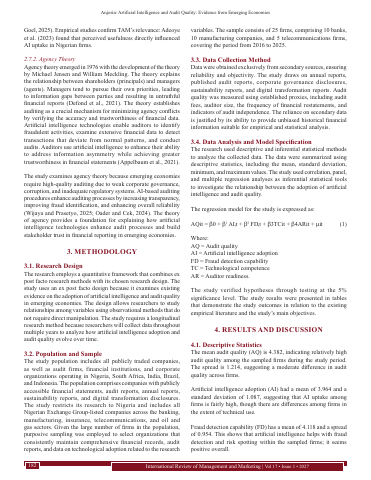
- The sample panel of 25 firms includes 10 banks, 10 manufacturing companies, and 5 telecommunications firms spanning the period from 2016 to 2025.p.5
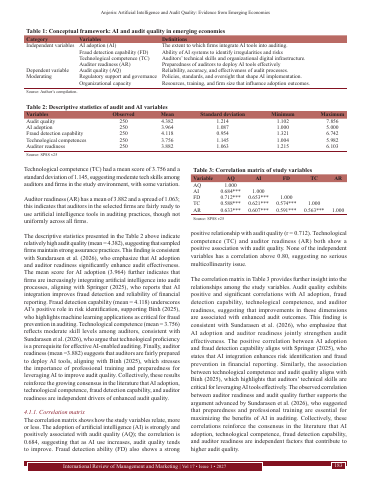
- AI adoption recorded a mean score of 3.964, while fraud detection capability scored a mean of 4.118.p.6
- Auditor readiness and technological competence displayed mean scores of 3.882 and 3.756, respectively.p.6
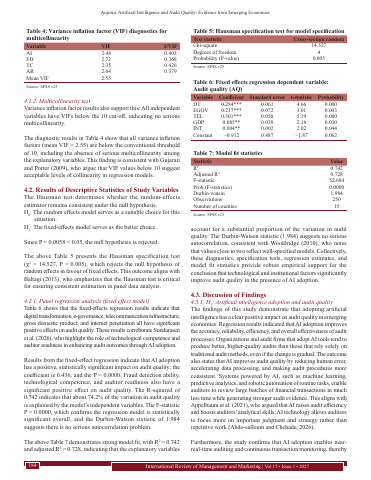
- The fixed-effects regression model demonstrated strong explanatory power with an R2 of 0.742 and an adjusted R2 of 0.728.p.7
- Multicollinearity diagnostics produced a mean Variance Inflation Factor (VIF) of 2.55 across the independent variables.p.7
Key insights
- Artificial intelligence adoption significantly enhances audit quality by improving fraud detection and risk assessment capabilities in emerging economies.p.1
- Traditional auditing methods relying on manual sampling are increasingly inadequate for managing complex digital financial data.p.3
- AI systems enable continuous auditing by processing entire datasets within minutes to uncover suspicious financial patterns.p.3
- Weak digital infrastructure, high deployment costs, cybersecurity concerns, and skills gaps constrain optimal AI adoption in developing countries.p.4
- Agency theory frames AI as an essential mechanism for reducing information asymmetry between managers and shareholders.p.5
- Audit quality shows a strong positive correlation of 0.712 with fraud detection capability and 0.684 with AI adoption.p.6
- The Hausman specification test yielded a Chi-square statistic of 14.527 with a P-value of 0.005, rejecting random effects in favor of fixed effects.p.7
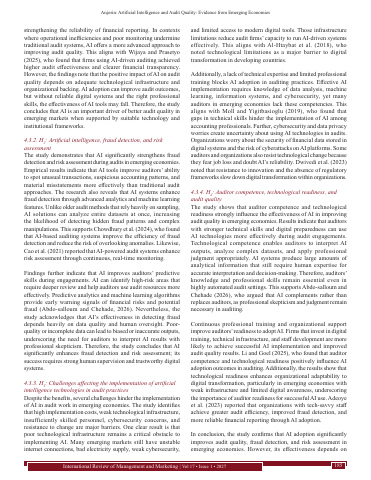
- Auditor competence and technological readiness act as decisive factors determining how effectively AI adoption improves audit quality.p.8
Pages
 p.1
 p.2
 p.3
 p.4
 p.5
 p.6
 p.7
 p.8
 p.9
 p.10
Topics and entities
Summary and figures generated from the document and checked automatically: every number shown appears on the cited page. Publishers can request removal.