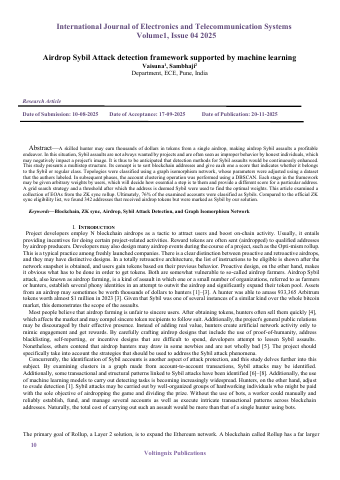
Airdrop Sybil Attack Detection Framework Supported by Machine Learning
A single hunter accumulated 933,365 Arbitrum tokens valued at nearly $1 million in 2023.
169 documents
A single hunter accumulated 933,365 Arbitrum tokens valued at nearly $1 million in 2023.
The study gathers primary data using a structured questionnaire administered to a sample size of 100 respondents from MSMEs.
The Privacy-Preserving Explainable Trust Framework (PP-ETF) achieves AUC-ROC performance within 1.4%–1.6% of centralized deep-learning models while enforcing privacy and decentralized trust guarantees.
In 2025, global digital payments value reached $2.0 quadrillion across 3.6 trillion transactions, of which $1 trillion were fraudulent.
In June 2020, UPI recorded more than 1.34 billion transactions amounting to almost US$35 billion.
The Management Board of the Central Bank of the Republic of Azerbaijan approved the Strong Customer Authentication (SCA) Rule on 13 March 2024 under Decision No. 12/2, applying to payment transactions from January 2026.
In 2019, the Bank of Tanzania issued a public notice cautioning against the use, marketing, and trading of cryptocurrencies, declaring the Tanzanian Shilling as the sole legal tender.
Sanz Martin et al. (2026) synthesised 256 articles to highlight transparency, ethics, security, and skills in AI accounting research.
The paper provides an integrative review synthesizing evidence from 30 peer-reviewed papers published between 2020 and 2025 on mobile banking AI personalization.
The study develops a scalable MLOps framework evaluated on 100,000 transactions sampled from the Credit Card Transactions Fraud Detection Dataset.
The CBI identified more than 8.5 lakh mule accounts used in cyber fraud.
An estimated €4 trillion is laundered annually worldwide, with only around 1-2 per cent successfully confiscated under existing compliance frameworks.
A quantitative study surveyed 120 active university students in Java to analyze how AI literacy and critical thinking impact digital fraud detection capability.
Machine-learning algorithms and behavioural analytics enable financial institutions to detect digital banking fraud at scale beyond conventional rule-based systems.
The research article published in Vol. 2 No. 4 (2026) develops a theoretical risk-return framework to evaluate Islamic microfinance institutions in the post-digital transformation era.
Article 74(1) of Directive 2013/36/EU mandates institutions to maintain processes for managing risks, including environmental, social, and governance (ESG) risks over a short, medium, and long-term horizon of at least 10 years.
According to international surveys by the Bank for International Settlements, about 70% of financial sector companies use AI for cash flow forecasting and risk assessment.
As of January 1, 2025, the total number of users of remote banking service systems in Uzbekistan reached 52,917,166, comprising 51,455,447 individuals and 1,461,719 legal entities and individual entrepreneurs.
A study recorded 3,069 fintechs in Latin America and the Caribbean at the end of 2023, up from 703 in 2017.
The study analyzed data from a questionnaire distributed to 250 employees of commercial banks to evaluate the impact of financial information systems on financial sustainability.
Internet penetration in Africa rose from 28% in 2019 to over 44% in 2024, while mobile money users surpassed 700 million.
The systematic review synthesises 50 highly relevant studies selected from a total pool of 615 candidate records published between 2014 and 2025.
The study conducts a structured review of literature spanning from 2018 to 2025 to synthesize how behavioral and contextual factors influence cryptocurrency payment adoption in African economies.
The study integrated the Ethereum Fraud Detection Dataset containing 9,841 transactions and 51 attributes with digital waqf system behavioral data.
On 29 October 2026, about $6.36 billion was taken from Binance's hot wallets across ten blockchains.
The 2023 IBM Cost of a Data Breach Report identified average breach costs in the financial sector exceeding USD 5.9 million per incident.
Since 2022, among 703 AGMs facilitated by the JSE and Computershare South Africa, 63 per cent of listed companies held their AGMs virtually, 25 per cent in a hybrid format, and 12 per cent in person.
The proposed deep learning ensemble combined with the SMOTE-ENN method achieved a sensitivity of 1.000 and a specificity of 0.997.
Threat of ransomware and phishing concerns 72% of surveyed community banks, while 67% report high costs associated with MFT adoption.
During the period from February to March 2024, Satgas PASTI identified 537 illegal online lending entities operating through unofficial websites and mobile applications.