The Potential of Using Artificial Intelligence Technologies for Prudential Supervision of Credit Institutions (Scientific Journal of Yuriy Fedkovich Chernivtsi National University Economics)
Summary
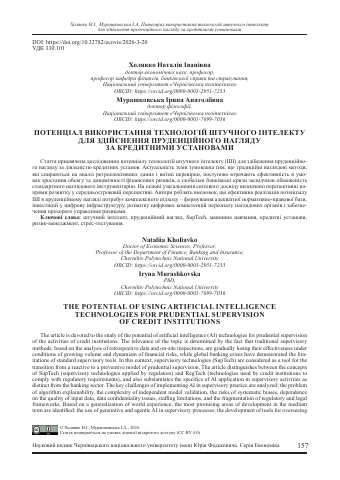
- Traditional supervisory methods based on retrospective data analysis and on-site inspections are losing effectiveness due to the dynamic nature of financial risks.p.1
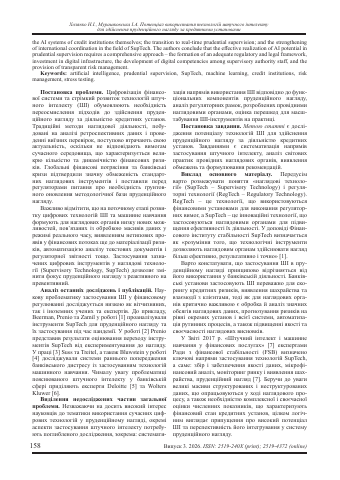
- SupTech tools enable supervisory authorities to transition from a reactive model to a preventive model of prudential supervision.p.2
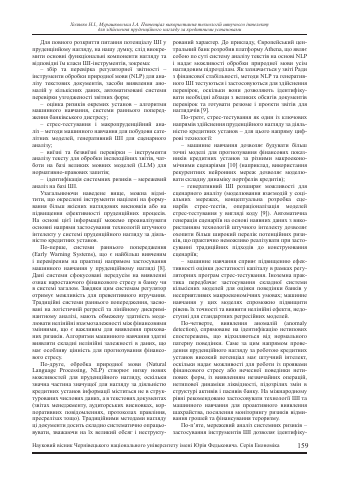
- Machine learning algorithms and Early Warning Systems facilitate the identification of non-linear dependencies and hidden financial stress before risks materialize.p.3
- A European digital bank developed 14 SupTech applications and platforms under a human-in-the-loop operational framework.p.4
- The Monetary Authority of Singapore established FEAT principles to define regulatory expectations for responsible AI adoption.p.5
- Medium-term SupTech priorities include real-time prudential supervision, agentic AI, and tools for overseeing credit institutions' own AI systems.p.5
Key insights
- SupTech differs from RegTech because it is used directly by regulators to increase supervision efficiency rather than by institutions for compliance.p.2
- Early Warning Systems based on machine learning improve early detection of financial stress compared to traditional linear regression models.p.3
- Generative AI expands stress testing capabilities by automating the creation of macroeconomic scenarios and operationalizing them into code.p.3
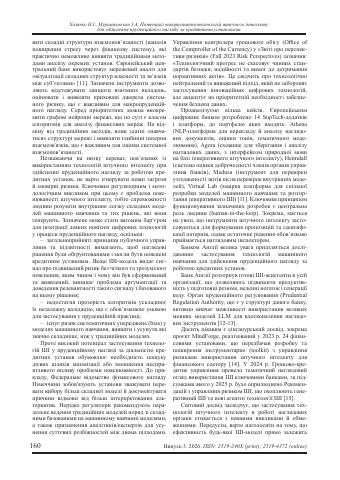
- Algorithm explainability represents a primary methodological challenge because public governance mandates transparent and justifiable supervisory decisions.p.4
- A human-in-the-loop approach ensures AI models generate recommendations while final decisions remain with human supervisory inspectors.p.4
- Real-time prudential supervision enables continuous monitoring by combining API data feeds, cloud computing, and AI algorithms.p.5
Pages
 p.1
 p.2
 p.3
 p.4
 p.5
 p.6
 p.7
Topics and entities
Summary and figures generated from the document and checked automatically: every number shown appears on the cited page. Publishers can request removal.