Common Policy Communication and Sovereign Yield Curves
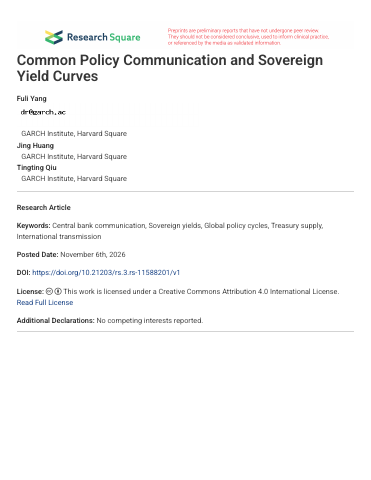
Between 2014-2019 and 2020-2025, two-year yield commonality rose from 45.2% to 56.4%, while ten-minus-two-year slope commonality declined from 66.7% to 56.4%.
Central bank · UN · 37 documents
Between 2014-2019 and 2020-2025, two-year yield commonality rose from 45.2% to 56.4%, while ten-minus-two-year slope commonality declined from 66.7% to 56.4%.
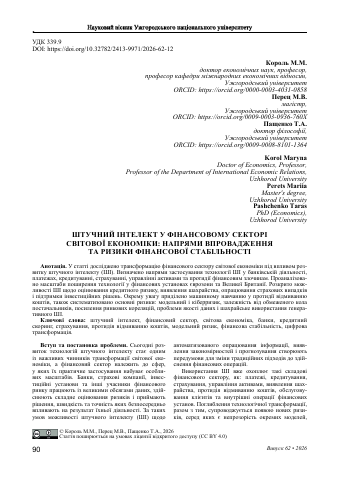
According to international surveys by the Bank for International Settlements, about 70% of financial sector companies use AI for cash flow forecasting and risk assessment.
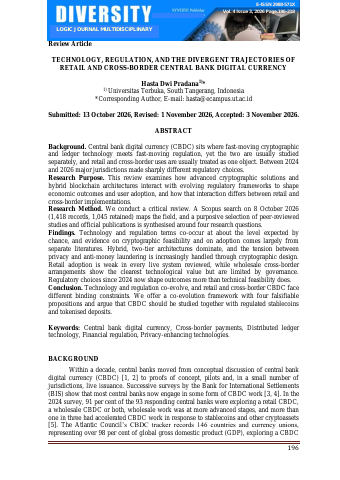
A Scopus bibliometric search conducted on 8 October 2026 retrieved 1,418 records, from which 1,045 were retained for critical analysis.
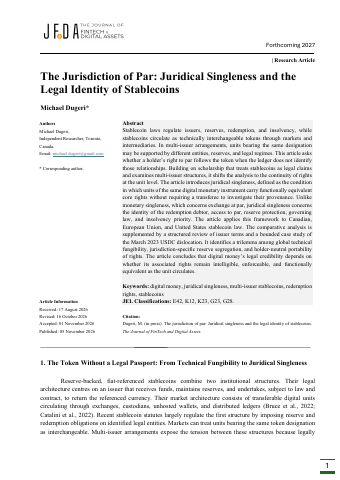
Expanding access to Tether's arbitrage mechanism reduced the absolute size of peg deviations by approximately one half.
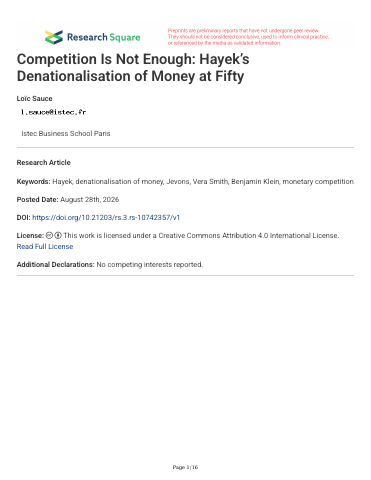
F. A. Hayek was awarded the Nobel Memorial Prize in 1974 jointly with Gunnar Myrdal, less than two years before the Institute of Economic Affairs published his monetary proposal in October 1976.
Traditional supervisory methods based on retrospective data analysis and on-site inspections are losing effectiveness due to the dynamic nature of financial risks.
Higher CBDC Readiness Index scores positively correlate with financial inclusion (β = 0.0042, p < .001).
In a March 2026 survey of 938 U.S. investors, 62% reported using AI tools for investment decisions, 22% used them to assist portfolio decisions, and 24% named "market herding" as a concern.
During 2022, the UK experienced three Prime Ministers alongside a peak inflation rate of 9.1%.
The UK tax gap deprives vital public services of approximately £46.8 billion in revenue annually.
The United Kingdom Parliament passed the Property (Digital Assets etc.) Act 2025, which came into force on December 2, 2025, establishing a legal basis for a third category of personal property.
The Financial Stability Board (FSB) identified 12 sound practices to help all financial institutions realise the benefits of AI while managing its risks responsibly.
A stocktake conducted by the FSB gathered 126 modernisation efforts from 24 jurisdictions and 3 SSBs across various financial sectors and entity types.
Only 4 (21%) of reviewed jurisdictions are fully compliant with KA 6, while 8 (42%) are materially non-compliant.
The FCA proposes splitting the equity consolidated tape income pool 50/50, reserving 50% for all eligible trading venues and APAs and 50% exclusively for CLOB and periodic auction trading systems.
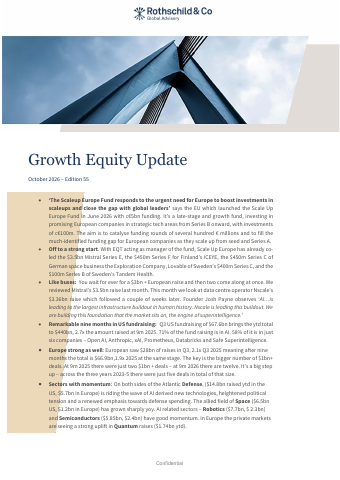
The EU launched the Scale Up Europe Fund in June 2026 with c€5bn funding to fill the late-stage funding gap for European tech companies.
In 1967, Barclays introduced an early automated teller machine (ATM) in the United Kingdom, establishing 24/7 self-service consumer banking access.
The automated processing level of regulatory reporting (SupTech) in Ukraine is projected to reach 72.8% in 2025, up from 31.0% in 2023.
Stock markets remained calm after the start of the conflict in Iran on February 28, 2026, with the S&P 500 gaining a maximum increase of 7% on May 10, 2026.
The aggregate monetary base of OECD countries increased from $2.5 trillion in 2000 to a peak of $25 trillion in March 2022.
UK private capital markets face a structural liquidity gap, with PE sponsors deploying capital at a 2.1x deployment-to-exit ratio between 2021 and 2025.
The note categorizes single-ledger arrangements into 4 operating models: integration, distribution, separation, and permissionless.
Over 90 percent of surveyed central banks are engaged in some form of CBDC work, with more than half involved in experiments or pilot projects.
Sweeping US import tariffs lifted the average effective US tariff rate to 18.0%, marking its highest point since 1934.
A total of 8 G20 members achieved the maximum 5/5 score for direct access of non-bank payment service providers (NBPSPs) to payment systems in 2025.
Research by Consumers International indicates that 57% of consumer bodies cite a lack of fee transparency as a primary reason behind consumer distrust in digital finance.
Eight G20 members achieved the full 5/5 direct access rating for non-bank payment service providers (NBPSPs) in 2025.
A total of 8 G20 members achieved the maximum 5/5 direct access rating for non-bank payment service providers in 2025.
The Boston Consulting Group estimates that asset tokenization could reach $16 trillion or 10 percent of global GDP by 2030.
The G20 Roadmap for Enhancing Cross-Border Payments (2020 - 2027) focuses on 5 main priority focus areas divided into 19 building blocks.
In Nigeria, 98.5 percent of eNaira wallets remained unused one year after launch.
Over 100 central banks around the globe are exploring central bank digital currencies to modernize payment systems.
Central banks must develop a long-term vision for monetary and payment systems spanning a time horizon of at least 5 to 10 years as economic digitalization accelerates.
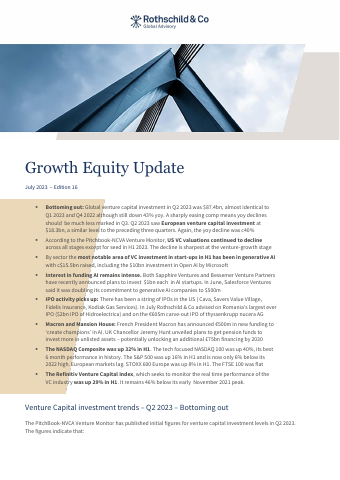
Global venture capital investment in Q2 2023 reached $87.4bn, down 43% yoy compared to $153bn in Q2 2022.
BigTech firms invested over $2 billion in fintech companies in 2020, with Alphabet generating 23 fintech investments alone.
The IMF note examines the institutional frameworks for fintech regulation and supervision across 10 selected jurisdictions.
E-money and i-money represent new forms of digital money competing directly with traditional cash and bank deposits.