Money Laundering - The Economic Impact and Its Implications
The Bangladesh Financial Intelligence Unit received 17,345 STR/SAR reports in FY2023–24, consisting of 11,736 STRs and 5,609 SARs.
442 documents
The Bangladesh Financial Intelligence Unit received 17,345 STR/SAR reports in FY2023–24, consisting of 11,736 STRs and 5,609 SARs.
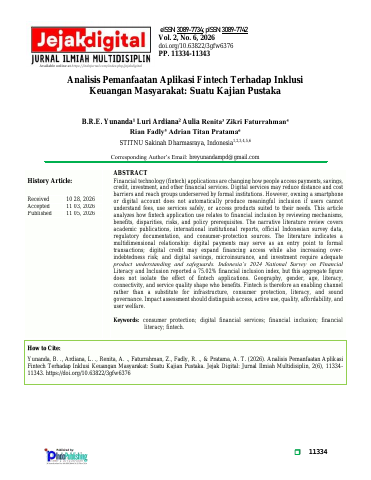
Indonesia's 2024 National Survey on Financial Literacy and Inclusion reported a 75.02% financial inclusion index.
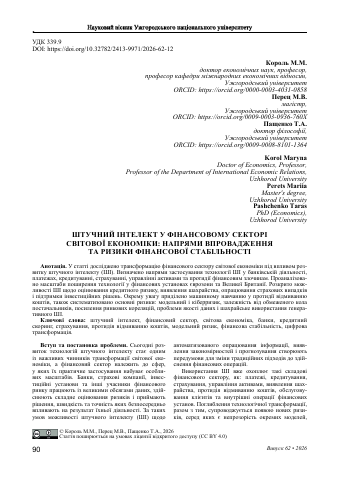
According to international surveys by the Bank for International Settlements, about 70% of financial sector companies use AI for cash flow forecasting and risk assessment.
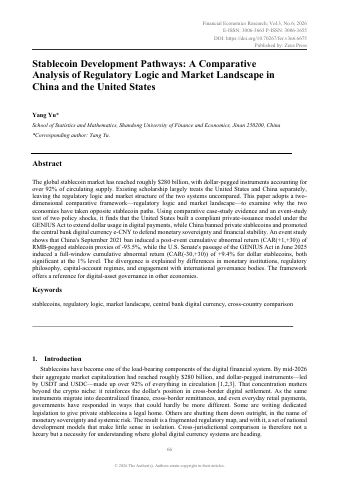
By mid-2026, the aggregate global stablecoin market capitalization reached roughly $280 billion, with dollar-pegged instruments comprising over 92% of circulating supply.
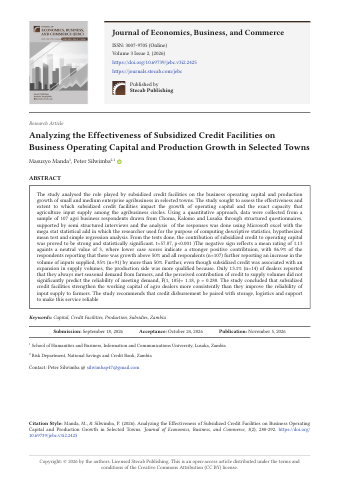
The study surveyed 107 agribusiness respondents across Choma, Kalomo, and Lusaka to assess how subsidized credit facilities impact working capital and production growth.
Deloof investigated working capital management and profitability using a sample of 1,009 Belgian non-financial companies observed between 1992 and 1996.
SWIFT diffusion among nearly 7,000 banks demonstrated that profitability benefits materialized only after several years of adoption.
Sanz Martin et al. (2026) synthesised 256 articles to highlight transparency, ethics, security, and skills in AI accounting research.
Global climate finance reached approximately USD 1.46 trillion in 2022 according to Climate Policy Initiative estimates.
Between 1 January 2021 and 1 January 2026, total banking assets in Uzbekistan grew from UZS 366.1 trillion to UZS 925.0 trillion, achieving a compound annual growth rate of 20.4 percent.
The sample hedge funds report an average monthly AUM of $396.773 million, a average monthly rate of return of 0.564%, and a monthly 7-factor alpha of 0.144%.
Purposive sampling selected 78 basic materials companies listed on the Indonesia Stock Exchange, yielding 390 company-year observations from 2021 to 2025.
An estimated €4 trillion is laundered annually worldwide, with only around 1-2 per cent successfully confiscated under existing compliance frameworks.
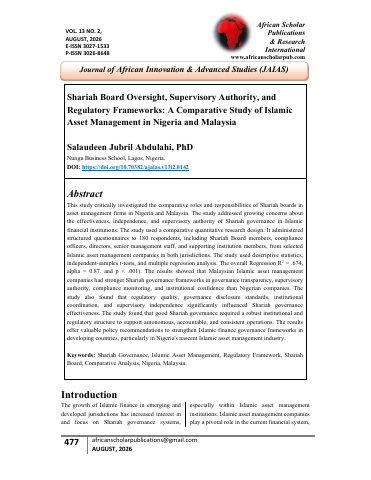
The study analyzed Shariah governance using a sample of 180 respondents from Islamic asset management institutions in Nigeria and Malaysia.
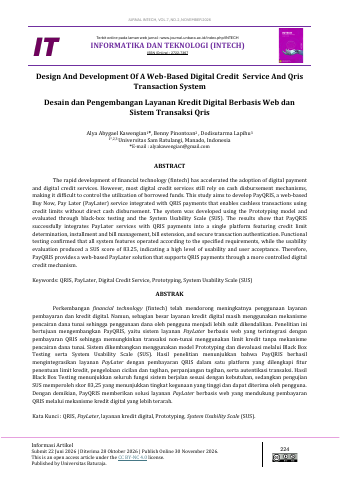
The PayQRIS system achieved a System Usability Scale (SUS) score of 83.25, indicating high usability.
Bonus abuse accounts for approximately 70% of all fraud events caught by automated anti-fraud tooling.
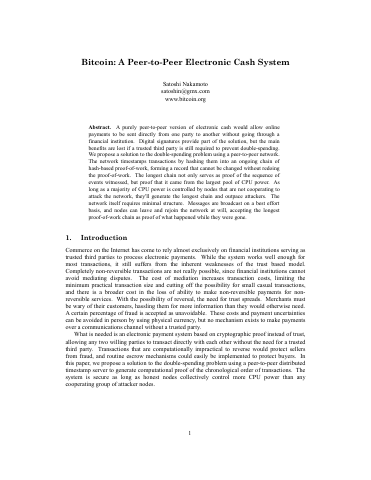
A block header without any transactions requires approximately 80 bytes of storage.
Data collection conducted between February and June 2025 yielded 500 initial survey responses, resulting in a final sample of 328 valid responses after screening [p.9].
The study evaluates cryptocurrency exchange service quality across 20 sub-criteria derived from 4 main dimensions of the ES-QUAL scale.
Extreme weather events like heatwaves occur three times more frequently globally than during the pre-industrial era.
The study analyzes an unbalanced panel of 91 observations from 25 basic materials and energy companies during 2020–2024.
Real GDP growth in Bangladesh slowed significantly to 5.8 percent in FY23 from 7.1 percent in FY22, weighed down by weak private consumption and investment.
Machine-learning algorithms and behavioural analytics enable financial institutions to detect digital banking fraud at scale beyond conventional rule-based systems.
Cross-Border Interbank Payment System (CIPS) daily usage was reported at about $60 billion compared to about $1,800 billion a day for CHIPS, with about 80 percent of CIPS payments still using Swift messaging.
The research article published in Vol. 2 No. 4 (2026) develops a theoretical risk-return framework to evaluate Islamic microfinance institutions in the post-digital transformation era.
The World Bank Firm Adoption of Technology Survey analytical dataset for India comprises 1,519 establishments and 987 variables.
South Africa was removed from the Financial Action Task Force list of jurisdictions under increased monitoring on 24 October 2025 following statutory reforms.
Principle 6 specifies that every activity, entity, and outsourced function of a bank must fall within the overall scope of internal audit.
An initial literature search across scholarly databases yielded 150 articles at the first stage.
The systematic review synthesises 50 highly relevant studies selected from a total pool of 615 candidate records published between 2014 and 2025.