Bitcoin: A Peer-to-Peer Electronic Cash System (Potchefstroom Electronic Law Journal/Potchefstroomse Elektroniese Regsblad)
Summary
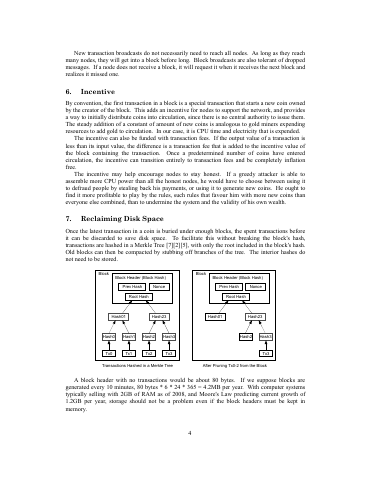
- A block header without any transactions requires approximately 80 bytes of storage.p.4
- Calculating 80 bytes * 6 * 24 * 365 yields an annual storage requirement of 4.2MB for block headers.p.4
- As of 2008, computer systems typically sold with 2GB of RAM, with Moore's Law predicting growth of 1.2GB per year.p.4
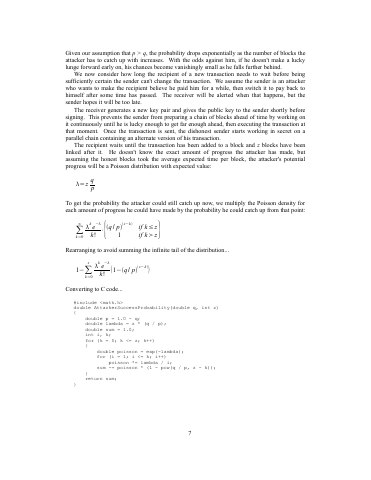
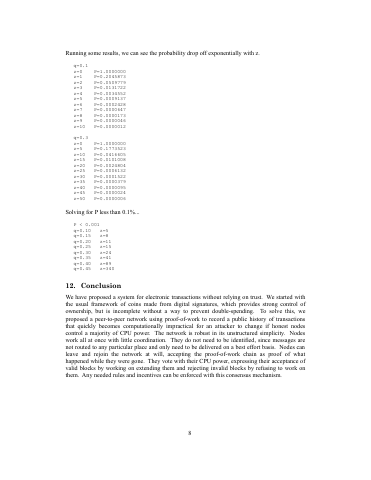
- For an attacker with q = 0.1, the probability of catching up drops to 0.0009137 when z = 5 blocks behind.p.8
- To achieve an attacker success probability P < 0.001 with q = 0.10, a recipient needs to wait for z = 5 blocks.p.8
- When an attacker controls q = 0.30 of CPU power, reaching P < 0.001 requires waiting for z = 24 blocks.p.8
- If an attacker holds q = 0.45 of CPU power, securing P < 0.001 requires waiting for z = 340 blocks.p.8
Key insights
- Peer-to-peer electronic cash allows direct online payments between parties without passing through a central financial institution.p.1
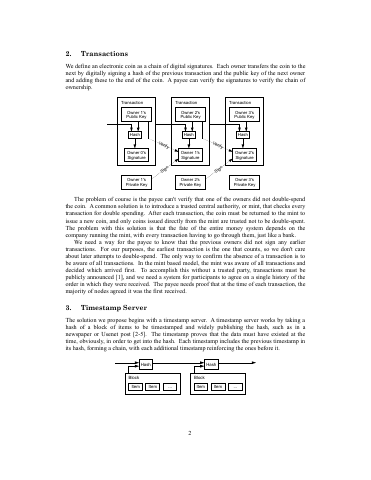
- Electronic coins are structured as chains of digital signatures where each owner signs a hash of the prior transaction and the next owner's public key.p.2
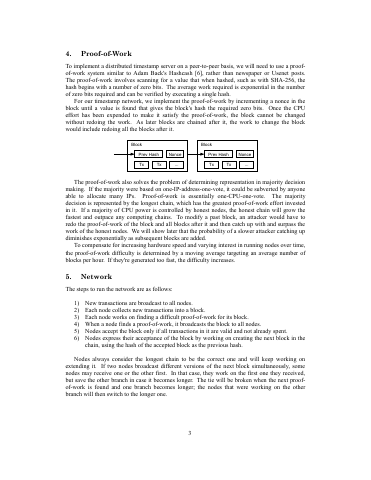
- Proof-of-work replaces single IP-address voting with a one-CPU-one-vote system to determine network majority decision making.p.3
- Network nodes continuously accept and build upon the longest proof-of-work chain as the authoritative history of transactions.p.3
- Initial coin distribution and node incentives are provided through block reward transactions analogous to gold mining.p.4
- Disk space is reclaimed by hashing transactions into a Merkle Tree and stubbing off spent branches.p.4
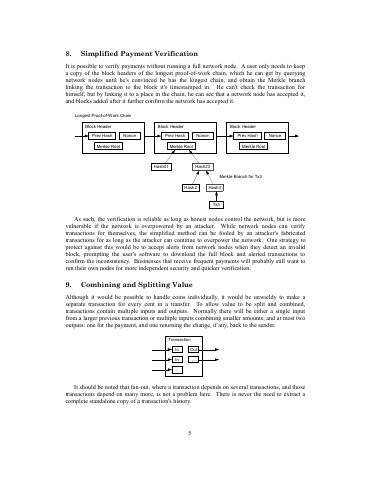
- Simplified Payment Verification permits users to confirm payments using only block headers and Merkle branches without operating a full node.p.5
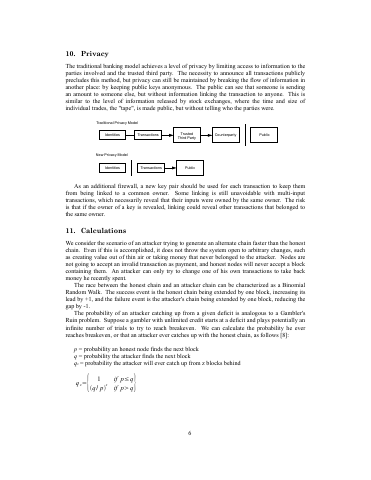
- Privacy is maintained by keeping public keys anonymous while publishing transaction times and sizes openly.p.6
- The likelihood of a dishonest node catching up to the honest chain diminishes exponentially with each block added.p.7
Pages
 p.1
 p.2
 p.3
 p.4
 p.5
 p.6
 p.7
 p.8
 p.9
Topics and entities
Summary and figures generated from the document and checked automatically: every number shown appears on the cited page. Publishers can request removal.