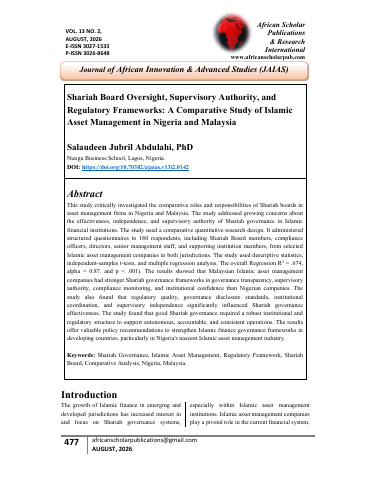
Shariah Board Oversight, Supervisory Authority, and Regulatory Frameworks: A Comparative Study of Islamic Asset Management in Nigeria and Malaysia (Journal of African Innovation and Advanced Studies)
Summary
- The study analyzed Shariah governance using a sample of 180 respondents from Islamic asset management institutions in Nigeria and Malaysia.p.8
- The research surveyed personnel across 6 Islamic asset management companies in Malaysia and 4 in Nigeria.p.8
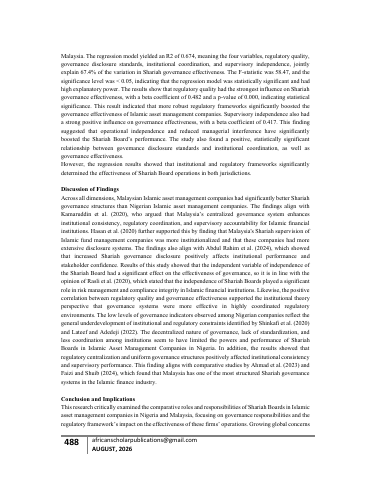
- Multiple regression analysis established that regulatory and institutional variables explain 67.4% of the variance in Shariah governance effectiveness (R2 = .674).p.1
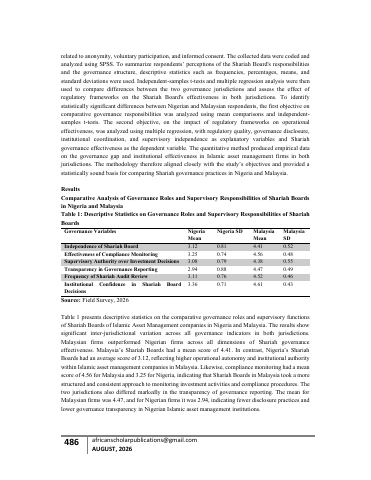
- Malaysian Islamic asset management firms recorded a mean score of 4.41 for Shariah Board independence compared to 3.12 for Nigerian firms.p.10
- Governance reporting transparency yielded a mean score of 4.47 for Malaysian companies versus 2.94 for Nigerian companies.p.10
Key insights
- Malaysian Islamic asset management firms achieved consistently higher scores across all dimensions of Shariah governance than Nigerian firms.p.10
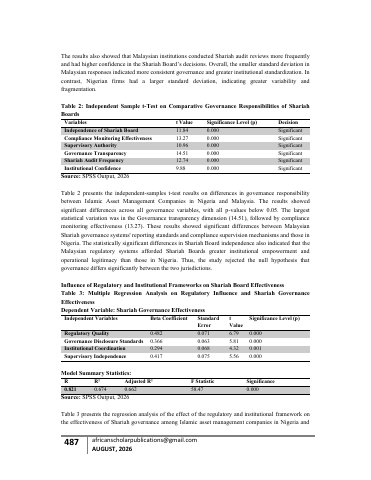
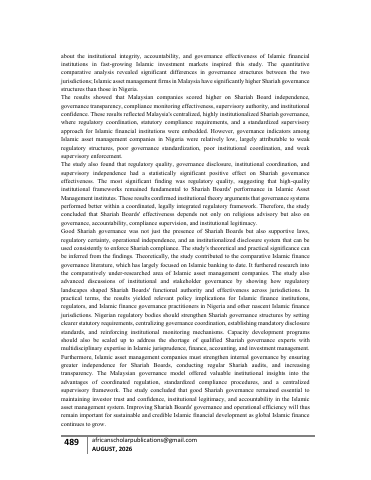
- Independent-samples t-tests confirmed statistically significant differences across all Shariah governance variables between Nigeria and Malaysia.p.11
- Regulatory quality proved to be the single most influential factor driving the operational effectiveness of Shariah governance.p.12
- Supervisory independence significantly increased Shariah Board performance by insulating operations from managerial interference.p.12
- Governance decentralization and lack of regulatory standardization in Nigeria constrained the authority and performance of local Shariah Boards.p.12
- The centralized regulatory model in Malaysia enhanced institutional consistency, supervisory accountability, and compliance coordination.p.13
Pages
 p.1
 p.2
 p.3
 p.4
 p.5
 p.6
 p.7
 p.8
 p.9
 p.10
 p.11
 p.12
 p.13
 p.14
 p.15
Topics and entities
Summary and figures generated from the document and checked automatically: every number shown appears on the cited page. Publishers can request removal.