Tokenization of Real-World Assets and Financial Market Transformation: A Review of Literature
The systematic literature review synthesized 25 peer-reviewed research works published between 2015 and 2026 to evaluate RWA tokenization.
163 documents
The systematic literature review synthesized 25 peer-reviewed research works published between 2015 and 2026 to evaluate RWA tokenization.
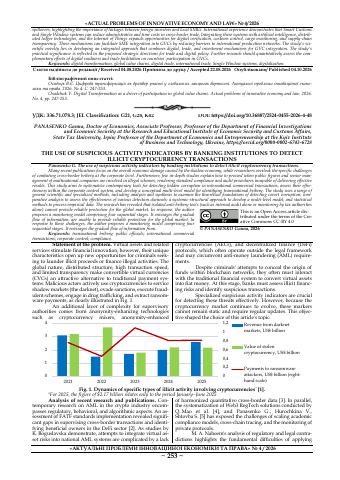
The author proposes a monitoring model comprising 4 sequential stages to enable the gradual flow of information in detecting money laundering [p.1].
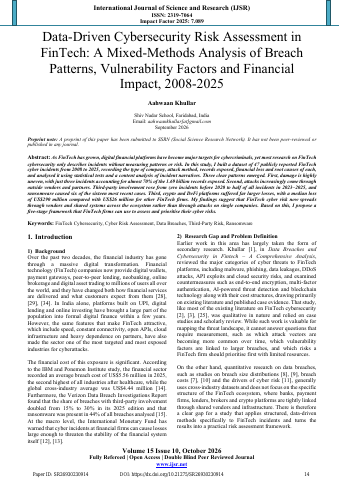
The study analyzes a dataset of 47 publicly reported FinTech cyber incidents occurring between 2008 and 2025.
Digital finance has transformed financial services while expanding the cyber-attack surface across banking, FinTech platforms, and decentralized systems [p.1].
The document dataset involved 177 authors with an average citation rate of 18.79 per document and an average age of 3.56 years.
The research conducted a systematic review following the PRISMA framework starting with an initial pool of 322 articles on blockchain and AI convergence.
Growth halved across B2B cross-border payout cohorts between 2023 and 2025, with enterprise payout fintechs showing better margin performance.
Corporate stablecoin adoption live in production doubled from 9% in 2025 to 18% in 2026.
European Crypto ETPs recorded $55.1M in aggregate net inflows in October 2026, bringing 2026 YTD net inflows to $1’693.8M.
India records over 40 billion UPI transactions annually, positioning it as a leader in fintech adoption.
In 1967, Barclays introduced an early automated teller machine (ATM) in the United Kingdom, establishing 24/7 self-service consumer banking access.
Aquafarming contributes approximately 30% to total fish production in Malaysia.
European Crypto ETPs captured $104 .5M in aggregate net inflows in September 2026, bringing YTD totals to $1.6B.
Stock markets remained calm after the start of the conflict in Iran on February 28, 2026, with the S&P 500 gaining a maximum increase of 7% on May 10, 2026.
A systematic bibliometric review analyzed 166 Scopus indexed publications from 1991 to 2025 using Biblioshiny and VOSviewer.
The global FinTech market is projected to reach 938–1250 млрд дол. США in the 2026–2035 period.
By early 2026, Kalshi surpassed $1 billion in trading volume on Super Bowl Sunday as the prediction market industry grew nearly 400% year-on-year.
Applying three inclusion criteria narrowed the primary analytical corpus down to 5 officially published rulings issued between 2017 and 2021.
Swiss real GDP growth is projected to reach 1,0 Prozent in 2026 and 1,4 Prozent in 2027.
A survey of 500 Russian technology companies by Baza.vc showed that 62% had not raised external financing, 29% received investments, and 10% obtained loans.
Primary microdata was collected from 1,653 university students to evaluate the determinants of Generation Z financial literacy across Spain and Ecuador.
Retail banking delivered an annual return of 15.83 percent compared to minus 23.18 percent for FinTech disruptors.
Between 1950 and the present, aggregate per capita national wealth in France, Germany, Italy, and Spain multiplied by 18 times, rising from 37% to 83% of US per capita national wealth.
Fair value losses on banks' available-for-sale and held-to-maturity securities portfolios totaled $300 billion combined at the end of 2025.
In the Riksbank's survey, 91 per cent of respondents used Swish in the past month, making mobile payments increasingly widespread.
Digital payment transactions in the European Union increased from 4.8% of total transactions in 2007 to 73.3% in 2014.
The report presents findings from 307 family offices across more than 30 markets worldwide, with an average net worth of USD 2.7 billion.
Ethereum ETH held by active validators reached an all-time high of 43.80 million ETH in Q3 2026, representing 35.9% of the total ETH supply.
Bitcoin's rolling three-month volatility averaged around 38% after US spot ETFs launched in January 2024, compared to close to 60% before 2024.
Thirty-two percent (32%) of advisors reported allocating to crypto in client accounts in 2025, an all-time high up from 22% in 2024.