Integrating Artificial Intelligence and Islamic Commercial Law to Enable Online Transactions Free of Gharar (Iqtishod.)
Summary
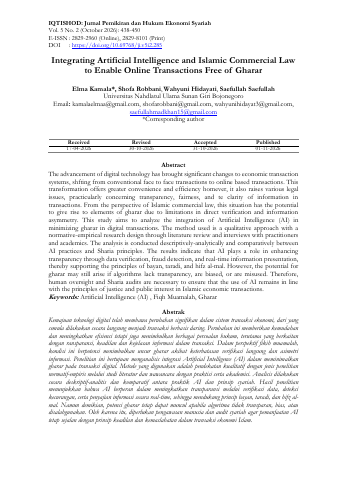
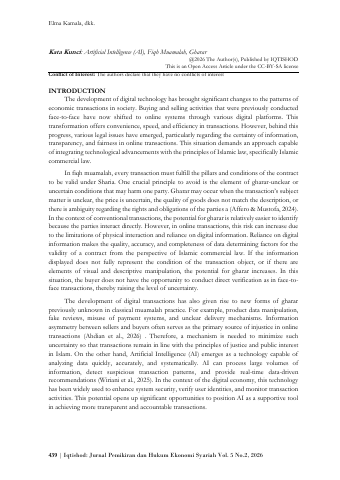
- Digital online transactions create legal risks around transparency and information asymmetry, increasing the potential for gharar (uncertainty) in contracts.p.1
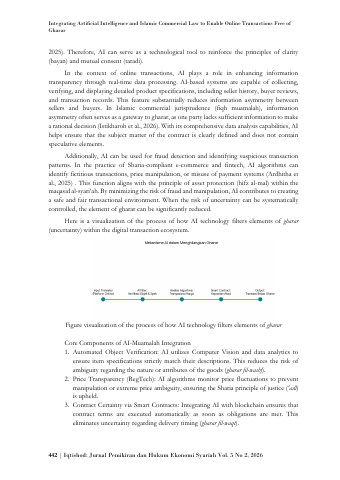
- Artificial Intelligence can process large data volumes in real time to verify product specifications, track seller history, and reduce information asymmetry.p.5
- The conceptual framework identifies 4 core components of AI-Muamalah integration: automated object verification, price transparency, contract certainty via smart contracts, and Sharia compliance detection.p.5
- Because AI lacks intent (qasd) and free will (iradah), legal liability for automated errors remains with platform developers, owners, or approving users.p.7
- Unclear dynamic pricing algorithms, biased data, and black-box AI systems introduce new forms of major gharar (gharar fahish) into digital contracts.p.9
- The authors recommend establishing a Sharia-based AI governance model featuring algorithmic transparency, pricing fairness, Sharia audits, and human oversight.p.11
Key insights
- Artificial Intelligence acts as a tool (wasilah) to facilitate clarity and fairness rather than as an independent legal subject under Islamic commercial law.p.6
- Integrating AI with smart contracts ensures automated execution occurs only after all essential contract terms and obligations are verified.p.5
- In digital commerce, uncertainty shifts from physical goods to algorithmic transparency, platform security, and descriptive data accuracy.p.8
- Legal responsibility cannot be shifted to automated algorithms because technology lacks the capacity of mukallaf required for accountability.p.7
- Data bias in AI models creates systemic disparities in financing assessments, violating the core Sharia principle of justice ('adl).p.10
- Dynamic pricing mechanisms lacking clear user parameters risk escalating uncertainty into prohibited major gharar (gharar fahish).p.9
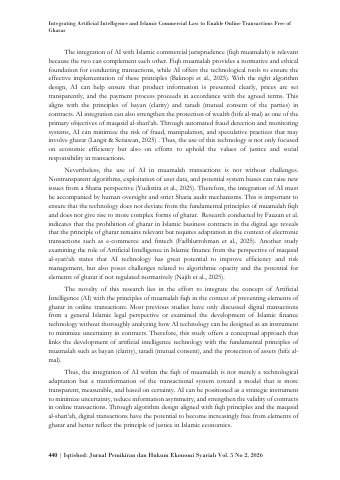
- Human oversight and periodic Sharia audits are necessary to prevent algorithmic systems from deviating into speculative or manipulative practices.p.3
Pages
 p.1
 p.2
 p.3
 p.4
 p.5
 p.6
 p.7
 p.8
 p.9
 p.10
 p.11
 p.12
 p.13
Topics and entities
Summary and figures generated from the document and checked automatically: every number shown appears on the cited page. Publishers can request removal.