State, Regions and Strategic Governance in Europe and India: Land Tokenisation and AI Stack in Finance
India's UPI digital public infrastructure processes 14 billion transactions monthly.
314 documents
India's UPI digital public infrastructure processes 14 billion transactions monthly.
On a 30,000-event synthetic stream with a 2.40% overall fraud rate, the proposed dual-horizon FPAA model achieves an average precision of 0.427 ± 0.038 across three training seeds.
According to international surveys by the Bank for International Settlements, about 70% of financial sector companies use AI for cash flow forecasting and risk assessment.
Sanz Martin et al. (2026) synthesised 256 articles to highlight transparency, ethics, security, and skills in AI accounting research.
The CBI identified more than 8.5 lakh mule accounts used in cyber fraud.
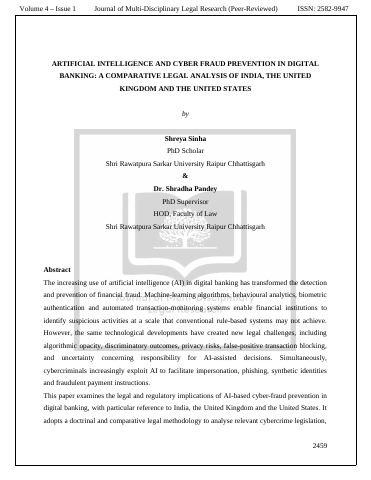
Machine-learning algorithms and behavioural analytics enable financial institutions to detect digital banking fraud at scale beyond conventional rule-based systems.
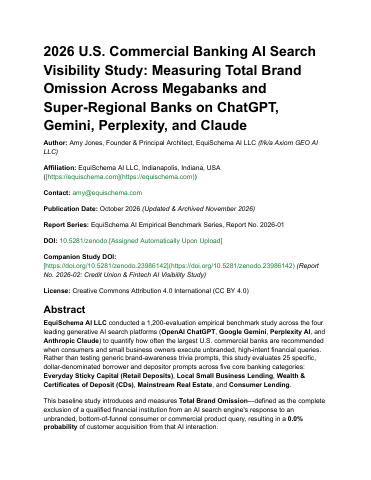
Super-Regional banks recorded a 0.0% visibility rate across all 192 evaluations for pure rate-driven retail savings, money market, and CD queries.
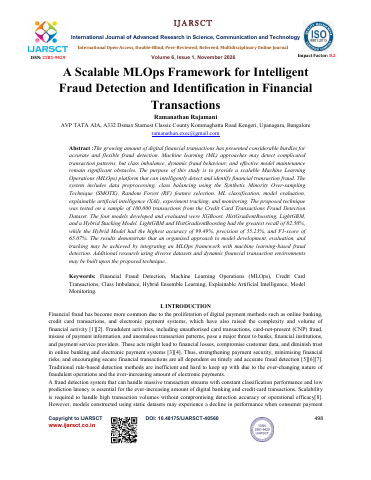
The study develops a scalable MLOps framework evaluated on 100,000 transactions sampled from the Credit Card Transactions Fraud Detection Dataset.
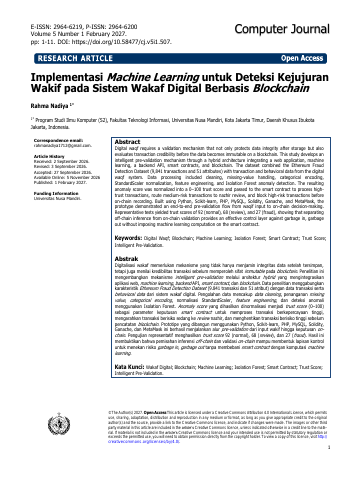
The study integrated the Ethereum Fraud Detection Dataset containing 9,841 transactions and 51 attributes with digital waqf system behavioral data.
The empirical study surveyed 256 corporate employees in Bengaluru to examine how trust in generative AI shapes financial decision-making.
The study evaluates distressed bank acquisition decisions across 55 FDIC-assisted acquisitions conducted between 2008 and 2024 by U.S.-listed acquiring institutions.
The proposed Extreme Gradient Boosting (XGBoost) model achieved a highest accuracy of 97.2% in differentiating legitimate and suspicious banking transactions.
Smallholders cultivating less than 2 hectares make up the majority of the rural agricultural workforce in India.
The Non-Compensatory Multimetric Framework (NCMF) is validated on 2 real technology initiatives of a leading insurance group [p.1].
The DRL-PPO strategy generated an annualized return of 37.22% under a 0.1% transaction cost constraint.
Gartner forecast generative AI spending of $644 billion for 2025, even as OpenAI reported 800 million weekly ChatGPT users in October 2025.
Financial fraud imposes estimated annual global losses exceeding $5.1 trillion, while digital payment fraud grows at over 30% per year.
UPI Fraud Shield is a prototype designed to monitor digital payment fraud in real time using tabular learning, graph neural networks, explainable AI, and an early-warning layer.
The study evaluates the impact of deploying artificial intelligence techniques to predict financial and administrative risks at the International Development Bank for Investment and Finance over the period 2015–2024.
Deep-π* models trend inflation by mapping 122 macroeconomic indicators through neural networks into trend innovations, eliminating latent random-walk shocks and enabling exact Shapley attribution.
Fin-HVA mathematically certifies autonomous agent decisions, eliminating safety violations (0.0% Violation Rate) with task success rates above >94% and step latency below <1.3s.
Generation Z (born 1995–2010) represents the primary target demographic for early-stage AI companion hardware startups.
The Anti-Money Laundering Tracker models transaction networks using the IBM AMLSim synthetic dataset, which includes approximately 9,945 account records and 68,289 transactions.
In 2023, roughly 666 million people lived without access to electricity, with 85 percent of them located in Sub-Saharan Africa.
The study population comprises 96 fintech companies licensed in Saudi Arabia by the Saudi Arabian Monetary Authority.
The conceptual study evaluates regulatory compliance and financial regulation issues in cross-border financial data flows, published in Volume 10, Number 10 of the journal.
The proposed deep learning ensemble combined with the SMOTE-ENN method achieved a sensitivity of 1.000 and a specificity of 0.997.
As of December 2025, India has approximately 21.6 crore demat accounts, with 17.3 crore held at CDSL and 4.3 crore at NSDL.
The proposed hybrid AI system was trained and evaluated on a transaction dataset containing more than 6 million records with transaction time steps ranging from 0 to 743.
Mutual funds collect capital from multiple investors to purchase pooled baskets of stocks, bonds, and monetary assets.