AgriVerse: An AI-Driven Agri-FinTech Decision Intelligence Platform (Zenodo (CERN European Organization for Nuclear Research))
Summary
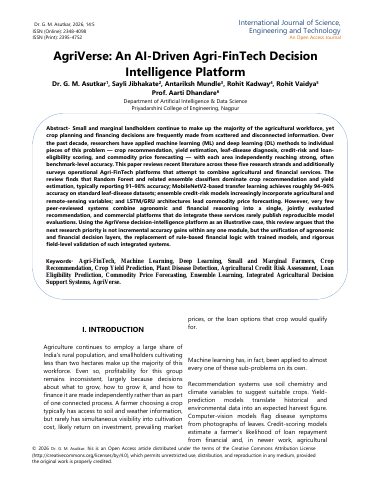
- Smallholders cultivating less than 2 hectares make up the majority of the rural agricultural workforce in India.p.1
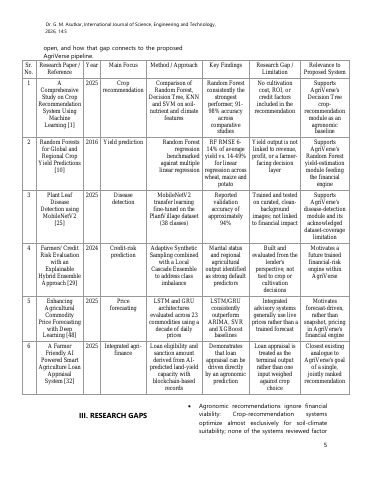
- Random Forest and related ensemble classifiers dominate crop recommendation and yield estimation, typically reporting 91–98% accuracy.p.1
- MobileNetV2 transfer learning achieves roughly 94–96% accuracy on standard plant leaf-disease datasets.p.1
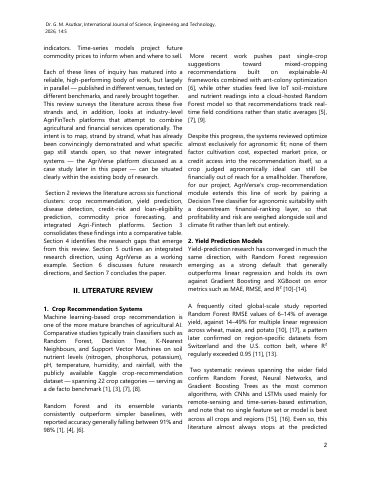
- Random Forest yield prediction models achieved RMSE values of 6–14% of average yield, compared to 14–49% for multiple linear regression across wheat, maize, and potato.p.2
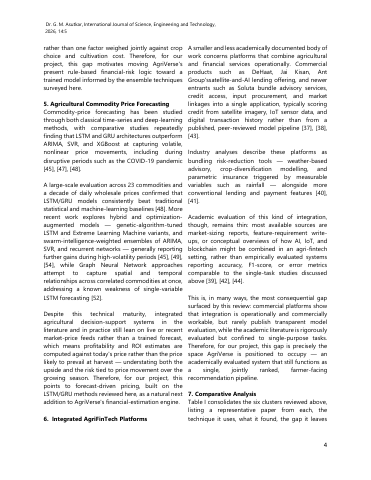
- Evaluating commodity price forecasting across 23 commodities and a decade of daily wholesale prices showed that LSTM/GRU models consistently beat traditional baselines.p.4
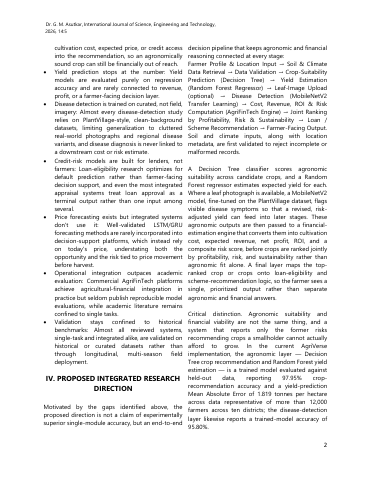
- AgriVerse achieves 97.95% crop-recommendation accuracy and a yield-prediction Mean Absolute Error of 1.819 tonnes per hectare across data representing over 12,000 farmers in ten districts.p.6
Key insights
- Agronomic decision support systems frequently optimize for soil and climate fit while failing to include cultivation cost, ROI, or market price into recommendations.p.2
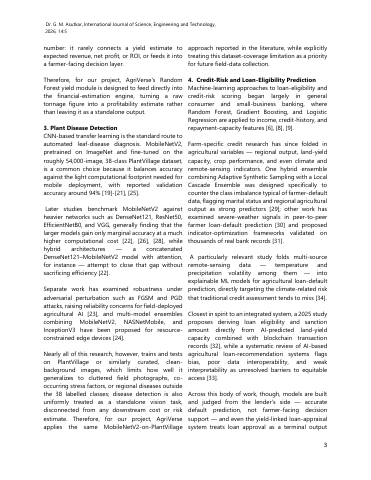
- Leaf disease detection models trained on clean-background datasets like PlantVillage struggle to generalize to cluttered field photographs and regional stress factors.p.3
- Credit scoring research in agriculture is primarily designed to minimize default risk for lenders rather than provide actionable decision support for farmers.p.3
- Deep learning architectures like LSTM and GRU outperform traditional statistical models in capturing volatile and nonlinear commodity price fluctuations.p.4
- Commercial Agri-FinTech platforms successfully integrate advisory and financial services operationally but rarely publish transparent, peer-reviewed model evaluations.p.4
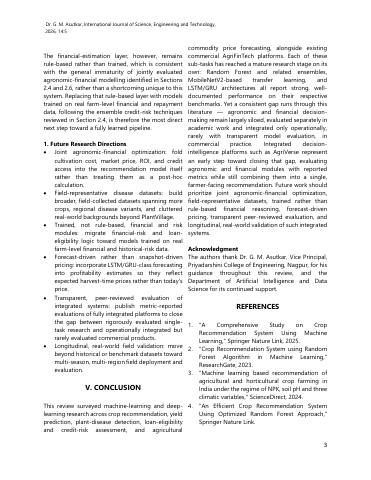
- AgriVerse connects agronomic predictions directly to a financial-estimation engine to rank crops jointly by profitability, risk, and sustainability.p.6
Pages
 p.1
 p.2
 p.3
 p.4
 p.5
 p.6
 p.7
 p.8
 p.9
Topics and entities
Summary and figures generated from the document and checked automatically: every number shown appears on the cited page. Publishers can request removal.