From Emotional Impulse to Recurring Revenue: Consumer Psychology, Unit Economics, and VC Investment Evaluation of AI Companion Hardware for Gen Z (Advances in Economics Management and Political Sciences)
What changed
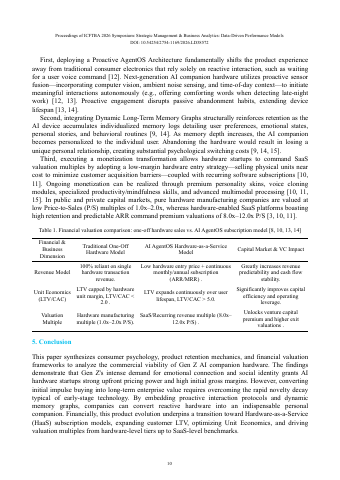
< 2.0 to > 5.0
LTV/CAC ratio shift from traditional model to Hardware-as-a-Service model p.4
Summary
- Generation Z (born 1995–2010) represents the primary target demographic for early-stage AI companion hardware startups.p.1
- Emotional safety needs allow AI hardware startups to command retail prices of $100–$250 and initial gross margins exceeding 60%.p.2
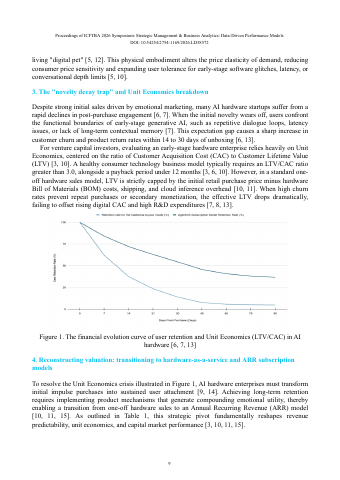
- Consumer AI hardware experiences steep novelty decay within 14 to 30 days post-purchase, driving user churn rates above 70%.p.2
- A sustainable consumer technology business model requires an LTV/CAC ratio greater than 3.0 and a payback period under 12 months.p.3
- Traditional one-off hardware sales result in LTV/CAC ratios below 2.0, whereas Hardware-as-a-Service models achieve LTV/CAC ratios above 5.0.p.4
- Shifting to an Annual Recurring Revenue (ARR) model expands venture capital valuation multiples from 1.0x–2.0x P/S to 8.0x–12.0x P/S.p.4
Key insights
- Gen Z's demand for loneliness compensation grants AI hardware startups strong upfront pricing power and gross margins exceeding 60%.p.2
- Organic sharing of novel AI hardware on social media platforms lowers initial Customer Acquisition Costs (CAC) through viral referral loops.p.2
- Severe novelty decay leads to user churn rates exceeding 70% within 14 to 30 days after unboxing.p.2
- One-off hardware sales cap Customer Lifetime Value (LTV) at initial product unit margins, causing Unit Economics to break down under high cloud and acquisition costs.p.3
- Proactive AgentOS architectures and dynamic memory graphs increase user switching costs by building personalized relational history.p.4
- Adopting a Hardware-as-a-Service subscription model lifts company valuation multiples from hardware tiers of 1.0x–2.0x P/S to SaaS levels of 8.0x–12.0x P/S.p.4
Pages
 p.1
 p.2
 p.3
 p.4
 p.5
Topics and entities
Summary and figures generated from the document and checked automatically: every number shown appears on the cited page. Publishers can request removal.