Buyout and Growth in Finland 2025
Finnish buyout and growth investors raised €535 million in new capital in 2025, representing a 47% decrease compared to the previous year.
1,216 documents
Finnish buyout and growth investors raised €535 million in new capital in 2025, representing a 47% decrease compared to the previous year.
The quantitative field study surveyed 400 stratified random-sampled bank employees in Zimbabwe using a Likert-scale questionnaire to measure the impact of digital process technologies.
The study collected survey data from 100 equity crowdfunding investors in Indonesia using a five-point Likert scale.
In India, lenders' aggregate exposure across all NBFC-P2P lending platforms is capped at INR 5 million.
South Africa recorded the highest Regulatory Readiness Index score of 75.0% among the four African jurisdictions evaluated.
Aquafarming contributes approximately 30% to total fish production in Malaysia.
Financial institutions globally must track and implement an average of 257 regulatory changes per day.
The UK tax gap deprives vital public services of approximately £46.8 billion in revenue annually.
The study analyzes a balanced panel dataset of 27 countries covering a total of 135 annual observations.
Cryptoasset seizures in criminal investigations by Brazil's Federal Police reached a record R$ 71 million in 2025.
The Insurance Authority launched the TAMEEN digital portal in February 2025 with 36 licensing, approval, supervisory and regulatory services.
The study conducted qualitative in-depth interviews with 26 FinTech users across Kano (14) and Abuja (12) to examine digital payment experiences.
More than 70% of startups in Colombia do not survive beyond five years of existence due to limited financing and administrative constraints.
The conceptual study was published in Vol. 16, No. 9 in September 2026.
The study analyzes institutional, socioeconomic, and human capital factors affecting enterprise income in the canton of Quevedo, Ecuador.
The United Kingdom Parliament passed the Property (Digital Assets etc.) Act 2025, which came into force on December 2, 2025, establishing a legal basis for a third category of personal property.
World Bank data shows that 1.4 billion adults worldwide lack bank accounts, while approximately 1.1 billion of them own mobile phones.
The long-run FMOLS and DOLS models accounted for 79.6% of the variation in commercial banks' Return on Assets.
From 364 documents retrieved from Scopus, the PRISMA 2020 protocol led to selecting 42 articles for bibliometric and thematic analysis.
The study selected 5 private banking companies resulting in 35 observation data points from an initial population of 48 listed banks on the Indonesia Stock Exchange for the 2018–2024 period.
Total costs for stablecoin cross-border remittances range between 0.5% and 3.0%, compared to 9.50% for traditional banking channels.
Global AI investment was projected to approach USD 200 billion by 2025, accounting for 2.5% to 4% of U.S. GDP.
Digital finance has transformed financial services while expanding the cyber-attack surface across banking, FinTech platforms, and decentralized systems [p.1].
The adult account ownership rate in Morocco stands at approximately 53%, reflecting ongoing progress alongside notable urban-rural and gender disparities.
The document dataset involved 177 authors with an average citation rate of 18.79 per document and an average age of 3.56 years.
Satgas PASTI stopped 242 illegal investment entity offers between January and August 2026.
Digital payment adoption reduces transaction costs and administrative duties, but introduces risks of resource centralization without institutional checks [p.1].
The AFMJ journal issue reports an Impact Factor of 8.167 for this publication on banking value creation.
The survey reviews a locked corpus of 25 papers published between 1 January 2025 and 30 September 2026 to evaluate AI evidence in personal finance.
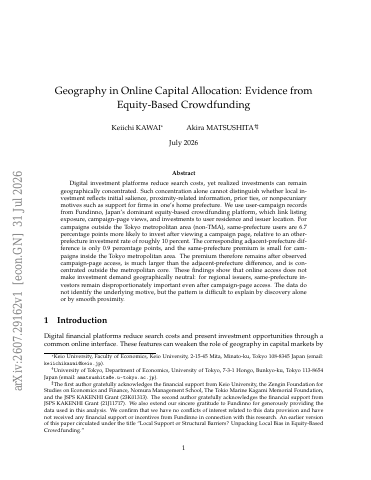
Regulatory constraints capped ordinary retail investor contributions at ¥500,000 per issuer, while firm fundraising through equity crowdfunding was limited to below ¥100 million per year.