A Conceptual Framework of Blockchain Technology and Bank Performance: A Resource Orchestration Perspective (International Journal of Academic Research in Business and Social Sciences)
Summary
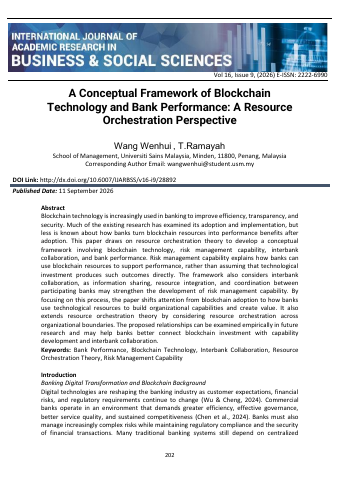
- The conceptual study was published in Vol. 16, No. 9 in September 2026.p.1
- The framework incorporates 4 core constructs to explain post-adoption blockchain value in commercial banking.p.8
- Bank performance is evaluated across 2 distinct dimensions: financial performance and market performance.p.6
- Resource orchestration theory details 3 processes required for value creation: structuring, bundling, and leveraging resources.p.7
- The authors set forth 4 theoretical propositions connecting blockchain technology, risk management capability, collaboration, and performance.p.8
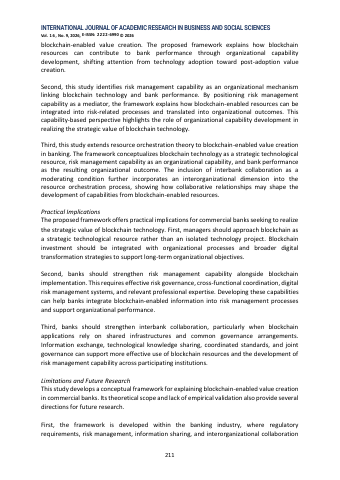
- The paper outlines 3 main theoretical contributions to advance blockchain literature beyond initial adoption.p.10
Key insights
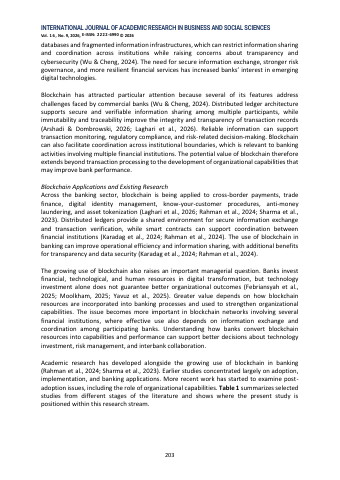
- Blockchain adoption alone does not guarantee performance gains unless technological resources are built into organizational capabilities.p.2
- Consortium blockchains provide joint governance and controlled privacy suitable for multi-bank operational workflows.p.5
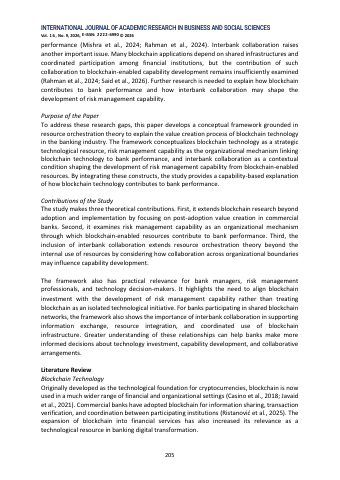
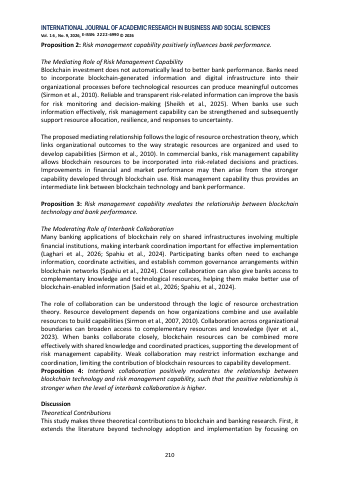
- Risk management capability mediates the relationship between blockchain technology investments and overall bank performance.p.9
- Interbank collaboration positively moderates the development of risk management capability from blockchain resources.p.9
- Resource orchestration theory shifts theoretical focus from technology possession to active bundling and deployment of capabilities.p.7
- Multi-institution banking networks depend on shared standards, transparent information exchange, and joint governance arrangements.p.6
Pages
 p.1
 p.2
 p.3
 p.4
 p.5
 p.6
 p.7
 p.8
 p.9
 p.10
 p.11
 p.12
 p.13
 p.14
 p.15
 p.16
Topics and entities
Summary and figures generated from the document and checked automatically: every number shown appears on the cited page. Publishers can request removal.