Customer Engagement as a Driver of Value Creation in Commercial Banking: Bridging the Internal Potential Market Gap-Evidence and a Structural Model for the Moroccan Banking Sector (Account and Financial Management Journal)
Summary
- The AFMJ journal issue reports an Impact Factor of 8.167 for this publication on banking value creation.p.1
- Common-method bias control is maintained with a full collinearity VIF requirement of < 3.3 across data layers.p.5
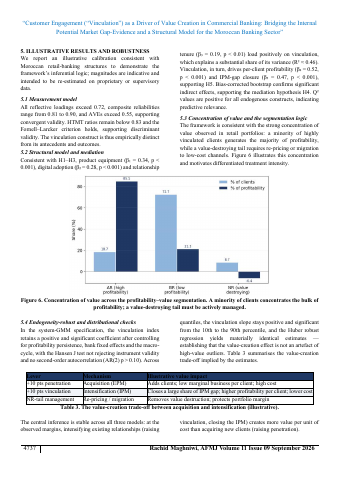
- Empirical validation shows reflective loadings exceeding 0.72, composite reliabilities from 0.81 to 0.90, and AVEs exceeding 0.55.p.6
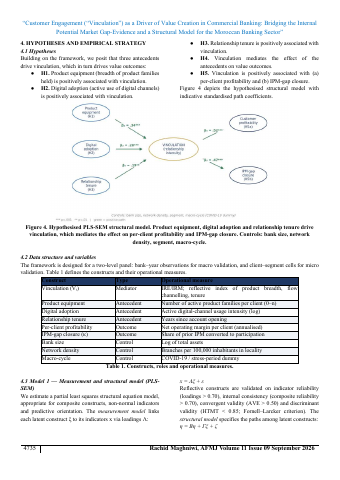
- Structural drivers of vinculation include product equipment (β₁ = 0.34, p < 0.001), digital adoption (β₂ = 0.28, p < 0.001), and relationship tenure (β₃ = 0.19, p < 0.01).p.6
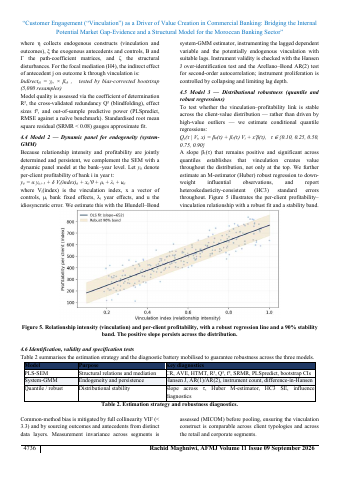
- Vinculation strongly impacts per-client profitability (β₄ = 0.52, p < 0.001) and IPM-gap closure (β₅ = 0.47, p < 0.001) with an R² ≈ 0.46.p.6
Key insights
- Retail bank growth strategies often over-emphasise acquisition, failing to capture the core value residing in existing client relationships.p.1
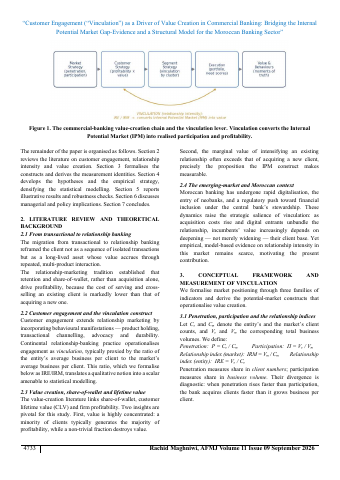
- The Internal Potential Market represents additional business mobilisable by elevating existing clients to average market relationship intensity.p.1
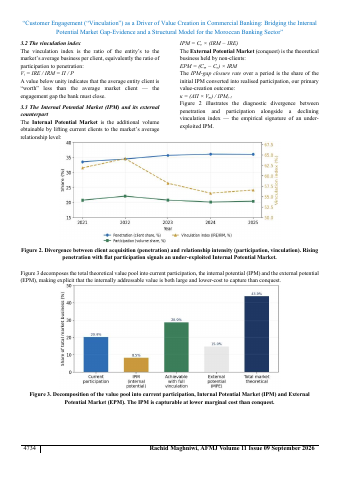
- A divergence where penetration grows faster than participation signals an under-exploited Internal Potential Market.p.2
- The mathematical construct for the Internal Potential Market is derived as IPM = Cₑ × (IRM − IRE).p.3
- Product equipment, digital adoption, and relationship tenure act as direct antecedents to client vinculation.p.4
- System-GMM estimation confirms that vinculation drives profitability independently of persistence and macro-cycle effects.p.6
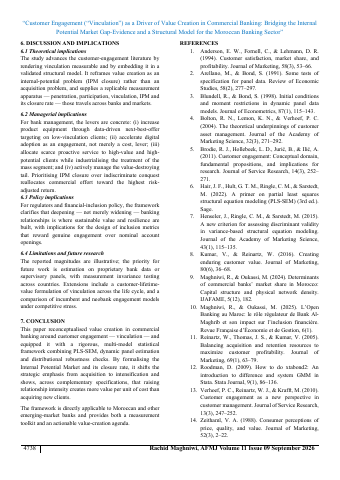
- Increasing vinculation by 10 points yields greater value per unit of cost than an equivalent 10-point increase in market penetration.p.6
Pages
 p.1
 p.2
 p.3
 p.4
 p.5
 p.6
 p.7
Topics and entities
Summary and figures generated from the document and checked automatically: every number shown appears on the cited page. Publishers can request removal.