Over-accumulating AI: Rationale and Fault Lines Beyond the US AI Investment Boom (Research Square)
SaveSummary
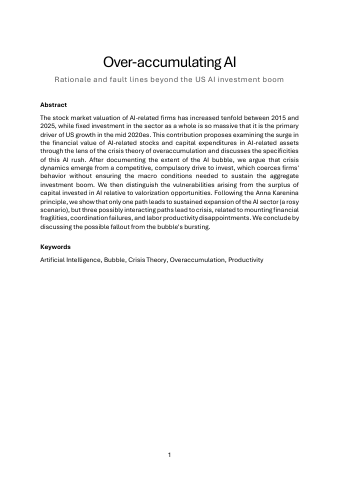
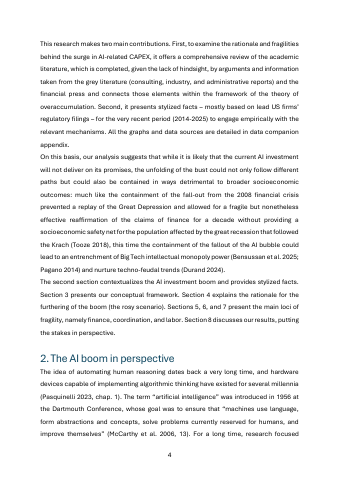
- The stock market valuation of AI-related firms increased tenfold between 2015 and 2025, making fixed investment in AI a primary driver of US economic growth.p.2
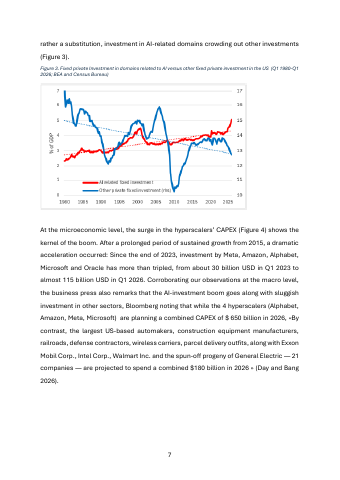
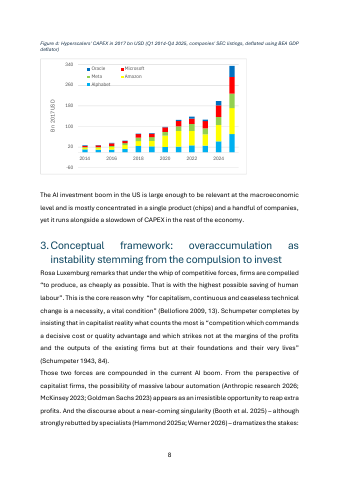
- Four major hyperscalers planned a combined CAPEX of $650 billion in 2026, compared to $180 billion combined for 21 other major US corporations.p.8
- Quarterly CAPEX by Meta, Amazon, Alphabet, Microsoft, and Oracle more than tripled from about 30 billion USD in Q1 2023 to almost 115 billion USD in Q1 2026.p.8
- The combined debt load of Alphabet, Amazon, Meta, Microsoft, and Oracle reached USD 541.2 billion in 2025, up from USD 294.3 billion in 2020.p.15
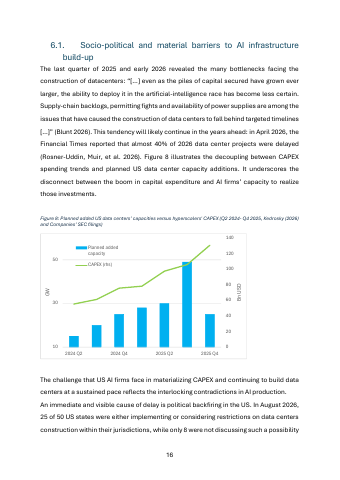
- Material supply chains and regulatory friction caused almost 40% of 2026 data center construction projects to be delayed.p.17
- OpenAI recorded a net loss of USD 38.5 billion in 2025, rising significantly from USD 5.09 billion in 2024.p.21
Key insights
- The massive expansion in AI capital expenditures exhibits key hallmarks of an overaccumulation crisis driven by market competition and coercive investment pressure.p.2
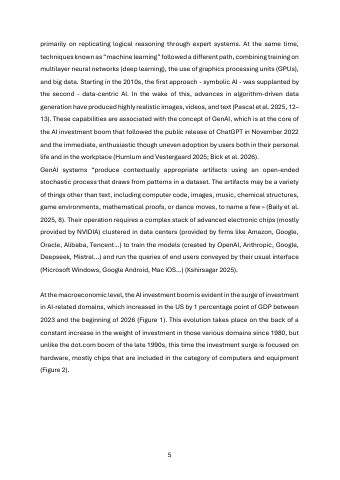
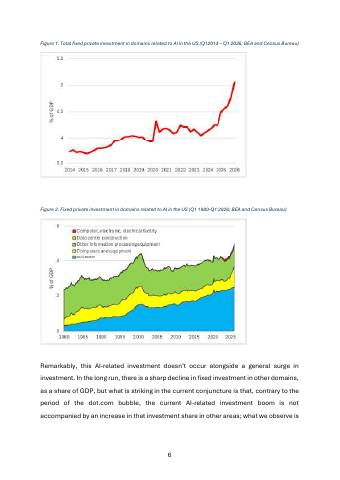
- Unlike the dot-com era, current AI investment is heavily concentrated in hardware, specifically AI computing chips included in computers and equipment.p.6
- Intricate circular equity investments and lease agreements between tech companies accelerate financial contagion risks across the AI sector.p.13
- AI chips face rapid economic and technical obsolescence within 2 to 6 years, shortening the required window for capital valorization compared to traditional physical infrastructure.p.19
- Approximately 49% of the average revenue backlog for Amazon, Google, Oracle, and Microsoft in March 2026 was tied directly to commitments from OpenAI and Anthropic.p.21
- The shift from subsidized access to usage-based token billing increases corporate costs and creates pricing pressure among model providers.p.22
- Automation of isolated tasks encounters weak links in unautomated workflow steps, limiting actual firm-level productivity gains.p.24
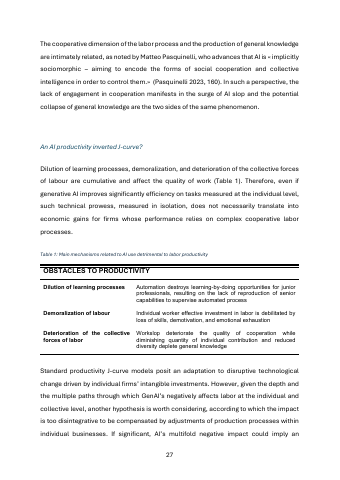
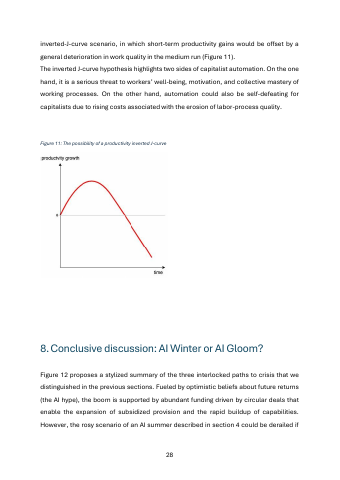
- Widespread GenAI deployment risks causing a productivity inverted J-curve by eroding junior employee training, critical thinking skills, and collective labor processes.p.28
Pages
 p.1
 p.2
 p.3
 p.4
 p.5
 p.6
 p.7
 p.8
 p.9
 p.10
 p.11
 p.12
 p.13
 p.14
 p.15
 p.16
 p.17
 p.18
 p.19
 p.20
 p.21
 p.22
 p.23
 p.24
 p.25
 p.26
 p.27
 p.28
 p.29
 p.30
 p.31
 p.32
 p.33
 p.34
 p.35
 p.36
 p.37
 p.38
 p.39
 p.40
 p.41
 p.42
 p.43
 p.44
Funders mentioned
Topics and entities
Summary and figures generated from the document and checked automatically: every number shown appears on the cited page. Publishers can request removal.