Comprehensive Assessment of Bank Risk Management Efficiency in Uzbekistan's Commercial Banks (Labor Economics and Human Capital)
SaveSummary
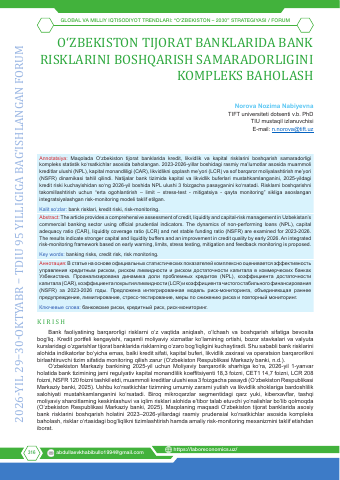
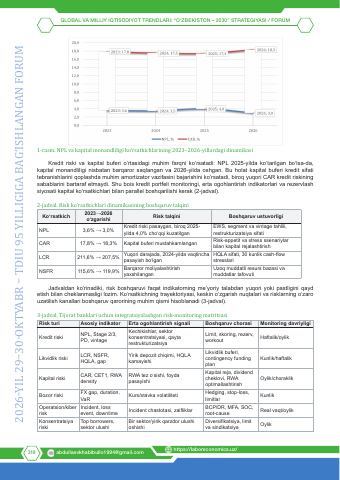
- By early 2026, the non-performing loans (NPL) ratio in Uzbekistan's commercial banking sector decreased to 3.0%, down from a peak of 4.0% in 2025 and 3.6% in 2023.p.11
- The Capital Adequacy Ratio (CAR) strengthened to 18.3% by early 2026, up from 17.8% in 2023, reflecting reinforced capital buffers.p.11
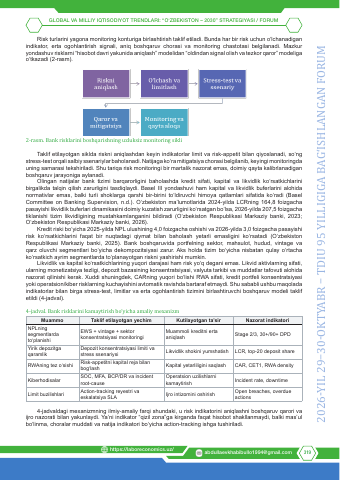
- The Liquidity Coverage Ratio (LCR) stood at 207.5% by early 2026 after temporarily dropping to 164.8% in 2024.p.12
- The Net Stable Funding Ratio (NSFR) improved from 115.6% in 2023 to 119.9% by early 2026, reflecting enhanced long-term resource stability.p.11
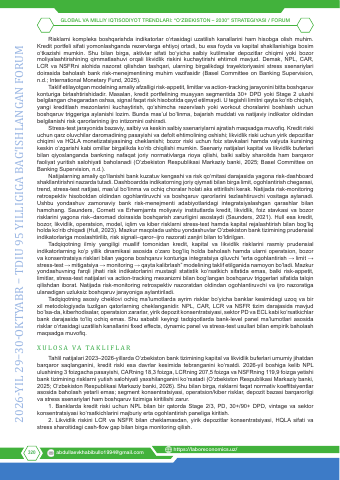
- The study proposes an integrated risk-monitoring framework following an early warning, limit, stress testing, mitigation, and feedback cycle.p.9
Key insights
- Capital adequacy ratios remained relatively stable during loan quality fluctuations, acting as an effective buffer against credit risk shocks.p.11
- Systemic risk indicators showed recovery in 2026 following increased credit risk pressures observed in 2025.p.9
- A temporary decline in the Liquidity Coverage Ratio to 164.8% in 2024 highlighted the critical need for continuous liquidity buffer tracking.p.12
- High levels of capital adequacy do not automatically eliminate concentration risks, operational vulnerabilities, or cybersecurity exposures.p.12
- Effective bank risk management requires continuous cycle-based monitoring rather than simple retrospective, end-of-period reporting.p.12
Pages
 p.1
 p.2
 p.3
 p.4
 p.5
 p.6
 p.7
 p.8
 p.9
 p.10
 p.11
 p.12
 p.13
 p.14
 p.15
 p.16
Topics and entities
Summary and figures generated from the document and checked automatically: every number shown appears on the cited page. Publishers can request removal.