Examining SME Owners' Willingness to Submit Personal and Business Documents as a Proxy for Trust and Creditworthiness: The Psychological Collateral Paradigm
SMEs represent about 90% of businesses and more than 50% of employment worldwide.
269 documents
SMEs represent about 90% of businesses and more than 50% of employment worldwide.
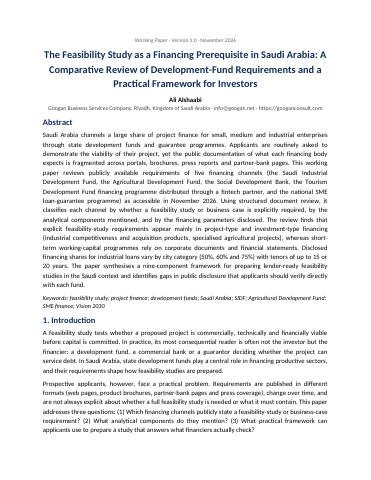
The Saudi Industrial Development Fund (SIDF) provides loan shares of 50%, 60%, and 75% based on city category, with loan tenors reaching up to 15 to 20 years.
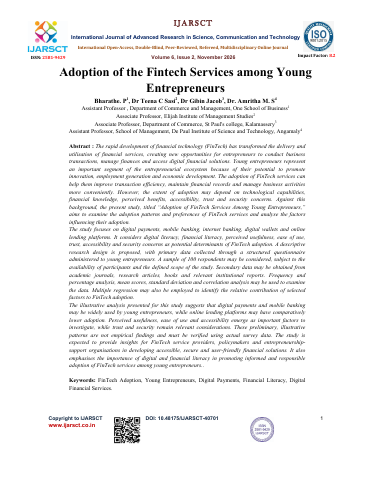
Digital wallets are used by 54% of respondents, and online lending platforms show an adoption rate of 28%.
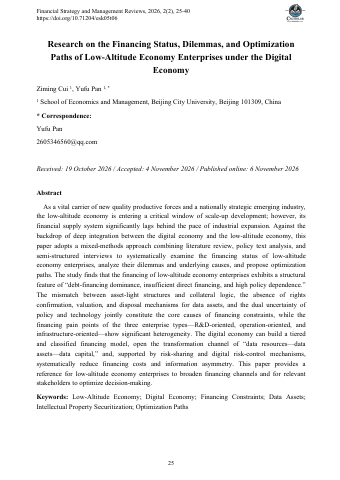
China's low-altitude economy market reached 505.95 billion yuan in 2023 and expanded to 670.25 billion yuan in 2024, with projections of 1.5 trillion yuan in 2025 and over 3.5 trillion yuan by 2035.
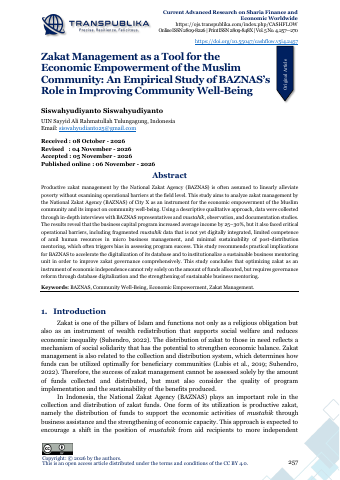
BAZNAS's business capital assistance program in City X increased average mustahik income by 25–30%.
The issuance of government securities in Uzbekistan doubled from 21.3 trillion UZS to 42.2 trillion UZS between 2023 and 2025.
Between 2023 and 2025, registered MSME taxpayers in Sukoharjo Regency rose by 56%, while the share filing tax returns fell from 99% to 49%.
Shareholder agreements in closely held corporations, regulated by Article 118 of Brazilian Law No. 6.404/1976, serve to maintain corporate stability but can face paralysis under equal or shared control.
Official lending rates across the Caribbean range from 5% to 15%, with public debt burdens exceeding 100% of GDP in several states.
SVEP implementation blocks receive an average financial allocation of Rs. 5-6 crore per block, with around Rs. 2.5 crore earmarked as Community Enterprise Funds (CEF).
Data from the Ministry of Cooperatives shows that the number of active cooperatives in Indonesia declined from 209,448 in 2014 to 130,119 in 2023.
High costs of credit, lack of collateral, and elevated agricultural risks restrict small and medium producers from accessing capital for modernization.
Morocco's National Entrepreneurship Context Index (NECI) score declined from 4.3 to 3.9 during the 2024–2025 period.
Data was collected from a sample of 40 small-scale business owners in Choma District using simple random sampling through structured questionnaires.
Data gathered from 215 valid questionnaires administered to SME respondents were analyzed to assess tax compliance determinants in Nairobi City County.
A study of 218 market traders in Chota and Bagua Grande revealed that 28.0% had low financial literacy and 33.5% had low tax management.
The study gathers primary data using a structured questionnaire administered to a sample size of 100 respondents from MSMEs.
The study analyzes 101 monthly observations from January 2017 to May 2025 to evaluate short-horizon liquidity dynamics at Pegadaian.
A study of 95 experienced bank loan officers across six major Belgian banks evaluated what drives approvals for family business succession loans.
Deloof investigated working capital management and profitability using a sample of 1,009 Belgian non-financial companies observed between 1992 and 1996.
Audited institutions suffered an aggregate 96.0% Total Brand Omission rate across 960 brand-inclusion evaluations on major AI search platforms.
A survey of 150 MSME owners and managers in Medan City evaluated the adoption of digital financial tools and their effect on financial management quality across 2024–2025.
The study surveyed 107 agribusiness respondents across Choma, Kalomo, and Lusaka to assess how subsidized credit facilities impact working capital and production growth.
The research article published in Vol. 2 No. 4 (2026) develops a theoretical risk-return framework to evaluate Islamic microfinance institutions in the post-digital transformation era.
Super-Regional banks recorded a 0.0% visibility rate across all 192 evaluations for pure rate-driven retail savings, money market, and CD queries.
Aggregate deposits of RRBs increased from Rs. 4,34,444 crore in 2019 to Rs. 4,78,547 crore in 2020.
SWIFT diffusion among nearly 7,000 banks demonstrated that profitability benefits materialized only after several years of adoption.
Asset tokenization serves as a digital financing mechanism converting real asset rights into blockchain-based tokens (page 2).
The study evaluated fifty (50) clients with active loan accounts in Gubat, Sorsogon to assess the impact of credit institution digitalization on client behavior.
The study evaluates rolling-origin forecasts across 21 economies using Asian Development Bank MSME loan-stock data for 2019–2024.