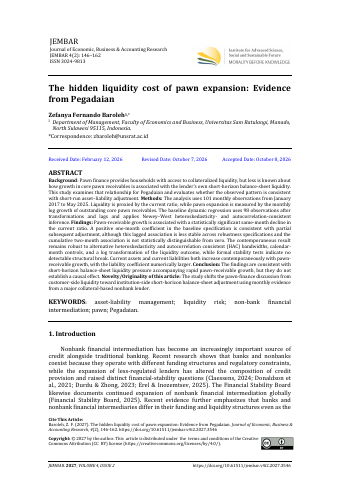
The Hidden Liquidity Cost of Pawn Expansion: Evidence from Pegadaian
The study analyzes 101 monthly observations from January 2017 to May 2025 to evaluate short-horizon liquidity dynamics at Pegadaian.
Central bank · IN · 39 documents
The study analyzes 101 monthly observations from January 2017 to May 2025 to evaluate short-horizon liquidity dynamics at Pegadaian.
A quantitative study surveyed 120 active university students in Java to analyze how AI literacy and critical thinking impact digital fraud detection capability.
The PayQRIS system achieved a System Usability Scale (SUS) score of 83.25, indicating high usability.
The study constructed an early warning detection system for non-performing loans using 12.500 simulated records with 76,0% performing loans and 24,0% non-performing loans.
A survey of 150 MSME owners and managers in Medan City evaluated the adoption of digital financial tools and their effect on financial management quality across 2024–2025.
The study evaluates a balanced panel of 6 digital banks listed on the Indonesia Stock Exchange covering 108 quarterly observations from 2021Q4 to 2026Q1.
A Scopus bibliometric search conducted on 8 October 2026 retrieved 1,418 records, from which 1,045 were retained for critical analysis.
Bank Indonesia maintains monetary and macroprudential stability under Law No. 23 of 1999 juncto Law No. 6 of 2009.
A PRISMA 2020-guided Systematic Literature Review screened 312 initial records down to 38 verified sources across five academic databases and regulatory repositories.
During the period from February to March 2024, Satgas PASTI identified 537 illegal online lending entities operating through unofficial websites and mobile applications.
Average Net Working Capital among listed Indonesian construction issuers dropped from IDR 1,911.42 billion in 2021 to IDR 640.83 billion in 2025.
The study surveyed a sample of 70 MSME respondents in Jakarta to evaluate the impact of fintech and financial literacy on financial behavior.
The study collected and analyzed data from 407 respondents using multiple linear regression in R via the Kaggle platform to examine blockchain-integrated digital payment systems.
Generation Z represented 27.94% of Indonesia's total population in the 2020 Population Census.
Global Islamic finance total assets reached USD 4.54 trillion in 2024, expanding at a compound annual growth rate of 8.9% since 2020.
The national Islamic financial inclusion index in Indonesia stands at 12.88%, leaving a 62.14-percentage-point gap compared to the 75.02% conventional financial inclusion rate.
Indonesian MSMEs expanded from 62,922,617 units in 2017 to 64,194,057 units in 2018, reflecting a growth rate of 2.02%, and reached 65,465,497 units in 2019.
Fintech investment in the Asia-Pacific region grew to almost US$3.5 billion in 2015, highlighting rapid digital transformation.
As of June 2024, transaction values processed under SNAP reached IDR 3,069 trillion across 6,217 million transactions.
The study identifies 5 interrelated themes governing how Indonesian banks integrate digital marketing management, local cultural wisdom, and artificial intelligence.
The study analyzes the impact of Big Data and AI-based financial technology on expanding financial inclusion across Indonesian provinces for the 2019–2024 period.
Crypto transaction value in Indonesia experienced significant growth, expanding by 335.91 percent annually to 650.61 trillion rupiah
Global cross-border payment transactions are projected to expand from over $150 trillion in 2017 to more than $250 trillion by 2027.
SpaceX closed on 2 October 2026 at a market value of about $2.16 trillion, representing more than eighty times its trailing revenue.
The study analyzes a panel of 31 commercial banks listed on the Indonesia Stock Exchange (IDX) across 155 observations from 2020 to 2024.
The national FinTech ecosystem reached 1,200 companies with daily transactions of USD 890 million or around Rp 14 trillion, growing 62% year-on-year per May 2025.
World Bank statistics reported 97.74 million unbanked adults in Indonesia in 2021.
The return on assets (ROA) of Islamic perbankan in Indonesia increased from 1,55% in 2021 to 2,15% in 2025.
During the pandemic, Bank Indonesia lowered its benchmark interest rate to an all-time low of 3.50%, driving a search for yield and an IPO surge during 2021-2022.
The study selected 5 private banking companies resulting in 35 observation data points from an initial population of 48 listed banks on the Indonesia Stock Exchange for the 2018–2024 period.
National digital payment transactions in Indonesia reached 43.5 billion transactions in 2024, driven by a 175.2% year-on-year surge in QRIS and 62.4% growth in BI-FAST.
Applying three inclusion criteria narrowed the primary analytical corpus down to 5 officially published rulings issued between 2017 and 2021.
The total number of Rural Credit Banks (BPR) operating in Indonesia continuously decreased from 1,468 units in 2021 to 1,339 units in June 2025.
Mobile banking transaction volume in Indonesia grew by 39,1% in 2024, while QRIS-based transactions surged by 175,2% year-on-year.
The study evaluated secondary data collected from 39 banking companies listed on the Indonesia Stock Exchange, comprising 195 observation data points for the 2020–2024 period.
Research by Consumers International indicates that 57% of consumer bodies cite a lack of fee transparency as a primary reason behind consumer distrust in digital finance.
Bank Indonesia launched BI-FAST on 21 December 2021, providing instant payments with transaction limits up to IDR 250 million.
The G20 Roadmap for Enhancing Cross-Border Payments (2020 - 2027) focuses on 5 main priority focus areas divided into 19 building blocks.
Total crypto asset market capitalization peaked at around $3 trillion in November 2021 before falling below $1 trillion.