Early Warning System for Non-Performing Loans Using Random Forest and Explainable AI Approach (Jurnal Locus Penelitian dan Pengabdian)
Summary
- The study constructed an early warning detection system for non-performing loans using 12.500 simulated records with 76,0% performing loans and 24,0% non-performing loans.p.1
- The optimal Random Forest model achieved an accuracy of 96,40%, precision of 91,52%, recall of 93,66%, F1-Score of 92,57%, and ROC-AUC of 0,9938 on test data.p.1
- National banking non-performing loan (NPL) ratios in Indonesia remained between 2,5% and 3,1% according to Otoritas Jasa Keuangan reports.p.2
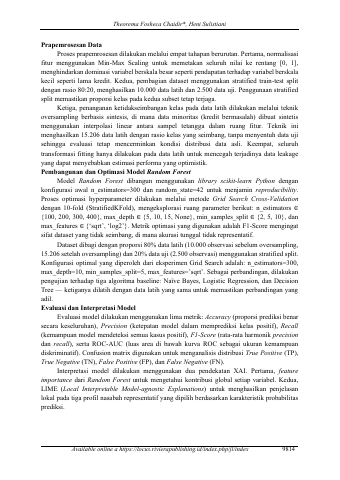
- Synthetic oversampling was applied to address training class imbalance, producing 15.206 balanced training records.p.4
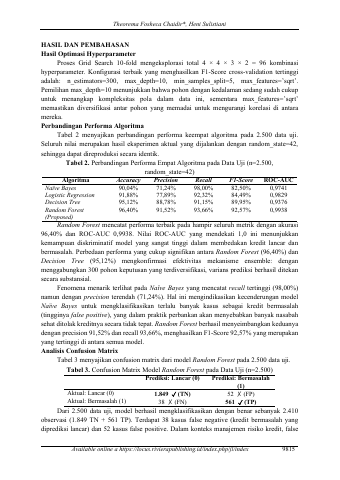
- Random Forest outperformed baseline algorithms including Decision Tree with 95,12% accuracy, Logistic Regression with 91,88% accuracy, and Naïve Bayes with 90,04% accuracy.p.5
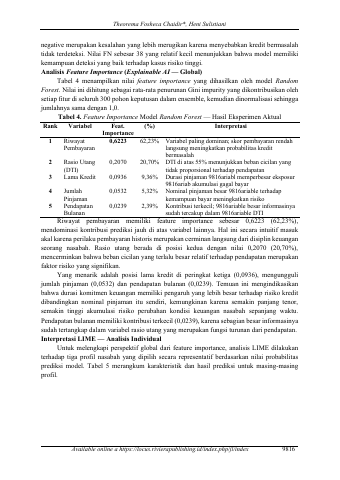
- Feature importance analysis revealed that payment history accounts for 62,23% of model prediction weight, followed by the debt-to-income ratio at 20,70%.p.6
Key insights
- The optimized Random Forest model demonstrated superior performance over baseline models, securing an accuracy of 96,40% and a ROC-AUC of 0,9938.p.5
- Payment history emerged as the most decisive factor for loan default prediction, contributing 62,23% to the total global feature importance.p.6
- The debt-to-income ratio is the second critical determinant of credit risk, representing 20,70% of the feature importance.p.6
- Class imbalance handling expanded the minority non-performing loan training data, creating a synthetic balanced training set of 15.206 instances.p.4
- A 10-fold Grid Search CV evaluated 96 hyperparameter combinations to determine the optimal depth of 10 and estimator count of 300.p.5
- Naïve Bayes recorded the highest recall at 98,00% but suffered from low precision at 71,24%, leading to excessive false positive classifications.p.5
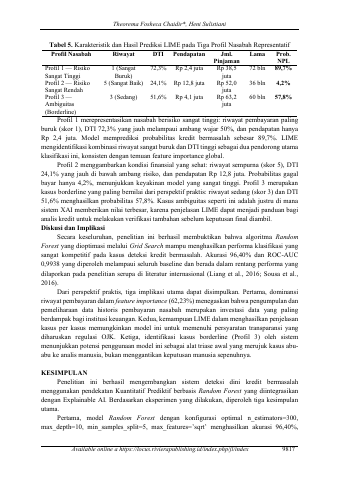
- LIME analysis enabled transparent individual interpretations across distinct high-risk, low-risk, and borderline borrower profiles.p.7
Pages
 p.1
 p.2
 p.3
 p.4
 p.5
 p.6
 p.7
 p.8
 p.9
Topics and entities
Summary and figures generated from the document and checked automatically: every number shown appears on the cited page. Publishers can request removal.