AI Literacy and Critical Thinking in Strengthening Students' Fraud Detection Capability in a Cashless Society (Financial Analytics and Economic Innovation Journal)
Summary
- A quantitative study surveyed 120 active university students in Java to analyze how AI literacy and critical thinking impact digital fraud detection capability.p.1
- The Indonesian National Police recorded 10,583 online fraud cases between January and March 2026, averaging 3,000 to 3,700 cases per month.p.2
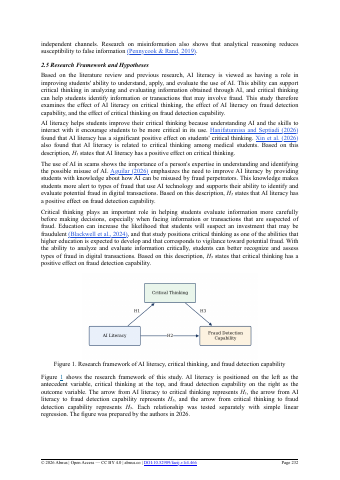
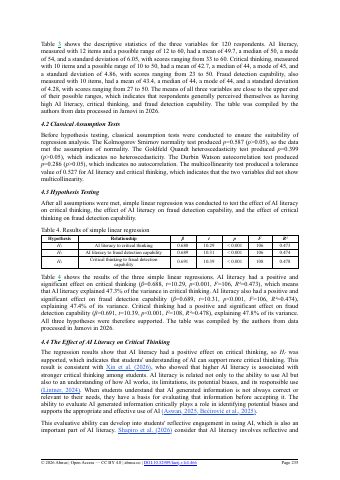
- Simple linear regression showed that AI literacy had a positive and significant effect on critical thinking (β=0.688, p<0.001, R²=0.473).p.1
- AI literacy demonstrated a positive and significant direct effect on fraud detection capability (β=0.689, p<0.001, R²=0.474).p.1
- Critical thinking significantly enhanced fraud detection capability among students (β=0.691, p<0.001, R²=0.478).p.1
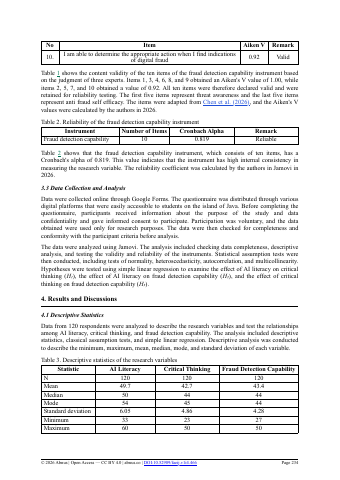
- The 10-item fraud detection capability measurement instrument achieved high internal consistency with a Cronbach's alpha of 0.819.p.8
Key insights
- AI literacy accounts for 47.3% of the variance in students' critical thinking performance.p.9
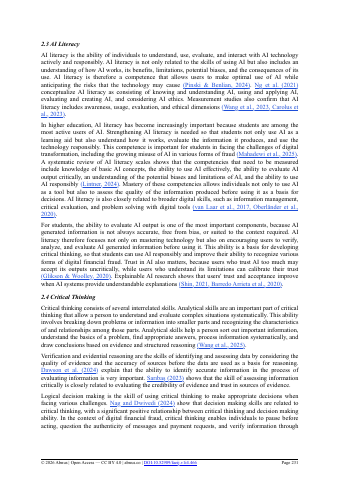
- Understanding how AI works and recognizing its limitations allows students to critically evaluate AI outputs rather than accepting them passively.p.9
- Higher AI literacy directly increases fraud detection capability, explaining 47.4% of its variance.p.9
- Critical thinking skills explain 47.8% of the variance in students' fraud detection capability in digital transactions.p.9
- Online fraud cases in Indonesia reached between 3,000 and 3,700 monthly incidents in early 2026.p.2
- Excessive reliance on AI tools without reflective engagement risks reducing independent reasoning through cognitive offloading.p.2
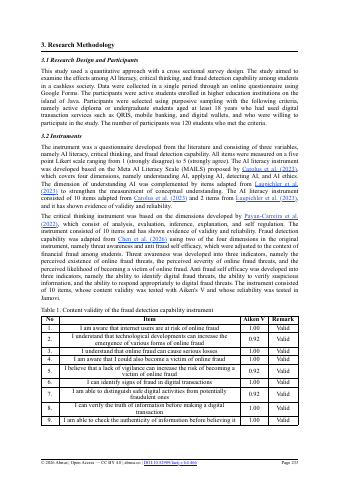
- Fraud detection capability among students consists of two key dimensions: threat awareness and anti-fraud self-efficacy.p.7
Pages
 p.1
 p.2
 p.3
 p.4
 p.5
 p.6
 p.7
 p.8
 p.9
 p.10
 p.11
 p.12
 p.13
 p.14
 p.15
 p.16
Topics and entities
Summary and figures generated from the document and checked automatically: every number shown appears on the cited page. Publishers can request removal.