Long-Term Performance and Determinants of IPOs on the Indonesia Stock Exchange in the Post-Pandemic Low Interest Rate Era (Branding Jurnal Manajemen dan Bisnis)
Summary
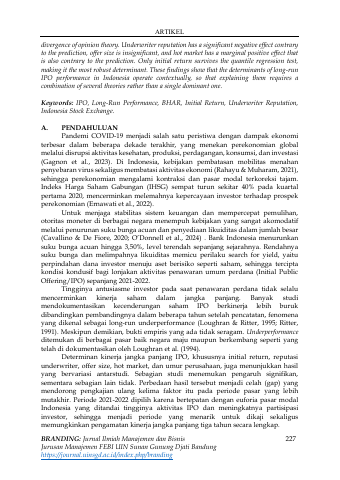
- During the pandemic, Bank Indonesia lowered its benchmark interest rate to an all-time low of 3.50%, driving a search for yield and an IPO surge during 2021-2022.p.2
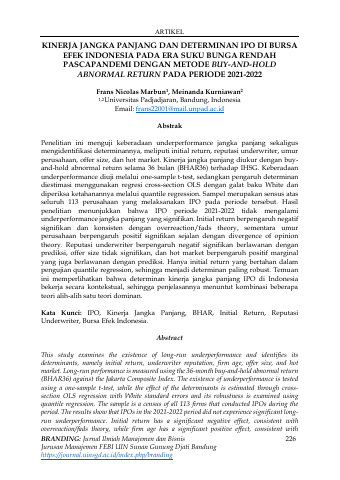
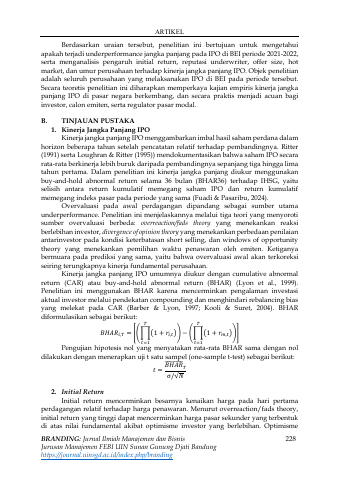
- A full census of 113 companies conducting IPOs on the Indonesia Stock Exchange in 2021-2022 was evaluated for 36-month buy-and-hold abnormal returns (BHAR36).p.5
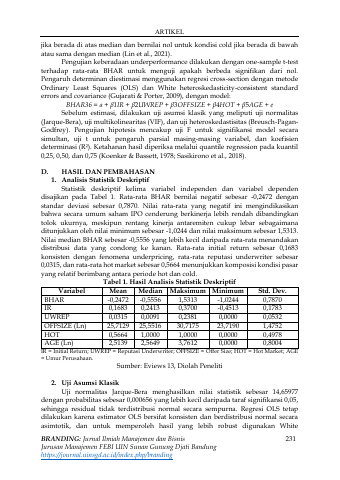
- The sample recorded an average BHAR of -0.2472 with a standard deviation of 0.7870 and an average initial return of 0.1683.p.6
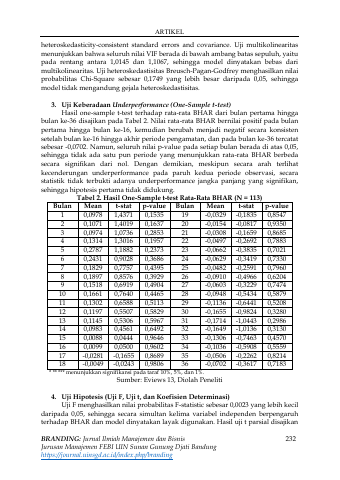
- Statistical testing showed no statistically significant long-run underperformance across months 1 to 36, despite mean BHAR turning to -0.0702 at month 36.p.7
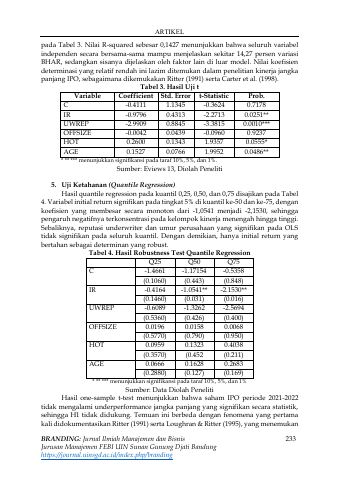
- Quantile regression confirmed that only initial return remained robust across higher quantiles, with coefficients of -1.0541 at Q50 and -2.1530 at Q75.p.8
Key insights
- IPOs listed on the Indonesia Stock Exchange during 2021-2022 did not exhibit statistically significant long-run underperformance over 36 months.p.1
- The Jakarta Composite Index dropped approximately 40% in the first quarter of 2020 due to pandemic-related economic disruptions.p.2
- Average BHAR remained positive for the first 16 months before turning consistently negative from month 17 through month 36.p.7
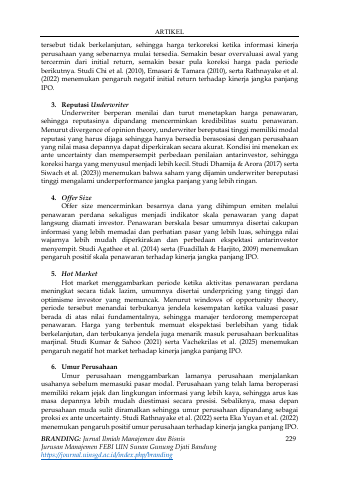
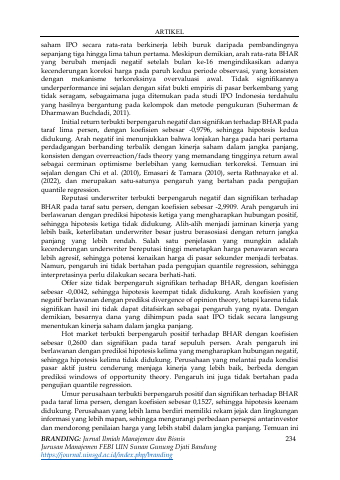
- Lead underwriter reputation exhibits a significant negative effect on long-term performance in OLS estimation, contrary to traditional theoretical predictions.p.9
- Offer size showed no statistically significant relationship with long-term BHAR performance.p.9
- Firm age positively impacts long-term IPO performance, aligning with divergence of opinion theory due to lower ex-ante uncertainty.p.9
Pages
 p.1
 p.2
 p.3
 p.4
 p.5
 p.6
 p.7
 p.8
 p.9
 p.10
 p.11
 p.12
Topics and entities
Summary and figures generated from the document and checked automatically: every number shown appears on the cited page. Publishers can request removal.