Beyond Access: Digital Payment Activity, Productive Investment and Economic Growth in Nigeria
The study analyzes quarterly time-series macroeconomic data for Nigeria covering 2010Q1 to 2024Q4, comprising up to 60 observations.
248 documents
The study analyzes quarterly time-series macroeconomic data for Nigeria covering 2010Q1 to 2024Q4, comprising up to 60 observations.
A PRISMA 2020-guided Systematic Literature Review screened 312 initial records down to 38 verified sources across five academic databases and regulatory repositories.
Polish banks account for 4 out of the 40 global Digital Champions, defined as the top 10% of banks.
As of December 2025, India has approximately 21.6 crore demat accounts, with 17.3 crore held at CDSL and 4.3 crore at NSDL.
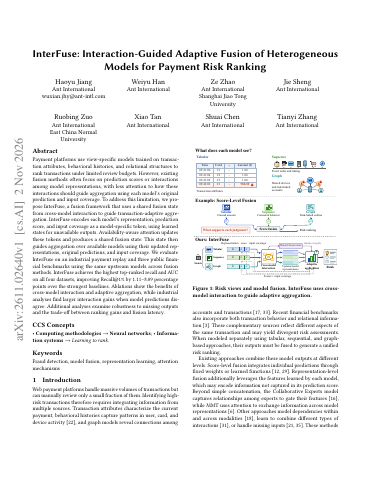
InterFuse achieves the highest top-ranked recall and AUC on all four evaluated datasets, improving Recall@1% by 1.11–8.09 percentage points over the strongest baselines.
The synthetic evaluation dataset contained 12,480 service–time interval–scenario observations across six mission-critical banking services.
The proposed hybrid AI system was trained and evaluated on a transaction dataset containing more than 6 million records with transaction time steps ranging from 0 to 743.
The study develops four theoretical hypotheses and corresponding assessment indicators to promote financial innovation while preserving stability.
By 2020, Mastercard and Visa issued 2,287 million credit cards worldwide, with Mastercard issuing 1156 million and Visa issuing 1131 million cards.
The research paper synthesizes data from secondary sources including the Reserve Bank of India, NPCI, SEBI, and twenty research papers published between 2020 and 2026.
The framework addresses extreme class imbalance in a dataset comprising 6,362,620 transaction records, where only 8,213 records (0.1291%) represent fraudulent activity.
Transition economies across Eastern Europe, Central Asia, and Latin America face unique structural macroeconomic challenges, including currency substitution and weak monetary policy transmission.
The empirical study analyzed Albania's digital banking ecosystem using quantitative data from a survey of 151 respondents and qualitative data from 15 semi-structured interviews.
In 2017, the South African Reserve Bank issued operational licenses to 3 fully digital banks, escalating competitive dynamics across the sector.
The proposed machine learning fraud detection pipeline achieves an ROC-AUC of 0.984 and a PR-AUC of 0.886 across 284,807 European cardholder logs.
The mixed-method study analyzed digital financial services gateways using survey data from 300 entrepreneurs and qualitative interviews with 50 participants in Tandag City, Surigao del Sur, Philippines.
Electronic payments in Saudi Arabia accounted for 85% of total retail payments in 2025, compared with 79% in 2024.
BRICS member countries represent around 55% of the global population and approximately 40% of global GDP in purchasing power parity.
The study presents a conceptual evaluation of digital currency adoption published in Vol. 13, No. 4 of the journal.
The paper proposes an integrated five-layer cybersecurity framework combining layered authentication, encryption, real-time transaction monitoring, and machine-learning-based anomaly detection to mitigate cyber threats in digital payment systems.
In 2008, TARGET2 settled a daily average of EUR 3.126 billion in value with 348,000 transactions.
The study collected and analyzed data from 407 respondents using multiple linear regression in R via the Kaggle platform to examine blockchain-integrated digital payment systems.
On a six-million-transaction synthetic dataset, the proposed ensemble attains a recall of 0.9184 at a false-positive rate of 0.0186.
Data were gathered from 523 university graduates across Dhaka, Chattogram, and Mymensingh to analyze FinTech payment acceptance.
The study surveyed a sample of 70 MSME respondents in Jakarta to evaluate the impact of fintech and financial literacy on financial behavior.
The study establishes a conceptual framework linking FinTech adoption, digital payments, AI-enabled services, consumer trust, and financial inclusion in India [p.1].
The platform achieved a fraud class precision of 94.2% using a hybrid machine learning approach with Random Forest and Isolation Forest classifiers.
On 30 October 2025, the ECB announced the transition beyond the 2023–25 preparation phase with potential readiness for first issuance during 2029.
The paper introduces a permissioned blockchain layer to enhance data security for digital payment systems in India across volume 3, issue 10(III) published on 31 Oct. 2026.
Total Ukrainian banking sector net assets grew by 70.1% from UAH 2,352 billion in 2022 to UAH 4,001 billion in 2025.