ARGUS Survey of AI Driven Personal Finance Analytics and Budget Forecasting
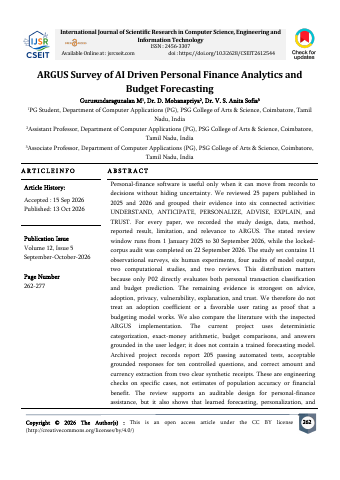
The survey reviews a locked corpus of 25 papers published between 1 January 2025 and 30 September 2026 to evaluate AI evidence in personal finance.
581 documents
The survey reviews a locked corpus of 25 papers published between 1 January 2025 and 30 September 2026 to evaluate AI evidence in personal finance.
Global financial wealth is projected to grow by 10.7% in 2025 to reach US$333 trillion according to BCG's report.
The study examines how algorithmic intelligence and decision architecture shape strategic and behavioral decision outcomes based on data from 176 banking decision-makers in the Philippines.
At year-end 2024, outstanding participatory financing in Morocco reached MAD 33.8 billion, representing a 19.9% increase year on year.
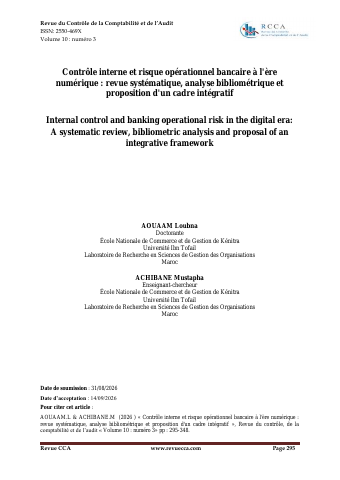
A bibliometric and integrative review analyzed 256 documents indexed in Scopus and Web of Science published up to July 2024.
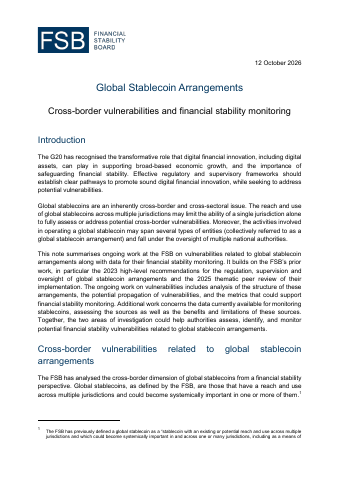
As of mid-2026, the total market value for stablecoins stands at around $300 billion.
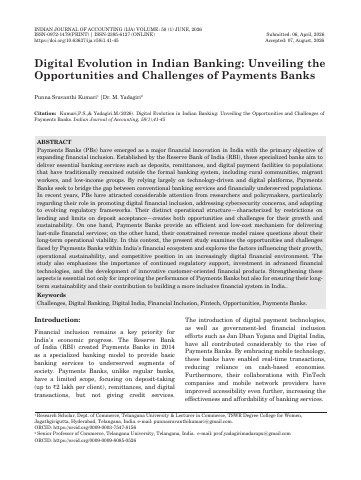
The Reserve Bank of India created Payments Banks in 2014 as a specialized banking model to deliver basic financial services to underserved populations.
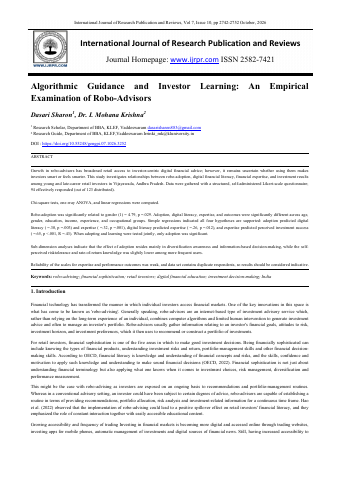
A total of 123 questionnaires were distributed to students and young investors in Vijayawada, with 94 retained for analysis.
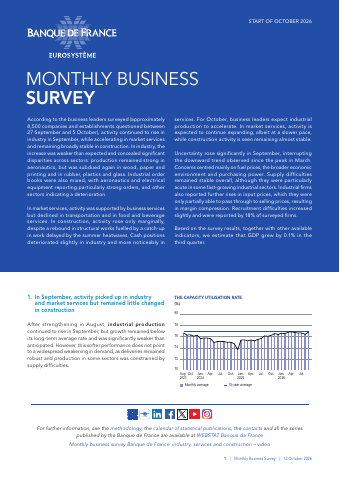
Approximately 8,500 companies and establishments were questioned between 27 September and 5 October.
According to KPMG, 71% of surveyed financial firms have deployed AI tools, with global banking sector AI spending estimated at USD 31.3 billion in 2024.
Small and Medium Sized Enterprises across the world utilize FinTech services at approximately 25 percent.
The study conducts an empirical investigation covering 74 countries over the 2002 – 2022 period to evaluate how digital financial innovations impact systemic financial stability.
Only 4 (21%) of reviewed jurisdictions are fully compliant with KA 6, while 8 (42%) are materially non-compliant.
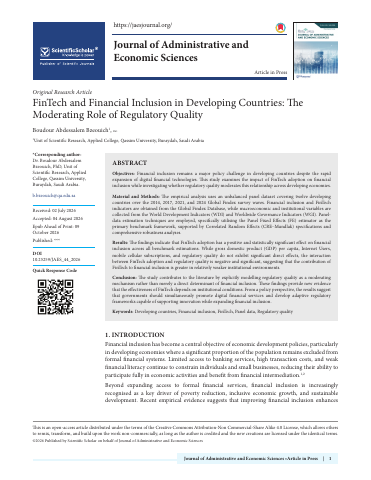
The empirical study examines the impact of FinTech adoption on financial inclusion using an unbalanced panel dataset of 12 developing countries across the 2014, 2017, 2021, and 2024 Global Findex survey waves.
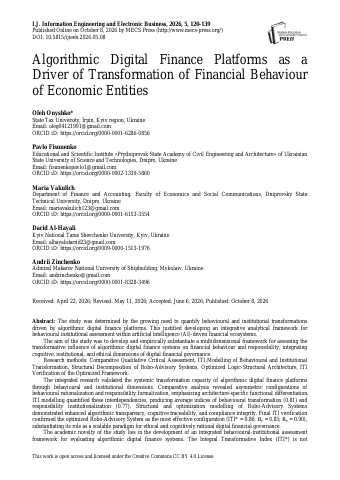
The ITI modeling framework established average baseline indices of 0.81 for behavioural transformation and 0.77 for responsibility institutionalization across platforms.
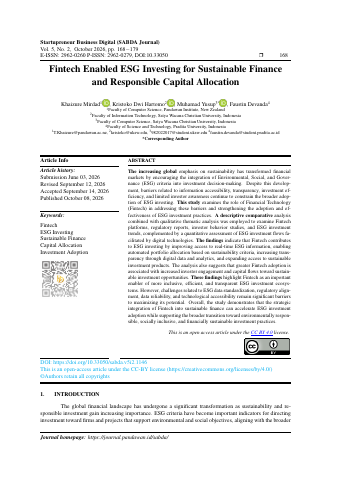
ESG mutual fund investments grew by 67.3% from $5.2B pre-adoption to $8.7B post-Fintech adoption.
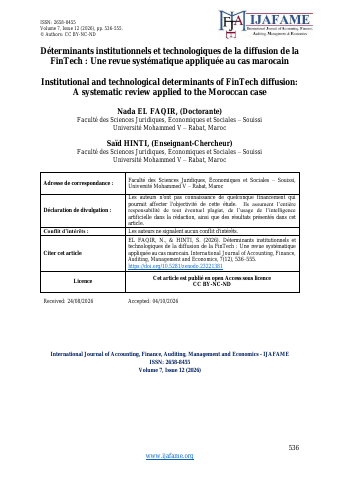
The systematic review protocol based on Google Scholar searches spanning 2004 to 2025 screened 98 unique references and retained 74 publications.
The study collected primary data from a sample size of 200 financial sector employees across Kathmandu Valley using a structured questionnaire on a 5-point Likert scale.
Across 96,600 prompts to Llama-3.1-8B-Instruct, the average identity swing in recommended equity allocation rises from 4.78 percentage points at full disclosure to 10.34 percentage points when no financial facts are supplied.
A structured questionnaire survey was conducted with 309 individual investors in Vietnam who have experience using AI for financial analysis and investment decision-making.
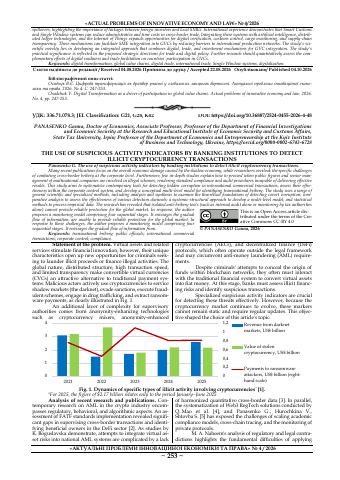
The author proposes a monitoring model comprising 4 sequential stages to enable the gradual flow of information in detecting money laundering [p.1].
The long-run FMOLS and DOLS models accounted for 79.6% of the variation in commercial banks' Return on Assets.
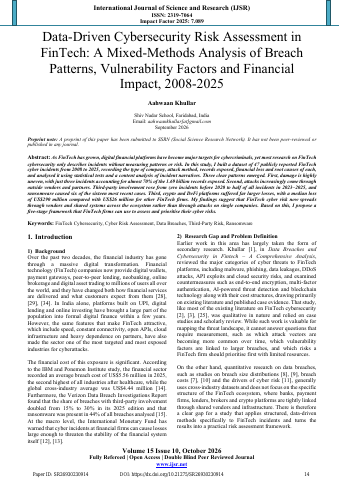
The study analyzes a dataset of 47 publicly reported FinTech cyber incidents occurring between 2008 and 2025.
From 364 documents retrieved from Scopus, the PRISMA 2020 protocol led to selecting 42 articles for bibliometric and thematic analysis.
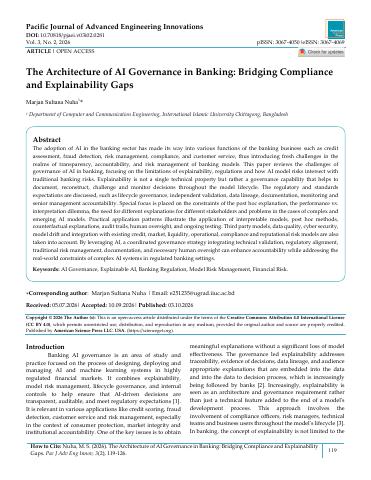
AI governance integrates explainability, model risk management, lifecycle governance, and internal controls to satisfy regulatory expectations in banking.
Total fees and commissions income in the analyzed EU banking sector sample reaches approximately EUR 157 billion, representing 37% of net operating income.
The HERA-XAI framework extends hierarchical corporate rating forecasting using 9 interconnected Random Forest classification nodes across Production, Trade, and Services sectors.
The paper proposes replacing structural asset correlation in the Merton-Vasicek framework with the linear correlation between credit survival logits, enabling the modeling of unlisted corporate credit risk from standard bank rating systems.
The adult account ownership rate in Morocco stands at approximately 53%, reflecting ongoing progress alongside notable urban-rural and gender disparities.
The research conducted a systematic review following the PRISMA framework starting with an initial pool of 322 articles on blockchain and AI convergence.